34 works in this view — arrow keys or swipe to move between them.
Dance in Art
Ballroom dancers
Unknown artist
- Medium:
- Dance:
- Ballroom
- Source:
- New York Public Library
- Rights:
- Public domain — free to use, share and adapt.
- Recorded as:
- public_domain
This work documents the visual language of early 20th-century ballroom dancing at the precise moment when the waltz and foxtrot had become the dominant social dances of the urban West. For dancers and historians, it preserves not just a costume or a pose but the fundamental technique and partnership structure of a major dance form, rendered by someone who clearly understood the dancing body. The drawing's circulation as a print would have shaped how thousands of amateur dancers learned to see their own partnership and posture.
What you are looking at
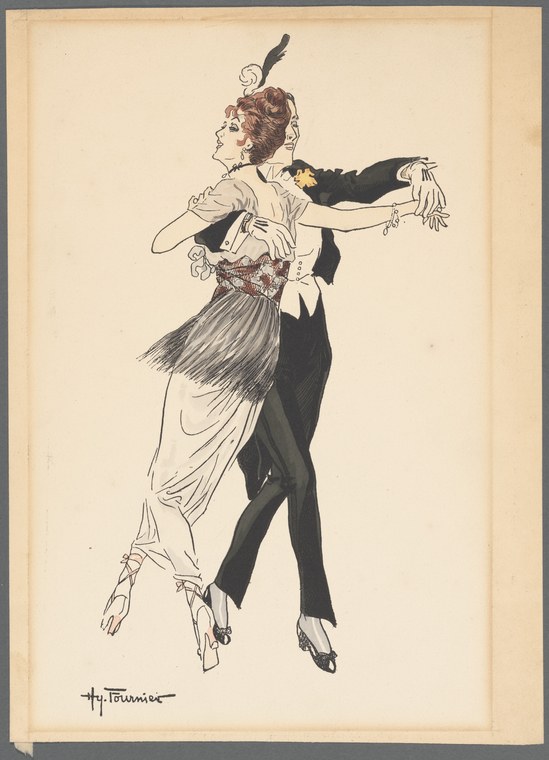
A couple poised mid-turn in a formal ballroom dance. The man, in black tailcoat with white shirt front and gloves, supports his partner from behind and to the side, his right arm extended. The woman wears a white or cream floor-length gown with a deep black waistband and a black feathered or pleated overlay at the hip, her arms extended in counterbalance to her partner's frame. Her hair is pinned up in the fashion of the early 20th century, topped with a black feather. The composition captures them mid-rotation, with both figures leaning into the turn—the woman's weight forward, the man's posture controlled and upright. The line drawing technique, rendered in black ink on a cream ground, creates a sense of movement through the elongated limbs and the subtle curve of their bodies. The setting is spare: no background, no floor, no orchestra—only the dancers and empty space, which emphasises the purity of the dance partnership.
The dancing
The hold is a closed ballroom frame: the man's left hand supports the woman's right shoulder blade, their right and left hands clasped at shoulder height, creating the characteristic boxed frame of early 20th-century ballroom dance. The woman's body is angled away from and slightly below her partner, her weight poised on her feet. Both figures lean into the turn with their heads turned in the direction of travel. The artist has rendered the woman's right leg and foot clearly extended, suggesting a long line and control; the man's left leg is bent, indicating he is leading the rotation. The drawing captures the tension and counterbalance essential to partner dancing at this period.
The dance depicted
This is a ballroom waltz or foxtrot from the early 20th century, most likely from the 1910s–1920s based on the costume and styling. The couple's frame, the forward-leaning posture, and the rotational movement are consistent with the smooth, turning dances that dominated middle-class and professional dancing in the Edwardian and immediate post-war years. The artist has chosen to depict not a stationary pose but a moment of rotation, suggesting either a traveling turn or a pivoting figure—a key element of ballroom technique in this era. The woman's controlled extension and the man's leadership through the frame would have been celebrated as the height of elegance in the social dances of this period.
How it was made
This is a pen-and-ink line drawing, likely prepared for reproduction as a print. The technique relies on clean, confident line work with minimal shading—the woman's skirt and the man's tailcoat are rendered with simple parallel hatching to suggest form and fabric. The artist has used only black ink and the cream of the paper itself, which allows for quick circulation and reproduction in newspapers, magazines, or inexpensive prints. The economy of the line suggests both a trained hand and an audience comfortable with gestural, semi-abstract representation rather than photographic realism. This was a standard medium for dance illustration in the early 20th century, affordable and suited to periodical publication.
About this work
A pen-and-ink illustration of a ballroom dance couple captured mid-turn, rendered in the elegant linear style of early 20th-century fashion and entertainment drawing. The artist demonstrates a sophisticated understanding of ballroom technique: the closed frame, the counterbalance between partners, and the moment of rotation are all rendered with anatomical precision and grace. The work belongs to a rich tradition of ballroom dance imagery from the 1910s–1920s, when such dances had migrated from elite ballrooms to become fashionable among the urban middle classes and were widely documented in periodicals, fashion plates, and theatrical programs.
The image is significant precisely because it captures not a theatrical performance or a formal portrait but a teaching moment or an ideal—the perfect couple in the perfect frame, the kind of image that would have been used to instruct dancers or to advertise dancing lessons, competitions, or fashionable nightclubs. The simplicity and clarity of the line make it memorable and reproducible, and the composition suggests the artist's first-hand knowledge of how ballroom dancing actually looked and felt.
How to look at it
Observe the architecture of the frame: how the man's arm and hand support and lead, how the woman's body responds with counterbalance rather than collapse, and how both figures are leaning into the turn rather than standing upright. The artist has chosen a moment of rotation—not a rest or a walk—which demands that the viewer read the dancers' weight and intention in the curve of their spines and the extension of their limbs. Note the woman's extended leg and the clarity of both dancers' profiles, which allows the viewer to see the line of the dancing body even in the moment of motion. This is not a snapshot but an idealization: the artist has simplified and clarified to show what a 'good' ballroom turn should look like.
The artist
The signature on the drawing is not fully legible in reproduction, but the style is consistent with the work of early 20th-century dance and theatrical illustrators who contributed to fashion magazines and entertainment periodicals. The economy and confidence of the line, combined with the anatomical accuracy, suggest a professional illustrator trained in figure drawing and fashion illustration, likely working for a major publication or print house. The artist's focus on the ballroom rather than the stage or the exotic suggests an audience of middle-class dancers rather than theatrical patrons.
The period
The early 20th century saw an unprecedented democratization and commercialization of ballroom dancing. The waltz, which had dominated the 19th century, was joined and eventually eclipsed by the foxtrot (introduced around 1912) and other American social dances. Professional dance instructors, traveling dance troupes, and dancing schools proliferated, particularly in cities. The decade 1910–1920 saw intense competition between different regional and national styles of ballroom dancing, codified in competing instruction books and standardized through competitions. Simultaneously, the cinema was beginning to document dancing, and illustrated periodicals relied heavily on dance imagery to attract readers and advertise the dances themselves. This drawing reflects that moment of intense cultural investment in the ballroom as both a site of social aspiration and a subject worthy of artistic attention.
Where it lives
The work is held in the New York Public Library collection. It is a reproduction print from the early 20th century, likely one of thousands of similar prints, magazines, and illustrations that documented and promoted ballroom dancing in the United States and Europe during this period.
Dance in this work
Questions about this work
What dance are they doing?
Most likely a waltz or foxtrot from the 1910s–1920s. The costume, frame, and rotational movement are consistent with both dances as they were taught and danced socially during this period. The foxtrot, introduced around 1912, became wildly fashionable during the 1910s and 1920s, but the waltz remained the foundation of ballroom technique.
How do we know this is a 'real' ballroom dance and not something made up?
The hold, the counterbalance, the frame, and the rotational movement all conform to the documented technique of early 20th-century ballroom dancing as described in surviving instruction books and photographs. The artist has rendered the partnership and the weight distribution with accuracy that suggests either direct observation or knowledge of how the dance was actually performed.
Who would have seen this image?
As a reproduction print from the New York Public Library collection, this image would have circulated in periodicals, fashion magazines, dance instruction manuals, and as standalone prints available to the public. It would have reached aspiring dancers, dance teachers, and general readers interested in fashion and entertainment. The style suggests it was used both to document fashionable dancing and to teach or inspire amateur dancers.
Why is the woman wearing a feather in her hair?
The large black feather (or plume) was a fashionable accessory for women's formal and evening wear in the 1910s–1920s, particularly for dancing. It was often secured in the hair or attached to a headpiece, and its height and movement would have added visual interest and elegance to the dancing figure. The feather also allowed the illustrator to emphasize the woman's profile and the grace of her carriage.
More Ballroom artwork