47 works in this view — arrow keys or swipe to move between them.
Dance in Art
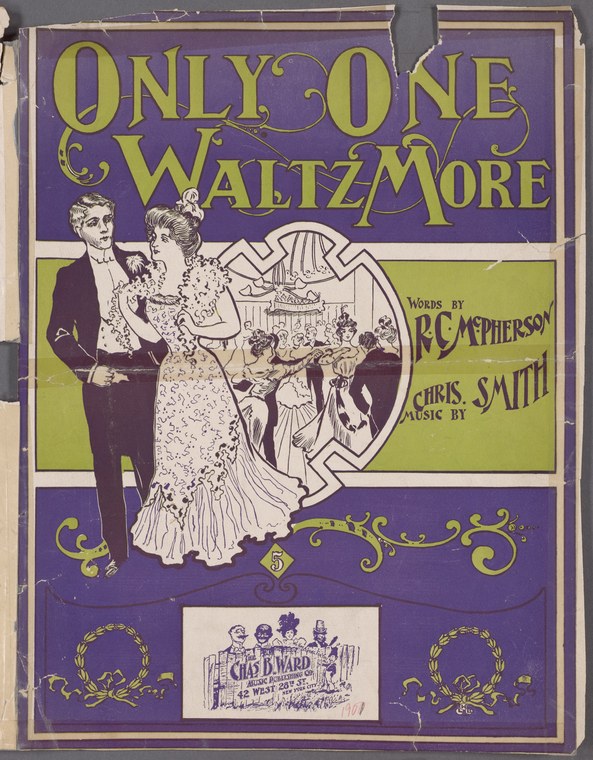
Only one waltz more
Unknown artist
- Medium:
- Lithograph
- Dance:
- Waltz
- Era:
- Early 1800s (Waltz Revolution)
- Source:
- New York Public Library
- Rights:
- Public domain — free to use, share and adapt.
- Recorded as:
- public_domain
This cover is direct visual documentation of how the waltz was performed and presented during its period of greatest cultural dominance, capturing the closed position, the dress codes, and the formal ballroom setting with specificity that written description cannot match. For historians of social dance, it is evidence of how the waltz moved from scandalous novelty (early 1800s) to mainstream respectability by mid-century, reflected in the cover's proud declaration of the dance as the culmination of the evening's festivities.
What you are looking at
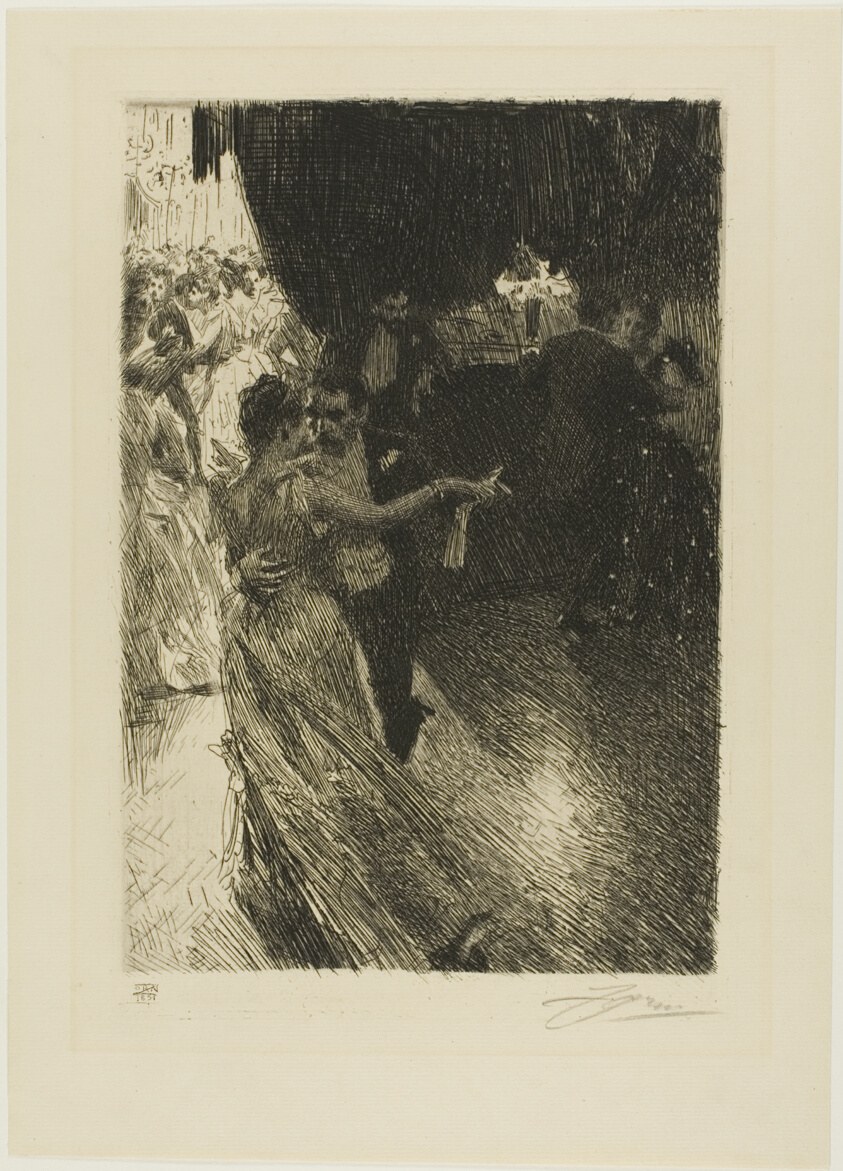
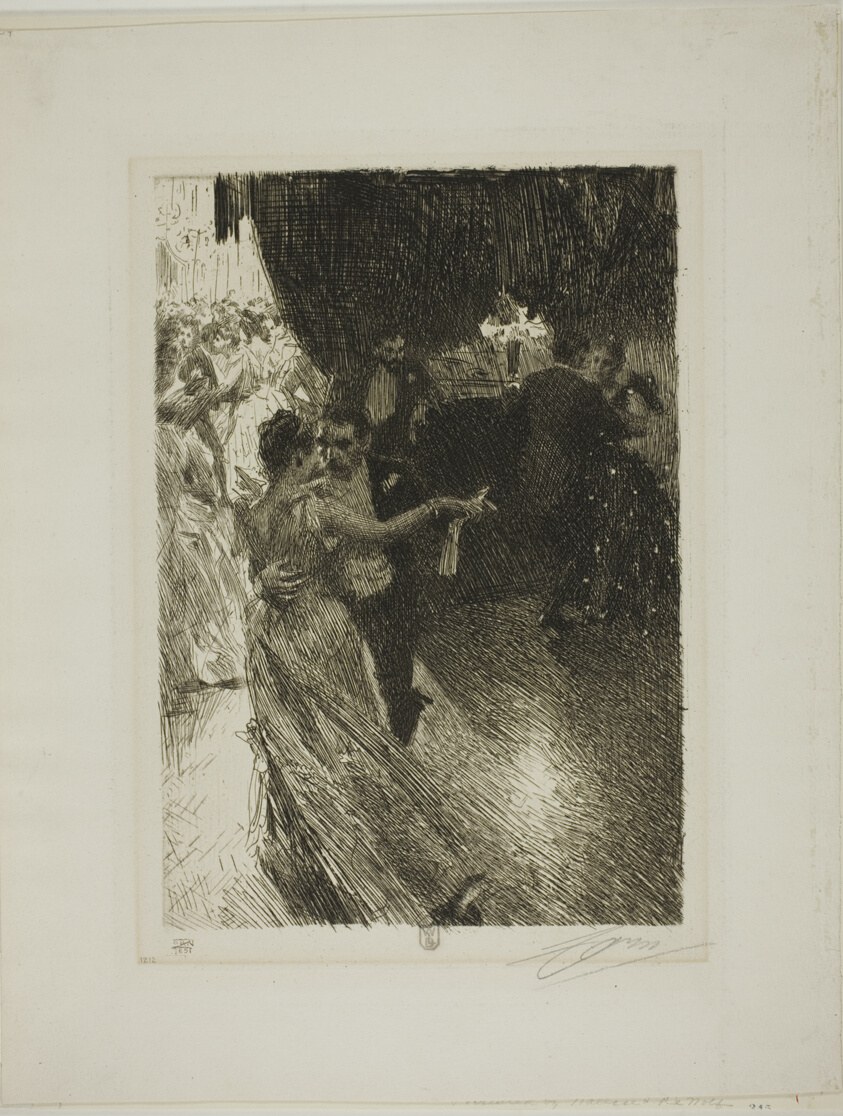
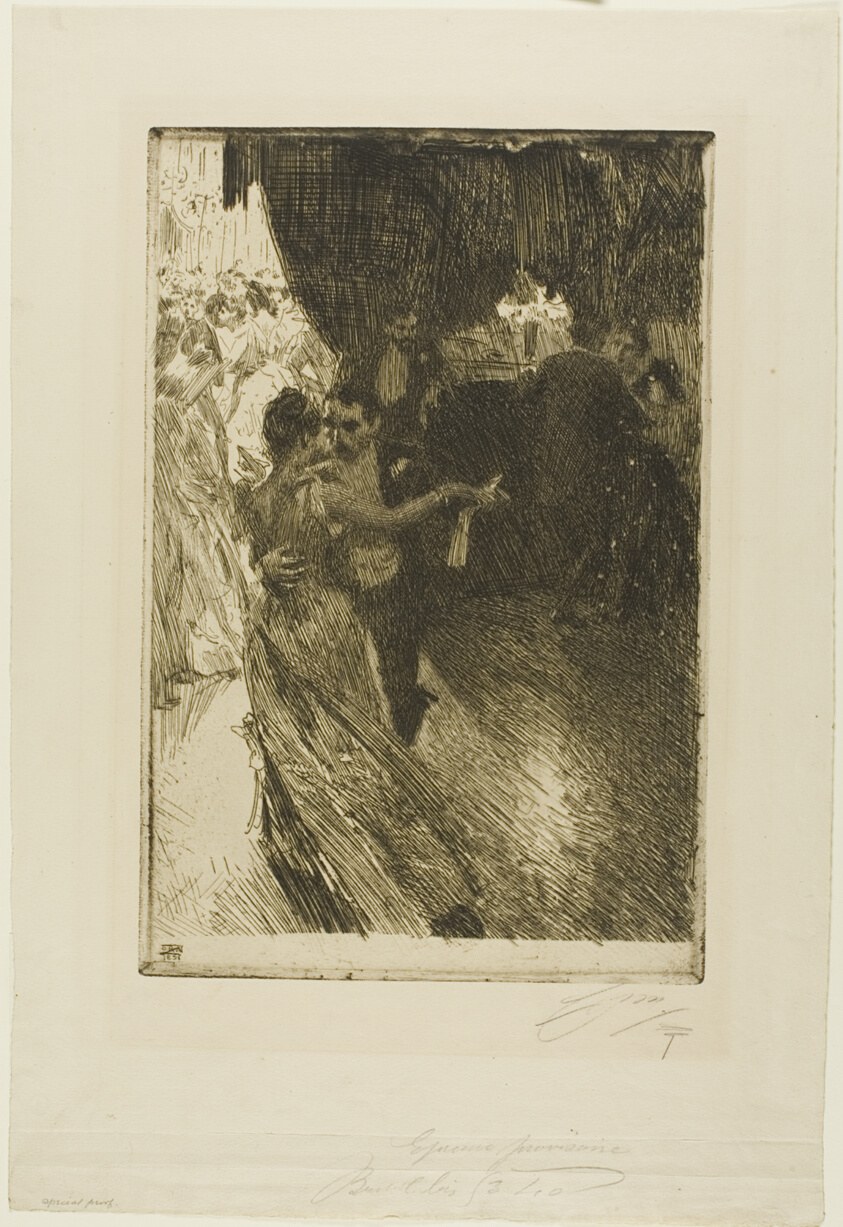
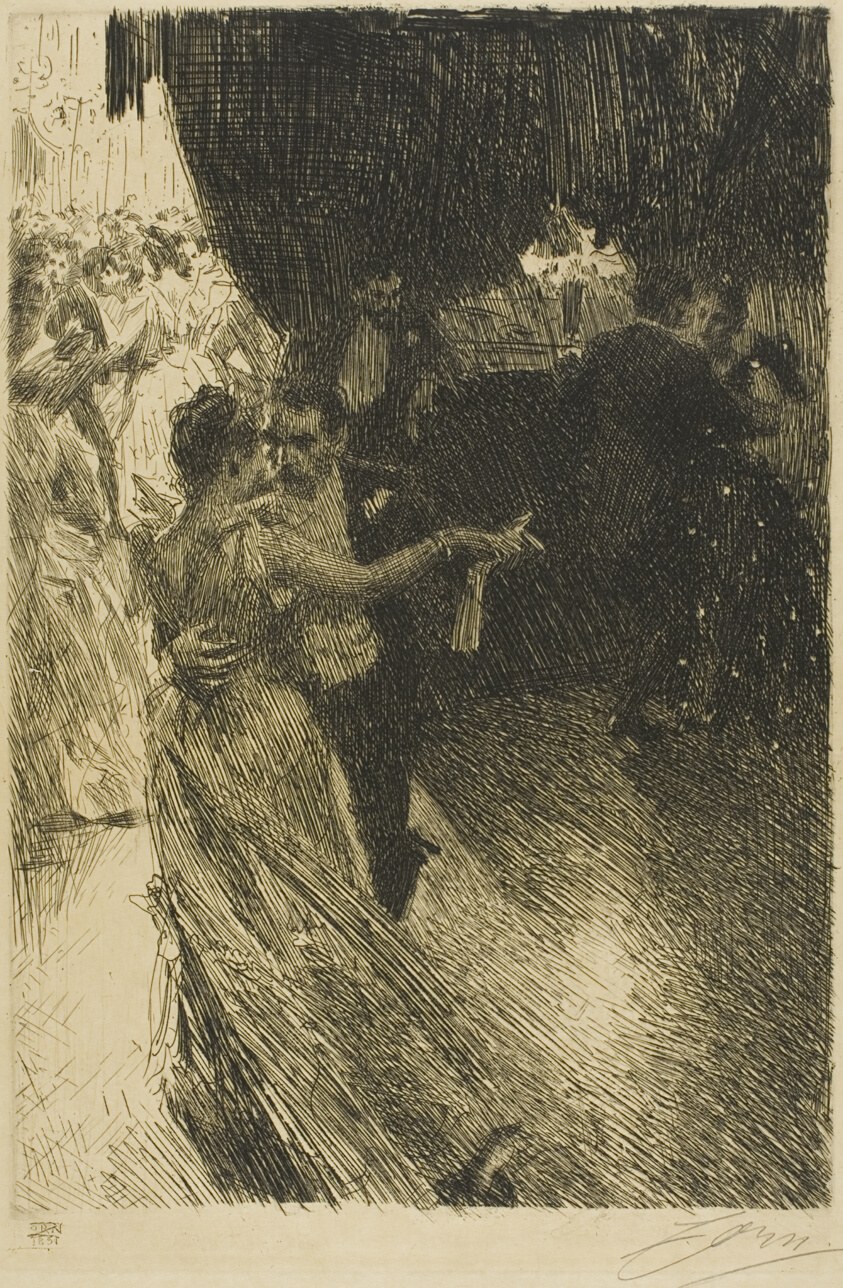
A lithographed sheet music cover depicts an elegant couple mid-waltz in a formal interior setting. The man, in dark tailcoat and white shirt, leads; the woman wears an elaborate pale gown with a fitted bodice, long skirt with deep ruffles at the hem, and ornamental hair adornment. They occupy the central round vignette, frozen in the turning motion characteristic of the waltz. Behind them, other couples dance in the background, rendered smaller and less distinct, establishing the ballroom context. The composition employs the period's taste for decorative typography: "Only One Waltz More" appears in large gilded letters across the top in Art Nouveau style, with ornamental flourishes framing the design. At the bottom sits a publisher's imprint cartouche. The color palette—purple, gold, cream, and black—creates the luxurious register expected of parlor music covers aimed at the drawing rooms of the middle and upper classes.
The dancing
The lead couple demonstrates the closed ballroom position characteristic of nineteenth-century waltz: the man's right hand on the woman's back, her left hand resting on his shoulder, their other hands joined at shoulder height. The woman's body leans slightly into the turn, her weight distributed to enable the three-count rotational movement. Her skirts suggest mid-rotation, the fabric caught and splayed by centrifugal force. The artist has captured a moment of suspension within the turn rather than a static pose—the bodies are animated, the frame energetic.
The dance depicted
This is unambiguously a waltz, the social dance that dominated European and American ballrooms from the 1820s onward. The image documents the Viennese or English closed-position waltz as danced in the mid-to-late nineteenth century, when it had become the dominant partner dance of polite society. The title's melancholic plea—"Only One Waltz More"—reflects the waltz's status as the centerpiece of the ball, often the last dance of the evening. The formal dress, the ballroom setting, and the partner configuration all confirm this is a ballroom waltz of the social variety, not a theatrical or competitive variant.
How it was made
This is a hand-colored lithograph, a print technique that allowed rapid, affordable mass production of sheet music covers for the home market. Lithography enabled soft gradations of tone and fine detail in the figures while keeping production costs low enough for parlor music to reach middle-class households. The technique allowed the artist to combine bold lettering and decorative borders with naturalistic figure drawing, a combination essential to the commercial appeal of such covers. As a lithograph on paper, this object was designed for wide circulation—destined to sit on piano racks and in music folios in domestic spaces rather than for gallery display.
About this work
This is a commercial sheet music cover for a waltz, produced as a lithograph in the mid-nineteenth century when the waltz reigned as the social dance of the ballroom. The cover functions as both commercial advertisement and visual documentation of how the waltz was danced, dressed, and valued in the era of the Waltz Revolution. It preserves not only the dance itself but the entire social and aesthetic context in which it circulated: the formal dress codes, the architecture of the ball, the gendered partnership, and the emotional investment in the dance as social ritual. The sheet music beneath the cover—credited to words by R.C. Mepherson and music by Chris. Smith—is now historically obscure, but the image remains a vivid record of nineteenth-century ballroom practice.
As a lithograph, the cover represents a democratization of visual culture: before photography became dominant, such prints were how people outside the ballroom could see what ballroom dancers actually looked like, how they held themselves, what they wore. The image circulated in homes, music shops, and performance venues, shaping expectations and aspirations around the waltz. For a dancer or historian, it is primary evidence of the dance's aesthetics and its place in the life of the period.
How to look at it
Attend first to the captured moment: the artist has frozen the waltz mid-turn, with the woman's skirts caught in the spiral motion. This is not a static pose but a slice of movement—observe how the fabric and the bodies convey momentum and rotation. Notice the contrast between the sharply rendered lead couple in the foreground and the smaller, hazier figures behind them, which creates both spatial depth and hierarchy: this is the featured dance, the moment worth seeing. Look at how the closed position is rendered—the hand placement, the frame of the man's arm, the angle of the woman's body—to understand what the artist expected the ballroom viewer to recognize as proper waltz form.
The artist
The lithograph is credited to R.C. Mepherson for words and Chris. Smith for music, but the visual artist is not identified in the catalogue record. The anonymous lithographer was likely a commercial artist working for a music publisher, producing covers to order. Such work was not signed individually and was understood as collaborative commercial labor rather than fine art authorship. The professionalism of the figure drawing and the sophistication of the decorative design suggest a practitioner with ballroom knowledge or at least familiarity with ballroom imagery.
The period
This lithograph dates to the height of the nineteenth-century Waltz Revolution, when the waltz had moved from its controversial origins in late-eighteenth-century Vienna to become the defining social dance of the Victorian ballroom. The period saw an explosion of waltz-themed sheet music, each cover competing for domestic consumption through increasingly ornate imagery. Lithographic printing technology, perfected in the early nineteenth century, made such illustrated covers economically viable and enormously popular. Simultaneously, photography was emerging as a medium, but for mass-market sheet music, the hand-colored lithograph remained supreme—offering color, artistic interpretation, and the idealized beauty that photography's mechanical accuracy could not yet achieve. The waltz itself, by this date, had become thoroughly respectable, losing the moral opprobrium it carried in the 1820s when its close partner position was considered sexually transgressive.
Where it lives
The lithograph is held in the New York Public Library collection, which acquired such sheet music covers as primary documents of nineteenth-century popular and domestic culture. It is indexed in the library's digitized collections and catalogued as a lithographic print from the early Gilded Age period, though the exact date of publication and the printer's details remain unrecorded in the available catalogue.
Dance in this work
Questions about this work
How do I know this is actually a waltz and not another ballroom dance?
The title announces it explicitly. Beyond that, the closed position—partners facing the same direction, man's right hand on woman's back, their outside hands joined—is characteristic of the waltz and distinguishes it visually from the quadrille, lancers, or cotillion, which used open or side-by-side positions. The rotational motion implied by how the woman's skirts are caught and splayed further confirms the waltz's characteristic three-beat turning pattern.
Why does the sheet music cover matter if I only care about the dance?
Sheet music covers are visual documentation of how dances were actually performed and what they meant to people. This image shows the waltz's aesthetic—the dress, the ballroom setting, the formal partner configuration—exactly as it was valued and circulated in the period. It is not a posed photograph or an artist's fantasy but a commercial product designed to appeal to the people who actually danced, so it records real practice.
What does the title mean—why 'only one waltz more'?
The waltz was traditionally the climactic dance of the ball, often the final or penultimate number. The melancholic plea in the title suggests the end of an evening of dancing, or the reluctance to leave the dance floor. It captures the emotional weight the waltz carried as the apex of ballroom sociability and partnership.
Is this a famous piece of music?
The music by Chris. Smith with lyrics by R.C. Mepherson is historically obscure today. Thousands of waltzes were published during the nineteenth century for domestic piano performance, and only a handful remain well-known. This one survives through its visual documentation rather than through continued musical performance.
More Waltz artwork