42 works in this view — arrow keys or swipe to move between them.
Dance in Art · 1910
Dancing
Unknown artist
- Source:
- Library of Congress
- Rights:
- Public domain — free to use, share and adapt.
- Recorded as:
- Public Domain
This object documents the vocabulary of American musical theater dance in the first decade of the 20th century—specifically, the buoyant, athletic leap that was stock vocabulary for vaudeville and musical comedy performers. It shows that dance was understood as a tool for comedic incongruity (a baseball player who dances) and that such numbers were prominent enough to warrant featuring on a theatrical poster. For historians of American dance and theater, it is evidence of how dance was marketed and consumed in the commercial theater of this era.
What you are looking at
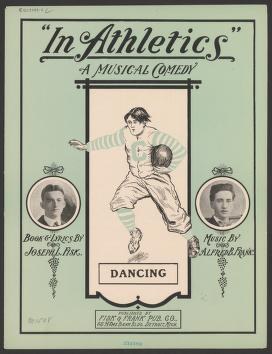
This is the cover or title page of a musical comedy called *In Athletics*, reproduced as a chromolithograph or color poster. The central image is a framed illustration of a male dancer in a baseball uniform executing a vigorous leap or jump, his body captured mid-air with legs bent and torso upright. The dancer wears a light-colored (cream or tan) uniform with darker trim. The frame itself is ornate, with decorative flourishes and a banner beneath reading "DANCING" in capital letters. Flanking the central image are two circular portrait photographs—credited as "Music by Joseph E. Howard" on the left and "Book by" someone on the right (the name is partially obscured in reproduction). The entire composition is set within a pale green or grayish background with ornamental borders and the title *"In Athletics"* with the subtitle *"A MUSICAL COMEDY"* at the top. The overall design is characteristic of early 20th-century theatrical promotional materials, with the bright frame device and celebrity portraits emphasizing the entertainment value of the production.
The dancing
A single male dancer dominates the composition, shown in a dynamic vertical leap with both feet leaving the ground. His body is upright and elongated, arms positioned at mid-level (one bent, one extended), and his legs are bent at the knees with feet pointing downward. The pose suggests explosive energy and athletic prowess—he is not executing a balletic line but rather a powerful, buoyant jump. The uniform is practical athletic wear rather than dance costume, grounding the movement in the sports context announced by the title. There is no partner or group; the dancer is presented as a soloist in the frame.
The dance depicted
This is theatrical dance integrated into a musical comedy set in an athletic or sports context (the title *In Athletics* suggests the premise). The jump itself recalls American vaudeville or musical theater vernacular dance—energetic, athletic, and designed to entertain a popular audience rather than exemplify classical technique. The baseball uniform transforms what might be a conventional dance leap into a comedic or novelty number, suggesting that the "dancing" in *Athletics* was meant to be unexpected, humorous, or incongruous. The work belongs to theatrical-musical-theater and possibly theatrical-jazz or street-funk traditions of early 20th-century American popular entertainment, though the precise choreography cannot be determined from the image alone.
How it was made
This is a color lithograph (chromolithograph or possibly a color offset print), a method that allowed rapid, inexpensive reproduction of theatrical posters in the early 1900s. The technique's bright, flat areas of color and bold outlines are visible in the frame ornaments and background. Lithography was the industry standard for theatrical promotion in this period, allowing for wide circulation and visibility on marquees and in lobbies. The inclusion of photographic portraits alongside drawn illustration was a common hybrid approach, combining the appeal of celebrity endorsement with artistic design. The medium implies this was a mass-produced promotional item, not a fine-art object.
About this work
This is a theatrical poster or program cover for *In Athletics*, a musical comedy from 1910 (or thereabouts). It advertises a production that incorporated dance—specifically, a comedic or novelty number in which a dancer in baseball uniform performs an athletic leap. The image sits at the intersection of American popular theater, vaudeville entertainment, and early musical comedy, capturing a moment when dance was being integrated into athletic or sports-themed comedy sketches for mass audiences. The work is emblematic of how dance functioned in early 20th-century American musical theater: as a vehicle for humor, spectacle, and physical display rather than as an art form in its own right.
How to look at it
Attend to the moment the artist chose: the dancer at the apex of his jump, weightless and suspended, rather than at the takeoff or landing. This captures the moment of greatest visual impact and maximum comedic or spectacular effect—the instant when the incongruity (baseball player as dancer) is most apparent and the physical achievement most undeniable. The ornate frame isolates and dignifies the image, treating a comedic moment as if it were a formal portrait or artistic tableau, which itself may be part of the joke: elevating a popular entertainment act to the status of high art through presentation.
The artist
The credits on the poster identify Joseph E. Howard as the composer of the music; the book writer's name is present but unclear in reproduction. Howard was a prolific composer and producer of musical comedies in the early 1900s, known for light, popular entertainments. The poster was designed by an uncredited commercial artist or design firm, typical of theatrical promotional work of the period. The identity of the choreographer and the dancer pictured is not recorded.
The period
In 1910, American musical comedy was booming, having evolved from operetta and vaudeville into a distinctly American form. Dance in musical theater was beginning to be formalized and integrated into narrative, though it remained closer to vaudeville novelty than to the ballet-influenced choreography that would emerge in the 1920s and 1930s. The athletic or sports-themed musical was a recognizable subgenre, often used as a frame for displaying young performers and physical comedy. Chromolithographic posters like this were the primary medium of theatrical promotion, circulated via mail, posted on streets, and displayed in theater lobbies.
Where it lives
This poster is held by the Library of Congress. It is part of the theatrical materials collection and serves as documentary evidence of early 20th-century American musical comedy promotion and design.
Dance in this work
Questions about this work
Was this a real production, and what was it about?
*In Athletics* was a musical comedy, likely staged around 1910. The title and imagery suggest it was built around athletic or sports comedy sketches, with musical numbers and dance integrated into the premise. Beyond the poster's evidence, details about the plot, cast, and run are not recorded here, though the credits suggest it was a professional production with recognizable talent.
What kind of dance is this?
This is American musical theater dance—specifically, the athletic or novelty style popular in vaudeville and early musical comedy. The jump is vigorous, explosive, and designed for visual impact and audience laughter rather than technical refinement. It is closer to acrobatic or physical comedy than to ballet or ballroom dance.
Why is the dancer wearing a baseball uniform?
The uniform is part of the joke or the production's theme. The incongruity of a ballplayer who dances is the point: it creates comic surprise and appeals to audiences who enjoyed both sports and entertainment. It also signals that this is light, popular entertainment rather than serious dance.
How was this poster made and distributed?
This is a chromolithograph, a color printing process that allowed theatrical producers to reproduce posters cheaply and quickly in large quantities. Posters like this were sent to theaters across the country, posted on streets and in lobbies, and mailed to newspapers and agents. They were a key tool for promoting touring productions and establishing the star power of performers and composers.
More dance artwork





