49 works in this view — arrow keys or swipe to move between them.
Dance in Art · 2019
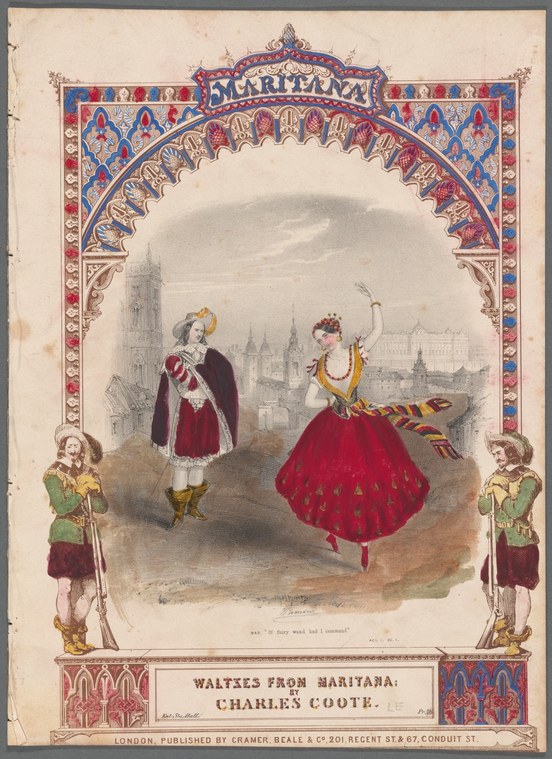
Waltzes from Maritana
Unknown artist
- Medium:
- Lithograph
- Dance:
- Waltz
- Era:
- Early 1800s (Waltz Revolution)
- Source:
- New York Public Library
- Rights:
- Public domain — free to use, share and adapt.
- Recorded as:
- public_domain
This image captures the critical moment when the waltz shifted from ballroom novelty to operatic spectacle—from something dancers did to something audiences watched and consumed through print culture. For historians, it documents how the dance was visually coded and marketed to the urban middle classes; for dancers, it shows the period's aesthetic ideals of the waltz body in motion: the turn, the lean, the swirl of fabric that defined the Viennese style. The marriage of operatic narrative, theatrical presentation, and dance image reveals how deeply the waltz had penetrated European culture by mid-century.
What you are looking at
This is a color lithograph celebrating the waltz through operatic imagery. The composition is framed by an ornate decorative border in the Victorian theatrical style, with gold filigree work and jewel-toned geometric patterns along the edges. Within this frame, two principal figures occupy a London rooftop or balcony with the city skyline—including what appears to be Big Ben and Westminster Abbey—rendered in soft gray wash behind them. A woman in a striking crimson ball gown dominates the right side of the composition, her skirt billowing dramatically as she executes a turning figure; her pose captures the characteristic rise and sway of the Viennese waltz, with her body inclined into the turn. To her left stands a man in formal court dress with a white waistcoat and embroidered tunic, his posture upright and observant. Two smaller figures in military or formal dress appear symmetrically placed at the lower corners, flanking the composition. The title and artist credit appear in printed text below the image. The overall effect is one of theatrical grandeur—this is not a ballroom scene but an operatic tableau, a visualized moment of dance abstracted and monumentalized.
The dancing
The woman's body shows the key hallmarks of the waltz turn: her weight appears shifted to one leg as her skirt fans outward with rotational momentum, her upper body inclined away from vertical in a controlled line that suggests the characteristic Viennese lean. The man stands in a more static pose, perhaps representing the gentleman partner's steadier frame, though the distance between the figures is greater than in actual closed-hold dancing. Her arms are raised and extended in a graceful arabesque-like position rather than in a standard waltz hold, emphasizing the theatrical nature of the image over ballroom realism. The two attendant figures are simplified but suggest the formal, courtly context of the dance.
The dance depicted
This is the waltz, specifically the Viennese waltz as performed and celebrated in the operatic and theatrical context of the 1840s–1850s, the height of the waltz revolution in European culture. The image frames the waltz not as a ballroom practice but as an artistic ideal—a moment of theatrical apotheosis. The woman's rotational pose and billowing skirt are the visual signature of the period's waltz imagery, which emphasized the dizzying turn and the drama of the woman's dress in motion. The London setting and the reference to *Maritana* (an 1847 opera by William Vincent Wallace) anchor this as a work celebrating the waltz's presence in popular opera and theatrical entertainment, the primary vehicle through which the dance reached the broadest urban audiences.
How it was made
This is a color lithograph, a medium that allowed rapid, affordable reproduction and wide circulation through print shops and music publishers. Lithography's capacity for subtle tonal gradation is evident in the skyline's atmospheric rendering, while the bold color areas—the woman's crimson dress, the decorative border's rich blues and reds—exploit the medium's strength in saturated hues. The ornate printed border and the placement of text below suggest this was a commercial publication, likely issued as a theatrical souvenir, music cover, or standalone print for consumers of opera and dance culture. The technique's popularity for such ephemeral cultural materials made it ideal for capturing and marketing the waltz craze.
About this work
This is a theatrical celebration of the waltz in its moment of maximum cultural prominence, created as a chromolithographic souvenir or illustration tied to a popular opera. Rather than documenting actual ballroom practice, it presents the waltz as a refined aesthetic ideal—a woman in a grand ball gown executing a turn against a backdrop of imperial London. The work belongs in a dance gallery as evidence of how the waltz was consumed, imagined, and circulated through operatic entertainment in the mid-nineteenth century. It shows not the dance as danced but the dance as dreamed: idealized, theatrical, monumentalized in the visual culture of the period.
How to look at it
Notice the moment the artist chose: not a static pose but a woman mid-turn, her body and dress caught in rotational movement. The skirt's volume and the tilt of her torso are the visual signature of the Viennese waltz as the period understood it. The decorative border, the formal clothing, and the London backdrop tell you this is not documentary but aspiration—a theatrical vision of dance elevated to high culture. The distance between the figures and the woman's unsupported arm position indicate this is an operatic tableau, not a ballroom instruction, and the scale and monumentality of the frame reinforce that you are looking at the waltz not as a social practice but as a cultural ideal.
The period
The waltz revolution of the early nineteenth century provoked intense debate across Europe—it was simultaneously celebrated as a modern, liberating social dance and condemned as morally dangerous. By the 1840s–1850s, when this print was made, the waltz had achieved complete respectability and had become a fixture of opera, ballet, and theatrical entertainment. Operatic composers including Strauss were writing waltz sequences into their works; the waltz had become synonymous with Vienna, romance, and the modern European city. Simultaneously, the theatrical presentation of dance—through opera, pantomime, and spectacular productions—was creating an increasingly powerful visual culture around movement. Lithographic prints like this one were central to circulating these idealized images of dance to audiences who might never attend a live performance.
Where it lives
The work is held by the New York Public Library and comes from their collection of theatrical prints and ephemera. It is a commercial chromolithograph, the type that would have been sold as a theatrical souvenir, music cover, or parlor print in the mid-nineteenth century, making it evidence of how widely waltz imagery circulated in the period.
Dance in this work
Questions about this work
Is this image showing a real waltz, or a staged version?
It is a theatrical idealization, not a documentation of ballroom practice. The woman's pose—particularly the unsupported arm and the exaggerated turn—follows the conventions of operatic pantomime rather than actual closed-hold waltz technique. The ornate frame and the iconic London backdrop reinforce that this is a visualized dream of the waltz, not a record of how it was danced in real ballrooms.
What is *Maritana*, and why is it relevant?
*Maritana* is an 1847 opera by William Vincent Wallace that was a major success in London and across Europe. It was one of many operas that incorporated the waltz into its score and spectacle, making the dance a central element of popular entertainment. The title suggests this print was issued as a theatrical souvenir tied to a production of the opera.
Why is the dress so important in waltz imagery of this period?
The waltz's key visual signature in the nineteenth century was the woman's full skirt in rotational motion—the fabric becoming almost a second character. The bell-shaped skirt, made possible by crinolines and hoop skirts by mid-century, was essential to the waltz's visual appeal and was heavily emphasized in theatrical presentations and prints. The dress's volume and movement were as much the 'point' of the waltz as the steps themselves.
More Waltz artwork