26 works in this view — arrow keys or swipe to move between them.
Dance in Art · 2019
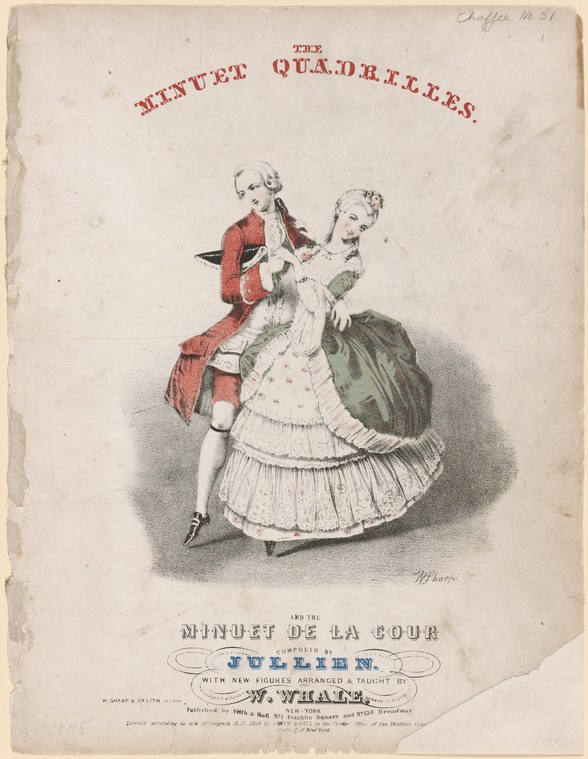
The minuet quadrilles. And The minuet de la cour composed by Jullien
Unknown artist
- Medium:
- Engraving
- Dance:
- Quadrille
- Era:
- 1700s (Enlightenment/Minuet Era)
- Source:
- New York Public Library
- Rights:
- Public domain — free to use, share and adapt.
- Recorded as:
- public_domain
The quadrille is often overlooked in dance history in favor of ballet or modern forms, but it was the dominant participatory dance form in the 19th century and shaped how ordinary people understood movement, sociability, and gender relations. This image shows why: it captures both the formal structure of the dance and the moments of individual expression and courtship that made it compelling. Jullien's quadrilles were among the most celebrated of the era, and this engraving is direct evidence of how his work was presented and understood by its audiences.
What you are looking at
A hand-colored engraving shows a man and woman in an intimate dance moment, likely from a cotillion or quadrille. The man, dressed in a red coat with applied trim, leans behind the woman in a playful gesture. The woman wears a white dress with a deeply gathered skirt and green silk overlay or panel, her posture open and responsive to his advance. The two figures are set against a plain background with subtle shading that gives them dimensional form. The composition captures a moment of flirtation or comic interaction rather than formal ballroom alignment—the man's gesture suggests animation and humor, while the woman's expression and body language indicate engagement with the moment.
The dancing
The pair are in close proximity but not in a standard ballroom hold. The man stands behind and slightly to the side of the woman, his arm extended in a gesturing motion near her shoulder or upper back—a pose suggesting surprise, pleading, or playful provocation rather than a fixed frame. The woman's upper body turns slightly toward him; her arms remain at her sides or held lightly. Both figures are vertical and upright, with weight distributed in an easy standing position. The spatial relationship and the man's animated gesture suggest this captures a moment of courtship dance ritual, where conversation and flirtation are as much part of the form as the steps.
The dance depicted
This is a quadrille, specifically 'The Minuet Quadrilles' or 'Minuet de la Cour' as indicated by the title. The quadrille was the dominant ballroom form of the 19th century, performed by sets of four couples in a square formation, and it incorporated elements of earlier dances, including the minuet, into a more playful social form. Quadrilles were danced at every level of society and were central to ballroom culture. The image captures not a step sequence but a characteristic moment of interaction—the flirtation and personal engagement that made quadrilles as much social theater as choreography. The gesture and proximity suggest this is from one of the figures or 'changes' within a quadrille, where the formal structure gave way to moments of individual personality.
How it was made
This is a hand-colored engraving, a reproductive medium that allowed wide circulation of dance imagery in the 19th century. The line work is precise and assured, with fine cross-hatching used to model form and create shadow, particularly in the folds of the woman's skirt and the curves of both figures. Color has been applied by hand over the printed engraving—the red coat and green silk are vibrant but delicately applied, and the technique allows both detail and readability. Engravings of this type were used to illustrate dance instruction manuals, promote fashionable dances, and document ballroom fashion and custom. They reached a broad educated audience and shaped how people understood both the steps and the social meaning of ballroom dance.
About this work
This engraving documents the quadrille, the dominant social dance of the 19th century, at a moment when it was at the height of its fashionability and social importance. The work is both an instructional image—showing the dress, posture, and spatial relationships appropriate to ballroom dance—and a social document, capturing the flirtation and individual expression that made quadrilles compelling as social events. The title credits the composition to Jullien, a celebrated dance composer and choreographer of the period, which suggests this image may have been created to promote or document one of his popular quadrille designs. Jullien's quadrilles were performed internationally and were among the most fashionable dances of his era. The image sits at the intersection of dance pedagogy, fashion documentation, and social commentary.
How to look at it
The artist has chosen to freeze a moment of interaction rather than a step sequence—the moment of approach, flirtation, or response that gave the quadrille its social energy. Notice how the man's gesture and the woman's responsive posture suggest a conversation happening through the body. The formal dress (the red coat, the elaborate skirt) establishes this as a ballroom context, while the informal proximity and gesture suggest the conventions of the period permitted—and even expected—moments of playfulness within the formal structure. The hand-coloring is delicate and selective, with the eye drawn first to the faces and then to the detail of the dress, reinforcing that this is as much a fashion image as a dance image.
The artist
The artist is not recorded in the catalogue, but the signature on the work appears to read 'Milnes' or similar. The composition is credited to Louis-Antoine Jullien (1812–1860), the celebrated French dance composer, choreographer, and conductor. Jullien was one of the most prolific and influential dance composers of the 19th century, known for his quadrilles, which were performed in ballrooms across Europe and North America. His work was extensively illustrated and promoted through prints, and his compositions often became the basis for published dance instruction. This engraving is likely part of a larger series or publication promoting Jullien's quadrilles to the ballroom public.
The period
The quadrille reached its peak popularity between the 1830s and 1880s, and this work dates from that era or shortly after. During this period, ballroom dance was a central feature of middle and upper-class social life in Europe and America. The minuet—a stately, formal dance from the 18th century—had largely disappeared from ballroom use by the 19th century, but its name and certain conventions (small steps, refined posture, courtship ritual) were incorporated into quadrilles as a sign of respectability and refinement. Dance composers like Jullien created hundreds of quadrille variations, each named for an event, location, or fashionable theme, and each quadrille was a set of five figures (or 'changes') that would take 10–15 minutes to complete. The publication and illustration of these dances was a major industry, and engravings like this one were used to teach, promote, and memorialize the most celebrated compositions.
Where it lives
This engraving is held in the New York Public Library collection. It is part of the extensive body of 19th-century dance imagery created to document, teach, and promote ballroom dances. Such works were published as sheet music covers, in dance instruction manuals, as standalone prints for framing, and as promotional materials for dance composers and ballroom venues.
Dance in this work
Questions about this work
What is a quadrille?
A quadrille is a ballroom dance performed by four couples standing in a square. It consists of five distinct figures, each with its own music and steps, and typically lasts 10–15 minutes. Quadrilles were enormously popular in the 19th century at all levels of society. Dance composers created hundreds of named variations, often inspired by current events, locations, or famous dances of the past (like this 'Minuet Quadrilles').
Why is this called the 'Minuet Quadrilles'?
The minuet was a formal, stately dance from the 18th century that had become old-fashioned by the time this quadrille was composed. Dance composers of the 19th century often created quadrilles that referenced older dances, either by incorporating some of their musical character or by incorporating steps or courtship conventions from the earlier form. This quadrille likely borrowed the measured, refined character of the minuet while maintaining the social and structural form of the contemporary quadrille.
Who was Jullien?
Louis-Antoine Jullien (1812–1860) was a French dance composer and choreographer, one of the most prolific of the 19th century. His quadrilles were performed internationally and were celebrated for their wit, variety, and musical sophistication. Jullien composed hundreds of quadrilles, each with its own character and story. His work defined what the quadrille could be during its period of greatest popularity.
What does this image tell us about how quadrilles were danced?
The image shows the dress, posture, and social interaction expected in quadrille dancing. The formal clothing (the tailcoat for the man, the elaborate gown for the woman) indicates this was a refined social practice. The proximity and gesture between the partners show that quadrilles, while structured, permitted and even encouraged moments of individual expression, flirtation, and personal interaction—they were as much social theater as choreography.
More Quadrille artwork