30 works in this view — arrow keys or swipe to move between them.
Dance in Art
A kagura dance
Unknown artist
- Medium:
- Engraving
- Era:
- Pre-1700 (Renaissance/Baroque)
- Source:
- New York Public Library
- Rights:
- Public domain — free to use, share and adapt.
- Recorded as:
- public_domain
Kagura is a foundational tradition in Japanese dance history, yet it remains less documented in Western archives than later theatrical forms like Kabuki and Noh. This print provides visual evidence of how kagura was performed and understood in the period of its creation, and demonstrates the continuity of the form across centuries. For dancers and historians, the image offers concrete evidence of the movement aesthetic—the emphasis on the torso, the expressivity of the head and arms, the integration of costume as a vehicle for spiritual expression—that distinguishes kagura from other Japanese performance traditions.
What you are looking at
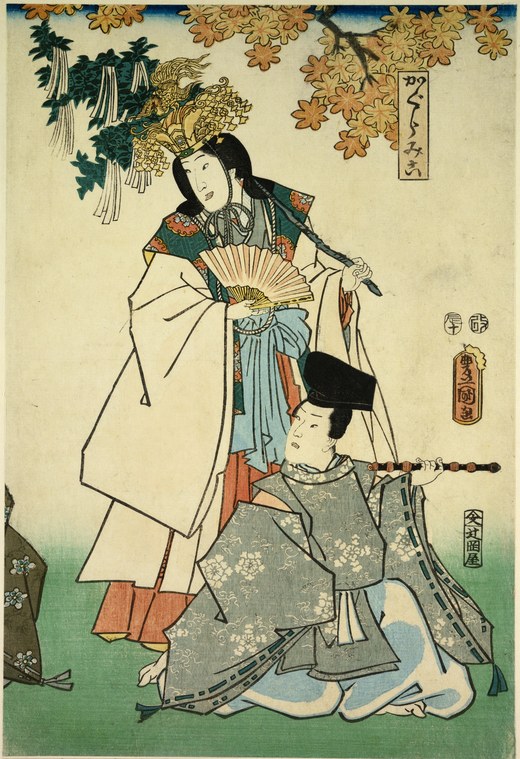
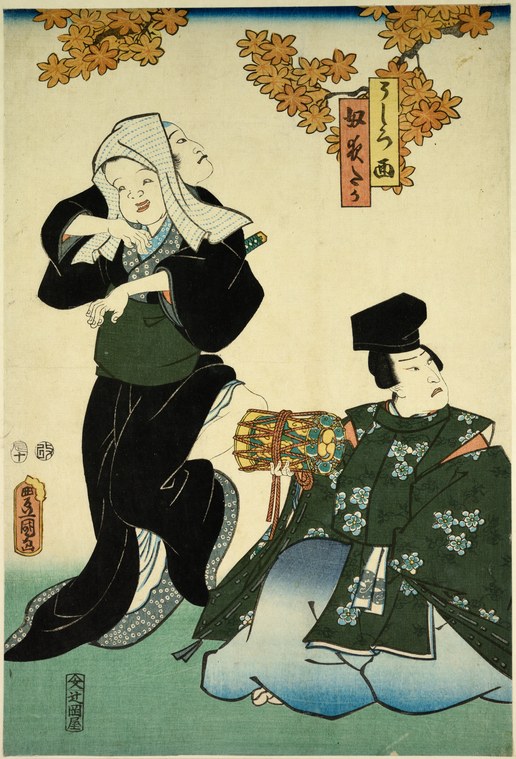
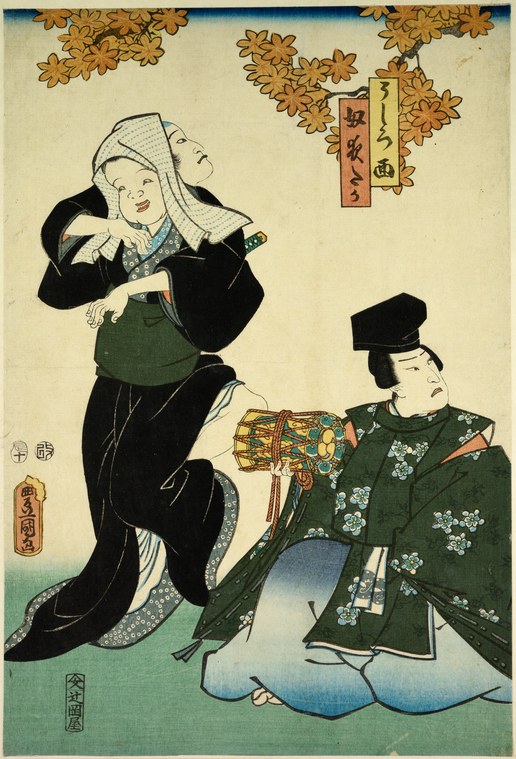
A woodblock print rendered in the ukiyo-e style depicts two figures engaged in what appears to be a kagura performance. On the left, a dancer in flowing black robes with a white head covering leans backward in an exuberant pose, one hand raised expressively near the face. On the right sits a second figure in green patterned garments and a black hat, turned slightly away, holding what appears to be a fan or ritual implement. Above them, gnarled branches laden with golden-brown chrysanthemum blossoms frame the composition against a pale sky. A cartouche with Japanese characters floats in the upper right. The print uses the characteristic bold outlines and flat color planes of the tradition, with careful attention to textile patterns and the play of light across the performers' garments. The intimate scale and domestic setting suggest a private performance or theatrical study rather than a grand ceremonial context.
The dancing
The left figure's body is arched backward in a pronounced contrapposto, with weight shifted and spine curved—a posture of surrender or ecstatic expression rather than athletic control. The head tilts back within the white hood, the face animated and upturned. The right arm gestures near the face with an open hand, suggesting emotional expression or a ritual gesture. The seated figure on the right maintains an upright, composed posture, creating a dynamic asymmetry between the two performers. The second figure's turn away from the primary dancer and the positioning of the fan or implement suggests either spectatorship or a complementary role in the kagura structure.
The dance depicted
Kagura is a sacred Shinto ceremonial dance with roots extending back centuries, performed at shrines and religious festivals. This print appears to document a moment from a kagura performance, likely a theatrical or semi-theatrical variant rather than a formal shrine ritual, given the intimate scale and the presence of an observer or attendant. The exuberant, inward-turning movement and the emphasis on the torso and head position align with kagura's expressive, spiritually-charged movement language, which prioritizes gesture and emotional intensity over codified footwork. The costume elements—the head covering, flowing robes, and formal dress of both figures—are consistent with kagura performance attire, though the print does not provide sufficient detail to identify the specific type of kagura or the particular narrative or deity being invoked.
How it was made
This is a woodblock print in the ukiyo-e tradition, identifiable by the bold outlines, selective use of color, and the compositional framing typical of the medium. The print demonstrates sophisticated use of overprinting to create the subtle gradations in the sky and the detailed patterning of the robes. The technique allowed for mass production and wide circulation in Japan during the Edo and Meiji periods, making images of popular theatrical and ceremonial performances accessible to a broad urban audience. The presence of cartouches with Japanese characters suggests this print is part of a series documenting particular performance types or theatrical celebrities of the era.
About this work
This woodblock print documents a moment from a kagura performance, a sacred Shinto ceremonial dance central to Japanese religious and cultural practice. The composition captures the expressiveness and spiritual intensity of the form through the exuberant backward arch of the primary dancer and the attentive presence of a second figure. The print is representative of ukiyo-e artists' documentation of theatrical and ceremonial performance, a major subject of the tradition that served to circulate knowledge of these performances and to celebrate celebrated performers. Kagura itself represents one of Japan's oldest continuous dance traditions, with roots in Shinto ritual and mythology, and its presence in the visual record of the period reflects both its cultural significance and its appeal as a subject for graphic documentation.
How to look at it
Attend to the contrast between the two figures: the dancer's open, ecstatic, backward-arching posture conveys emotional or spiritual intensity, while the seated figure's composed, inward-turned presence suggests either witness or complementary performer. The artist has chosen the moment of greatest physical and expressive extension—the arch, the upturned face, the open hand—a technique common in ukiyo-e theatrical prints to convey the essence of a performance rather than a neutral moment. The framing of the dancers beneath the heavy, ornamental branches of chrysanthemums creates a sense of the performance occurring within a natural or ritual sacred space. The careful rendering of textile patterns and the subtle use of color to distinguish the two figures' garments signal the importance of costume and visual splendor to the performance tradition.
The period
Kagura has existed in various forms since at least the Heian period (794–1185), when it was performed at court and at Shinto shrines as a ritual invocation of the kami (spirits). By the Edo period (1603–1868), when most surviving woodblock prints were created, kagura had diversified into multiple regional and functional variants: some remained strictly ceremonial and shrine-based, while others had become semi-theatrical entertainment for popular audiences. The print's style and the presence of theatrical costume suggest this documents a performed rather than strictly ritual version. Woodblock documentation of kagura alongside other theatrical forms reflects the period's appetite for visual records of performance and the celebrity status of accomplished dancers. The print predates or coincides with the Meiji modernization period (1868 onward), when traditional performance forms faced pressure and transformation due to rapid Westernization.
Where it lives
The print is held in the New York Public Library collection. It is catalogued as an engraving, though the technique and visual characteristics identify it as a woodblock print (likely color woodblock or hand-colored woodblock), a common format for theatrical and performance documentation in Japanese visual culture of the period.
Dance in this work
Questions about this work
What is kagura?
Kagura is a sacred Shinto ceremonial dance with origins in ancient Japanese religious practice. The form emphasizes spiritual or emotional expression through the movement of the torso, head, and arms, and often involves interaction with ritual objects or implements. By the early modern period, kagura had diversified into shrine-based ritual forms and more theatrical, entertainment-oriented versions. It remains an active tradition in Japan, particularly associated with regional festivals and shrine ceremonies.
How do we know this depicts kagura specifically?
The cartouche with Japanese characters on the print likely identifies the performance type, though the text is difficult to read in reproduction. The costume elements—the distinctive head covering, flowing robes, and ritual implements—are consistent with kagura performance attire. The movement aesthetic, particularly the emphasis on the torso and expressive head position, aligns with documented kagura technique. Without clearer inscription, the attribution rests on these visual and contextual cues rather than on definitive textual evidence.
Who made this print?
The artist is not recorded in the catalogue. Japanese woodblock prints of this era often went unsigned or bore signatures that are illegible in reproduction. The cartouche may reference the performer or the print series rather than the artist. Attribution would require examination of the original or comparison with documented artists' works from the same period and tradition.
When was it made?
The catalogue record dates the work as pre-1700, though the style and subject matter suggest it is more likely from the late Edo period (late 18th or early 19th century) or the early Meiji period (late 19th century). Ukiyo-e prints documenting theatrical and ceremonial performance were particularly prolific during these eras. More precise dating would require technical examination or comparison with dated prints in the same series.
More dance artwork