49 works in this view — arrow keys or swipe to move between them.
Dance in Art
Pheon waltz song
Unknown artist
- Medium:
- Lithograph
- Dance:
- Waltz
- Era:
- Early 1800s (Waltz Revolution)
- Source:
- New York Public Library
- Rights:
- Public domain — free to use, share and adapt.
- Recorded as:
- public_domain
This object reveals how waltz circulated in early 20th-century America not only as a dance but as a musical and theatrical fantasy sold to middle-class audiences through illustrated sheet music. The image shows the gendered, ethereal aesthetic that had come to dominate popular representation of waltz by this period, far removed from the controversial, sensual dance that had sparked moral panic decades earlier.
What you are looking at
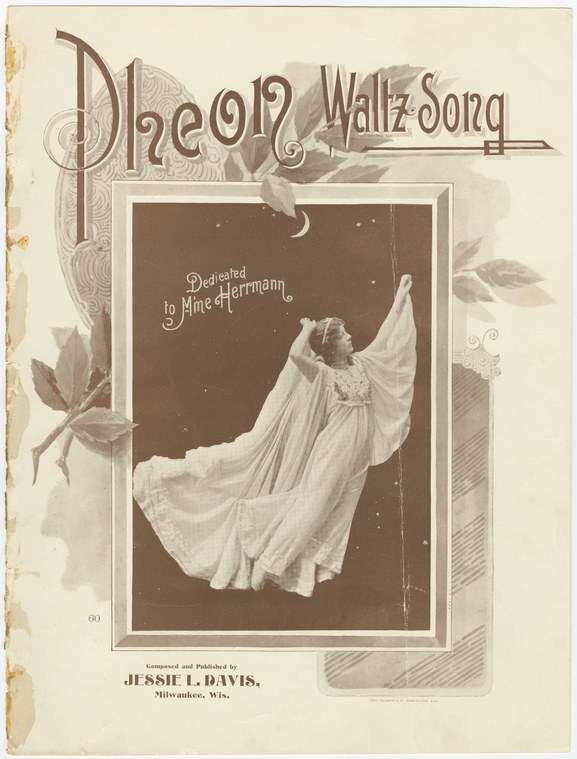
A single female figure dominates this lithographic cover design, shown in three-quarter view against a dark background. She wears a flowing white nightgown or chemise with billowing sleeves, her body caught mid-movement as the fabric swirls around her. Her head is tilted back, arms raised and extended as if in an expressive, almost ecstatic gesture. The composition is framed by ornamental art nouveau borders in brown ink—interlocking geometric patterns on the left margin and stylized foliage along the top and right edges. The title "Pheon Waltz Song" appears in decorative lettering at the top, and below the central image are the credits: "Dedicated to Mme Aldermann" and "Composed and Published by Jessie L. Davis, Milwaukee, Wis." The overall effect is theatrical and romantic, emphasizing the ethereal quality of the figure's movement.
The dancing
A single dancer is shown in an open, unsupported posture with arms raised and extended outward at shoulder height or slightly higher. Her weight appears to rest on one leg while the other is suggested beneath the flowing skirt. The pose is expansive and unrestrained, with no closed frame or partner contact—the figure exists in a moment of solitary, lyrical expression rather than in the structured partnering typical of ballroom waltz.
The dance depicted
This work depicts waltz as a theatrical or performative genre rather than a social ballroom dance. The title identifies it as a waltz song—a musical form tied to the waltz rhythm—and the dedication suggests it was written for a specific performer (Mme Aldermann). The figure's open, expressive posture and the ethereal quality of her costume and movement align with romantic-era theatrical conventions of the late 19th and early 20th centuries, in which waltz themes appeared in ballet and musical theatre. The absence of a partner and the emphasised verticality and arm expression suggest this is closer to theatrical interpretation than social dancing.
How it was made
This is a lithograph, a printing process that allows for soft tonal gradations and fine detail. The artist used brown ink on cream stock, creating subtle shading around the figure and bold outlines for the decorative borders. Lithography was the dominant commercial printing technology of this period and allowed for rapid, economical production of illustrated sheet music covers and promotional materials, making such works accessible to middle-class households and performers. The quality of the line work and the sophistication of the art nouveau design suggest a professionally executed production.
About this work
This is a sheet music cover for a waltz composition published in Milwaukee in the early 20th century, combining musical commerce with theatrical imagery. It presents waltz not as the social dance of ballrooms but as a sentimental, emotionally expressive form suitable for performance and dedicated patronage. The figure's romantic costume and ecstatic pose invoke the theatrical waltz of 19th-century ballet, even as the music was marketed for amateur performance in the home. The work sits at the intersection of commercial music publishing, art nouveau design, and the romanticisation of waltz in American popular culture.
How to look at it
Observe how the artist has chosen a moment of maximum extension and openness—the arms spread, the body lifted—rather than a rotational instant typical of social waltz. This emphasis on vertical lift and expressive arm positions reflects late 19th-century ballet aesthetics more than ballroom convention. Note the contrast between the ornamental, angular art nouveau borders and the soft, voluminous movement of the figure itself: the design frames the dancer as a precious object, and the decorative language elevates the music and performance as worthy of artistic attention.
The artist
The work is credited to Jessie L. Davis of Milwaukee, Wisconsin, identified as composer and publisher. Davis appears to have been active in music publishing in the Midwest during the early 1900s, producing commercially distributed sheet music with illustrated covers. Little else is recorded of Davis's practice or biography.
The period
By the early 20th century, waltz had been fully integrated into American middle-class culture and theatrical tradition. The waltz revolution of the 1800s—which had scandalized conservative moralists with its close partnering and rotational movement—had yielded to a more domesticated, romanticised version suitable for drawing rooms and concert halls. Simultaneously, art nouveau design was at its height, with its emphasis on flowing lines, natural forms, and ethereal femininity. This cover synthesises both trends: the waltz as respectable, sentimental entertainment, and the woman dancer as a romantic, almost otherworldly figure.
Where it lives
This work comes from the New York Public Library collection, where it is catalogued as a lithographic print from the early 1900s (Era: Waltz Revolution). It is a commercial print object—sheet music cover art intended for wide distribution—rather than an unique work or fine art print.
Dance in this work
Questions about this work
What is a waltz song?
A waltz song is a vocal or instrumental musical composition written in waltz time (3/4 meter) and rhythm. By the late 19th and early 20th centuries, waltz songs were hugely popular in America and Europe, often published as sheet music with illustrated covers for home performance. They typically carried romantic or sentimental themes and were marketed to amateur musicians and singers.
Is this showing social dance or theatrical dance?
This is theatrical in character. The single figure, the open unsupported posture, the expressive arm work, and the romantic costume all suggest a performer in a staged or concert context rather than a social dancer in a ballroom. The waltz has here become a vehicle for romantic expression rather than a partner dance.
Who was Mme Aldermann?
The record does not identify her. The dedication indicates she was a performer of some standing for whom Jessie L. Davis composed this piece, but no further information is available.
Why does the figure look so ethereal?
By the early 20th century, the visual representation of waltz—especially in theatrical and commercial contexts—emphasised ethereal, romantic qualities. The flowing white gown, the lifted posture, the expressive arm position, and the soft lithographic rendering all work together to evoke a fantasy of feminine grace and transcendence rather than the energetic, sensual reality of the dance itself.
More Waltz artwork