49 works in this view — arrow keys or swipe to move between them.
Dance in Art
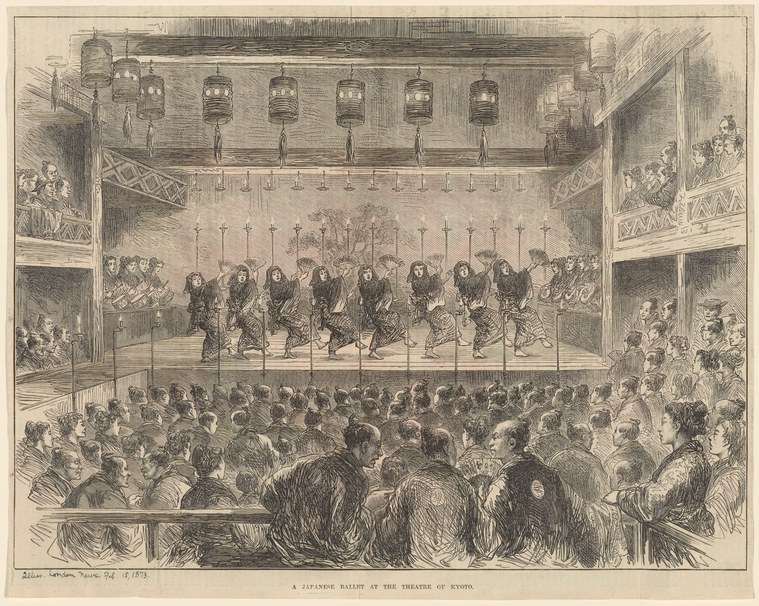
A Japanese ballet at the theatre of Kyoto
Unknown artist
- Medium:
- Dance:
- Ballet
- Source:
- New York Public Library
- Rights:
- Public domain — free to use, share and adapt.
- Recorded as:
- public_domain
This image is a primary document of 19th-century Japanism and cultural translation: it shows how Japanese theatrical dance was understood, framed, and circulated for a European public. It demonstrates the role of commercial engraving in creating visual knowledge of world performance traditions, and the linguistic slippage ('ballet') that often accompanied that knowledge.
What you are looking at
A crowded theatrical interior depicts a performance in progress on a raised stage. A line of approximately nine figures in dark, flowing costumes moves across the stage, their poses suggesting synchronized or sequential movement. The stage is lit by gas lamps suspended from above, casting light on the performers and the ornate proscenium arch. The auditorium is packed with spectators occupying the stalls and balconies on both sides—gentlemen in top hats and women in bonnets lean forward attentively, some gesturing in animated conversation. The architectural setting is richly detailed with decorated railings, balcony fronts, and classical ornamentation typical of a mid-19th-century theatre. The composition is rendered in the linear, cross-hatched style of engraving or wood-engraving, with fine line-work creating tone and shadow throughout.
The dancing
The dancers move in a nearly linear formation, each figure articulated with bent knees and bent arms, suggesting a controlled, deliberate vocabulary distinct from Western balletic technique. The poses are held and repetitive across the line, implying a choreographic sequence performed in unison or near-unison. Their dark, loose-fitting garments drape heavily, obscuring the precise articulation of limbs but revealing a bodily approach emphasizing torso and hip rather than the extended verticality of classical ballet. No pointe shoes or tutus are visible.
The dance depicted
The title names this as a Japanese ballet performed at Kyoto theatre, but the choreography and costuming bear no resemblance to European ballet vocabulary. The dancers' postures, group formation, and costume suggest Japanese traditional theatrical dance, possibly Kabuki (KABU) or a related form such as Buyō (classical Japanese dance). The term 'ballet' appears to be a Western categorical label applied to a non-Western theatrical form—a common 19th-century practice of naming unfamiliar dance traditions by European reference. The synchronised, formal line and the controlled repetition of gesture are consistent with Japanese classical training rather than Romantic ballet.
How it was made
This is an engraving or wood-engraving, likely from the mid-19th century, evident from the uniform line-weight, precise cross-hatching, and formal composition. The technique allowed for mass circulation in illustrated periodicals and books; the fine detail and small scale suggest publication in a London or European newspaper or weekly illustrated magazine. The signature mark at lower left ('Edward Kenan [or Kennan], Paris, 1873' or similar—partially legible) indicates French or expatriate production and dating. Engraving was the standard medium for topical theatrical reportage in this period before photographic reproduction became reliable.
About this work
This engraving documents a performance of Japanese dance at a Kyoto theatre, captured for a European audience accustomed to reading theatrical subjects in prints. It is a record of cultural encounter: a Japanese theatrical practice viewed, absorbed, and reproduced by a European artist working in the commercial press tradition. The image serves as evidence of the circulation of Japanese performance in Western consciousness during the early Meiji period, when Japanese culture was beginning to be collected, exhibited, and reproduced for European audiences. The misapplication of the term 'ballet' reveals the conceptual distance between the forms and the Western urgency to taxonomize unfamiliar movement.
How to look at it
Attend to the formal line of dancers and the precision of their repeated poses—this is the visual signature of Japanese classical training, emphasizing group harmony and formal geometry over individual virtuosity. Notice the theatre architecture and audience: the image frames Japanese performance as a spectacle for European consumption, staged within a European theatrical architecture and consumed by a European crowd. The engraving's fine linear detail allows the artist to distinguish the dancers' postures from the crowded audience, clarifying the performer-spectator boundary while making the audience the secondary subject.
The artist
The artist is not securely identified in the catalogue, but the signature suggests a connection to Paris or the Parisian expatriate press. The subject—topical theatre reporting illustrated for a weekly periodical—was a staple of commercial engraving practice in the 1870s. European artists producing theatrical reportage during this period typically worked from eyewitness sketches or secondhand description, balancing documentary impulse against the conventions of theatrical illustration.
The period
This print dates to the early 1870s, a moment of intense European fascination with Japanese art and design following Japan's opening to Western trade in 1853 and its participation in international exhibitions. Japanese theatrical traditions were still largely unknown in Europe; this image participates in their first circulation through the press. At the same time, European ballet was fragmenting: Romantic ballet was in decline, and classical Russian ballet had not yet achieved international prominence. Japanese performance appeared to European viewers as exotic, formally structured, and entirely separate from ballet, yet Western publishers repeatedly applied that term.
Where it lives
The work is held in the New York Public Library collection. It is identified as a print, likely extracted from an illustrated periodical of the 1870s, and has been catalogued with minimal descriptive information.
Dance in this work
Questions about this work
Why is this called a 'ballet' when it is clearly not European ballet?
The term 'ballet' was used by 19th-century European commentators as a catch-all for any formal theatrical dance performance. It reflects the Western cultural framework through which Asian performance was understood and named. This practice was common in illustrated newspapers and periodicals, which often misapplied European terminology to unfamiliar dance traditions.
Is this performance documented elsewhere, and can it be identified?
The image alone does not provide enough information to identify the specific theatre, troupe, or performance. Japanese theatre records and European periodical archives might contain corroborating reports or advertisements. The Meiji-era opening of Japanese theatre to Western visitors is documented, but this particular event remains uncertain without further research.
Who was the artist, and why was this made?
The catalogue does not securely identify the artist, though the signature suggests a Paris-based engraver working in the 1870s. Such images were produced for illustrated weeklies (similar to the Illustrated London News) that specialized in topical reporting, including theatre reviews and exotic cultural attractions. They were commercial, time-sensitive illustrations, not fine art.
More Ballet artwork