Dance in Film · 1961
West Side Story (1961)
Jerome Robbins's choreography transforms Shakespeare's Romeo and Juliet into a Mambo-fueled street ballet in 1950s New York.
West Side Story is a 1961 dance musical centred on American Rhythm, Global Afro-Diasporic, Ballet, Musical Theatre Dance. For dancers, it's a chance to see these styles performed on screen — the phrasing, partnering, and musicality that the same dances carry onto a real floor.
Jump to the 11 indexed dance sequences ↓
Dance styles featured
Where to watch: Streaming (various)
Featured clip
An excerpt — one number from the full work.
The dance sequences in West Side Story
11 sequences, 11 with a timestamp — what is danced, by whom, and where to find it.
Danced by Russ Tamblyn; George Chakiris; Tucker Smith; Bert Michaels; Tony Mordente; David Winters; David Bean; José De Vega; Jets ensemble; Sharks ensemble · Choreography Jerome Robbins
The aerial dive into Manhattan, the gangs' synchronized finger snaps, and street fighting rendered as a continuous urban ballet.
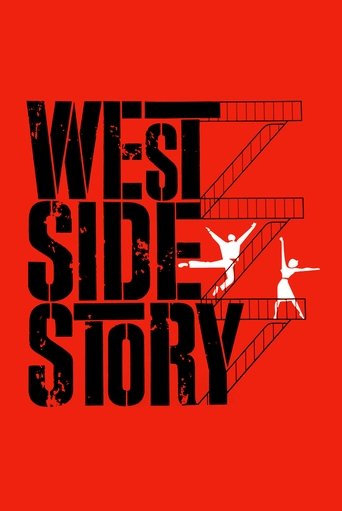
Saul Bass's vertical city graphic gives way to a helicopter view that plunges from Manhattan into a fenced playground, where Riff's Jets answer Bernstein's whistles with finger snaps and low, prowling steps. The Jets' high kicks and running jumps carry them across streets and a basketball court until Bernardo's Sharks steal the same pulse, so territorial control is visible before either gang explains it. A patrol car finally freezes the athletic chase into a police lineup, making the interruption part of the sequence's design.
Stream or rental only — the timestamp is for when you have it playing. Whistling begins at 00:05:07 in the named 153-minute Blu-ray subtitle reference; the dance-fight continues until the police break up the playground brawl. [Scene timings were checked against a fan-made subtitle track; that track is timing provenance only, not a source about the work. films_tv 2026-09-14, legal ruling 10445.]
Danced by Russ Tamblyn; Tucker Smith; Bert Michaels; Jets ensemble · Choreography Jerome Robbins
Riff and the Jets making their family oath physical through linked shoulders, crouched walks and the final command to walk tall.
On the playground, Riff pulls the Jets into a shoulder-linked cluster for “When you're a Jet,” then breaks that brotherhood into crouches, lunges and sharp changes of direction as he proposes challenging Bernardo at the gym. The war-council dialogue interrupts the number without releasing its physical pressure; when the Jets resume with “walk tall,” their compact unison turns a boast about belonging into a literal way of occupying the court. Russ Tamblyn's high, springing attack keeps Riff visibly in command even when the gang fans away from him.
Stream or rental only — the timestamp is for when you have it playing. The musical entrance begins at 00:21:01 in the named 153-minute Blu-ray subtitle reference; MC² catalogs the number as an approximately two-minute Jet ensemble. [Scene timings were checked against a fan-made subtitle track; that track is timing provenance only, not a source about the work. films_tv 2026-09-14, legal ruling 10445.]
Danced by Natalie Wood; Russ Tamblyn; Jets ensemble; Sharks ensemble · Choreography Jerome Robbins
The supposedly friendly school dance beginning as a slow, openly hostile contest between the color-coded Jets and Sharks.
Glad Hand's gym mixer starts with the Jets in pale clothes and the Sharks in darker colors refusing to soften their angled bodies even when the slow Blues asks for partnered ease. A floor-level camera watches the two camps bend, swivel and advance toward the same patch of floor, making every relaxed-looking hip or shoulder a challenge for space. Natalie Wood's backward spin supplies the dissolve into the gym, but the image immediately divides her excitement into two rival color fields.
Stream or rental only — the timestamp is for when you have it playing. The sultry band cue begins at 00:31:58 in the named 153-minute Blu-ray subtitle reference; MC² identifies the Blues portion as a distinct gym number. [Scene timings were checked against a fan-made subtitle track; that track is timing provenance only, not a source about the work. films_tv 2026-09-14, legal ruling 10445.]
Danced by Rita Moreno; Russ Tamblyn; George Chakiris; Susan Oakes; Tucker Smith; Tony Mordente; David Winters; David Bean; José De Vega; dance ensemble · Choreography Jerome Robbins
The gym-wide cry of “Mambo!” as Rita Moreno, George Chakiris and Russ Tamblyn turn a social dance into a territorial showdown.
The whistle releases both gangs into a Mambo contest, and the gym floor erupts into rival circles whose dancers shout the style's name back at the band. Rita Moreno and George Chakiris drive the Sharks with snapped turns, skirt sweeps and deep lunges while Russ Tamblyn's Jets answer with airborne kicks, each camp repeatedly invading the other's center. The camera drops among the dancers and then rises far enough to show the two color-coded groups reorganizing around every featured pair.
Stream or rental only — the timestamp is for when you have it playing. The band begins the Mambo at 00:36:28 in the named 153-minute Blu-ray subtitle reference; the shouted response follows at 00:36:40. [Scene timings were checked against a fan-made subtitle track; that track is timing provenance only, not a source about the work. films_tv 2026-09-14, legal ruling 10445.]
Danced by Natalie Wood; Richard Beymer · Choreography Jerome Robbins
Tony and Maria's restrained Cha-Cha continuing after the gym and its dancers appear to vanish around them.
As Tony and Maria notice one another across the gym, the surrounding Mambo crowd falls out of focus and the hard floor dissolves into a dark field pricked with colored lights. Their Cha-Cha uses small side steps, hand changes and a single unforced turn, a deliberate reduction after the gangs' acrobatic competition. Bernardo's hand entering to wrench Tony away restores the gym and ends the duet at the exact moment its private space seems complete.
Stream or rental only — the timestamp is for when you have it playing. The soft Cha-Cha cue begins at 00:39:40 in the named 153-minute Blu-ray subtitle reference; MC² catalogs the duet as a separate 58-second number. [Scene timings were checked against a fan-made subtitle track; that track is timing provenance only, not a source about the work. films_tv 2026-09-14, legal ruling 10445.]
Danced by Rita Moreno; George Chakiris; Yvonne Wilder; Suzie Kaye; Joanne Miya; José De Vega; Sharks ensemble · Choreography Jerome Robbins
Rita Moreno whipping her purple skirt across the rooftop while the Shark women and men trade increasingly athletic claims about America.
On the tenement roof, Anita's skirt slices broad red arcs while Bernardo and the Shark men answer her praise of Manhattan with bent-knee jumps, heel beats and objections delivered from the opposite side of the clotheslines. Robbins makes the argument change partners: the women fan their skirts and travel forward on “I like to be in America,” then the men seize the center to puncture each promise with a physical retort. When the company closes with rapid turns, claps and a final olé against the skyline, immigration debate and dance contest have become the same event.
Stream or rental only — the timestamp is for when you have it playing. The score's “America” cue begins at 00:49:45 in the named 153-minute Blu-ray subtitle reference and runs roughly 4m42s through the final olé. [Scene timings were checked against a fan-made subtitle track; that track is timing provenance only, not a source about the work. films_tv 2026-09-14, legal ruling 10445.]
Danced by Russ Tamblyn; Bert Michaels; Tony Mordente; David Winters; David Bean; Jets ensemble · Choreography Jerome Robbins
The Jets using Krupke's own cap and the drugstore furniture to impersonate an entire police, court, psychiatric and social-work bureaucracy.
Inside Doc's drugstore, Riff turns Officer Krupke's cap and baton into the first costume of a vaudeville case history, then the Jets rotate through judge, psychiatrist and social-worker roles by commandeering the counter, stools and whatever props are within reach. Each new diagnosis physically ejects the same delinquent toward another institution, so the boys' leaps and mock courtroom gestures expose how quickly adults pass responsibility along. The real Krupke's return punctures the show just after the Jets have converted his name into their final obscene dismissal.
Stream or rental only — the timestamp is for when you have it playing. The music cue begins at 01:06:32 in the named 153-minute Blu-ray subtitle reference; MC² catalogs the number at approximately 3m53s in its release reference. [Scene timings were checked against a fan-made subtitle track; that track is timing provenance only, not a source about the work. films_tv 2026-09-14, legal ruling 10445.]
Danced by Natalie Wood; Yvonne Wilder; Suzie Kaye; Joanne Miya · Choreography Jerome Robbins
Maria dancing through the bridal shop's mirrors and dress forms while her coworkers mock-crown her as the happiest girl in New York.
At Madame Lucia's bridal shop, Maria treats mirrors, dress forms and bolts of fabric as witnesses to her transformation, darting between worktables while Consuelo, Rosalia and Francisca try to keep her at the sewing task. Natalie Wood's bright spins repeatedly place the white bridal merchandise around her like an accidental wedding chorus, even though the women know nothing about Tony. The number's last teasing cluster around Maria makes her happiness look communal seconds before the film returns to the coming rumble.
Stream or rental only — the timestamp is for when you have it playing. The music cue begins at 01:23:46 in the named 153-minute Blu-ray subtitle reference; MC² catalogs the number at approximately 2m38s in its release reference. [Scene timings were checked against a fan-made subtitle track; that track is timing provenance only, not a source about the work. films_tv 2026-09-14, legal ruling 10445.]
Danced by Richard Beymer; Russ Tamblyn; George Chakiris; Tucker Smith; Jets ensemble; Sharks ensemble · Choreography Jerome Robbins
The knife fight moving with balletic precision until Riff and Bernardo lie dead beneath the highway and Tony is caught alone in a spotlight.
Beneath the highway, the Jets drop from a concrete wall and the Sharks scale a chain-link fence before Ice and Bernardo square off, arranging the supposedly fair fight as two opposing geometric blocks. Tony's attempt to stop them fractures the pattern: Riff and Bernardo circle with switchblades, spring away from the fence and re-enter on musical attacks until Bernardo's thrust catches Riff. After Tony kills Bernardo, the choreography empties the space under a siren, leaving the two leaders' bodies aligned on the ground and Tony isolated in a round spotlight.
Stream or rental only — the timestamp is for when you have it playing. Approximate start mapped to the named 153-minute Blu-ray release from MC²'s 2m21s release-reference entry; marked medium because the intermission and overture differ between editions. [Scene timings were checked against a fan-made subtitle track; that track is timing provenance only, not a source about the work. films_tv 2026-09-14, legal ruling 10445.]
Danced by Natalie Wood · Choreography Jerome Robbins
Maria's brief, hopeful rooftop solo ending the instant Chino arrives with news of Bernardo's death.
Alone on the tenement roof, Maria lets the instrumental phrase carry her through buoyant turns and light, ballet-inflected steps while she waits for Tony to report that the rumble was stopped. Her pale dress and open arms catch the rooftop light until Chino's bruised face enters from darkness and stops the solo without a musical resolution. The interruption makes the forty seconds painfully specific: Maria is dancing inside the last moment when she still believes both Tony and Bernardo are safe.
Stream or rental only — the timestamp is for when you have it playing. The instrumental cue begins at 01:47:02 in the named 153-minute Blu-ray subtitle reference; MC² identifies the rooftop solo as a distinct 40-second number. [Scene timings were checked against a fan-made subtitle track; that track is timing provenance only, not a source about the work. films_tv 2026-09-14, legal ruling 10445.]
Danced by Tucker Smith; Tony Mordente; David Winters; Eliot Feld; Jets ensemble · Choreography Jerome Robbins
The Jets snapping almost silently in the parking garage while Action's body keeps bursting through Ice's command to stay cool.
In the low-ceilinged delivery-van garage, Ice orders the Jets to contain their panic with pinched finger snaps, shoulders held down and feet placed as if every sound might betray them to the police. Action repeatedly tears out of the group in kicks and off-balance lunges, and each “cool” forces him back into a tighter line against the concrete walls. The last explosive turns do not release the grief over Riff; they show the gang spending enormous physical effort to make terror look controlled.
Stream or rental only — the timestamp is for when you have it playing. The music cue begins at 01:57:55 in the named 153-minute Blu-ray subtitle reference; MC² catalogs the number at approximately 3m44s in its release reference. [Scene timings were checked against a fan-made subtitle track; that track is timing provenance only, not a source about the work. films_tv 2026-09-14, legal ruling 10445.]
More dance films
Poster artwork from TMDB.
 This site uses TMDB and the TMDB APIs but is not endorsed, certified, or otherwise approved by TMDB.