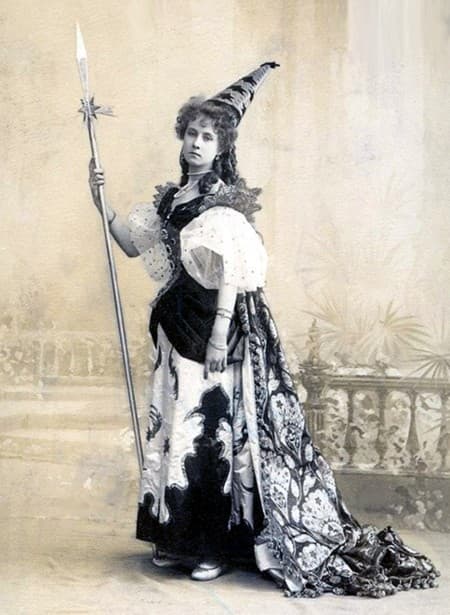
Unknown photographer of the St. Petersburg Imperial Theatres. — Self-scanned · Public domain
Barbe-Bleue (Bluebeard) is a three-act, seven-scene ballet-féerie choreographed by Marius Petipa to a score by Pyotr Schenk, with a libretto by Lydia Pashkova drawn from Charles Perrault's fairy tale. It was first given on 20 December 1896 (8 December Old Style) at the Imperial Mariinsky Theatre in St Petersburg, mounted as the benefit performance marking Petipa's fiftieth year of service to the Imperial Theatres — a state occasion rather than an ordinary repertory premiere.
What it contains
- Classical Ballet · Throughout, particularly the Pas d'action and Grand pas d'action numbers of Act I — Structured classical variations (adagio, solo variations differentiated by tempo, coda), corps de ballet writing, and formal danced sequences described as masterworks of the danse d'école. Source: "Petipa's dances for Bluebeard were universally hailed as masterworks of classical choreography."
- Classical Ballet — Grand pas de deux électrique · Act III, Scene 2 — the Grand pas de deux électrique for Ysaure and Arthur — A principal pas de deux built as adagio, separate solo variations for the danseur and danseuse, and a closing coda — the standard classical grand pas de deux template. Source: "featured in a performance of Petipa's celebrated Pas de deux éléctrique"
- Galliard — Grand pas de deux électrique · Act III, Scene 2 — the Temple of the Past ('Le temps passé') — Characters representing an ancient period of France perform period dances explicitly named as the Gaillarde within the historical-tableau divertissement. Source: "who render several early dances such as the Gaillarde"
- Passepied · Act II, Scene 1 — Ysaure's chamber — A named passepied is danced by the characters Anne and Arthur as a discrete social/character number within the scene. Source: "Anne and Arthur dance a passepied."
- Cotillion — Grand pas de deux électrique · Act III, Scene 2 — closing general dance before the apotheosis — A titled cotillon closes the divertissement as a general ensemble dance for the wedding guests, following the temple divertissements and the Grand pas de deux électrique. Source: "Danse générale: Le cotillon"
What is danced
The ballet is built as a chain of set pieces typical of late Petipa: a Pas d'action with a run of contrasting variations (waltz, 'quasi orientale', pizzicato) and a coda in Act I; a full Grand pas d'action with an adagio for solo cello, mazurka- and waltz-tempo variations and a coda-valse; and, in the underground treasure chambers of Act II, a sequence of animated-object and 'national' divertissements — a Bacchanale for living gold and silver vessels, a Japanese fan dance and Hindu dance grouped as a Pas oriental, and a Pas des pierres précieuses in which diamonds, emeralds, rubies and sapphires dance successive waltzes. Act III's wedding divertissement moves through allegorical dances for the stars and Venus, an evocation of 'Le temps passé' danced as a Gaillarde, a 'polka fin de siècle' for the present, and closes with the ballet's most durable number, the Grand pas de deux électrique (adagio, solo variations for the leading man and woman, and coda), created for Pierina Legnani and Sergei Legat, followed by a Danse générale billed as a cotillon and a final apotheosis.
Context
Made in 1896 for Petipa's own fiftieth-anniversary benefit, Barbe-Bleue belongs to the last wave of grand Imperial ballet-féeries, where the danse d'école of pas d'action, adagio-variations-coda structures sits alongside elaborate stage transformation and pantomime spectacle. Critics at the premiere already registered the tension this generated: the libretto was treated as scaffolding for scenic effects, even as Petipa's own choreography — corps de ballet writing and classical variations — was singled out as masterly.
Staging history
The full production ran successfully at its 1896 premiere but never entered steady repertory; its last complete outing was in 1899 for Pierina Legnani's benefit, and in 1901 only Acts I and III were given for her farewell before she returned to Italy. Nikolai Legat mounted a revival in 1910 that was itself successful at first, but the ballet's scale and complex stage machinery became impossible to sustain once war logistics intervened, and the full-length work was last performed in 1913; excerpts, chiefly the Grand pas de deux électrique, were still given in galas until 1916. The score resurfaced in the twenty-first century: in 2009 Yuri Burlaka and Vasily Medvedev drew on Schenk's music for a new Grand pas des fleurs in their Bolshoi revival of La Esmeralda, and in 2014 Medvedev staged a new Grand pas électrique after the Bluebeard original for the Dance Open Festival Gala in St Petersburg.
How to watch it
Look for the classical grammar inside the spectacle: the Pas d'action and Grand pas d'action structure variations by tempo and character before resolving in a coda, and the Grand pas de deux électrique follows the same adagio–variations–coda template built for a single leading couple. Distinguish this danse d'école vocabulary from the interpolated 'national' and animated-object divertissements — the Japanese and Hindu dances, the jewel waltzes, the Bacchanale — which are costume-and-effect numbers rather than extensions of the ballet's classical technique.
Structure
- Act I · Scene 1Arthur the page loves Ysaure, but her brothers betroth her to the wealthy Bluebeard instead; the act closes with betrothal and wedding dances and processions.
- Act II · Scene 1In Ysaure's chamber, Bluebeard gives her the keys before departing for battle; Anne and Arthur dance a passepied and Ysaure dances before her mirror.
- Act II · Scene 2 · BacchanaleLed underground by the Spirit of Curiosity, Ysaure enters a treasure chamber where gold and silver vessels and caryatids come to life and dance.
- Act II · Scene 3 · Pas orientalA chamber of fabrics comes alive in an orientalist divertissement including a Japanese fan dance, a Hindu dance, a variation and coda.
- Act II · Scene 4 · Pas des pierres précieusesJewels dance in the third chamber — a waltz of diamonds, then dances for emeralds, rubies and sapphires — before Ysaure opens the forbidden door.
- Act III · Scene 1Bluebeard discovers the blood-stained key and is about to execute Ysaure when her brothers and Arthur arrive and kill him in combat.
- Act III · Scene 2 · Grand pas de deux électriqueA wedding divertissement of stars, Venus, and allegorical 'temples' of past, present and future closes with the Grand pas de deux électrique for Ysaure and Arthur, a cotillon and apotheosis.
Structure read from an encyclopaedia article, not from a libretto or score we hold. Confirm against a programme before treating the numbering as authoritative.
More from Marius Petipa
Other staged works in the register connected to this one by author or lineage.
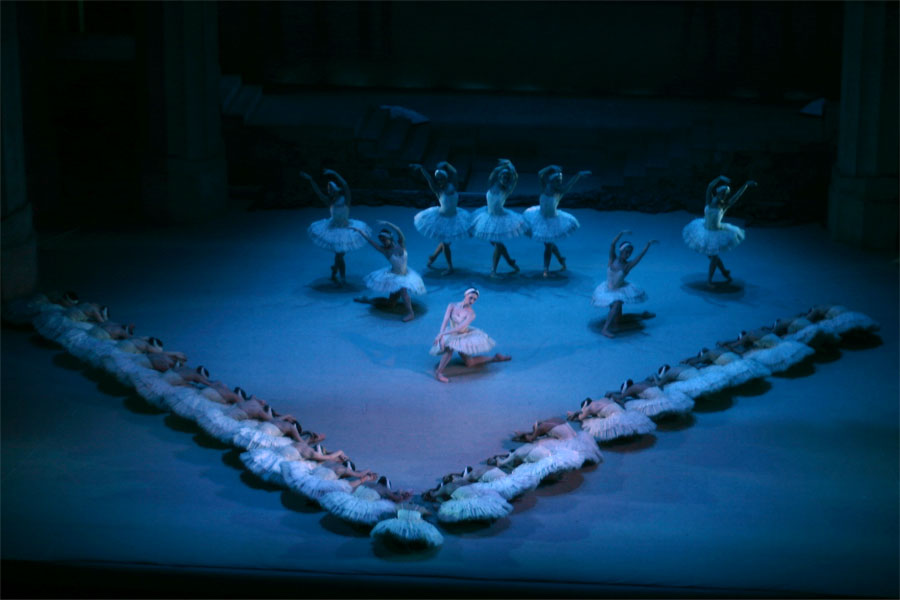 Swan LakeBallet · 1877Petipa · video
 The NutcrackerBallet · 1892Petipa · video
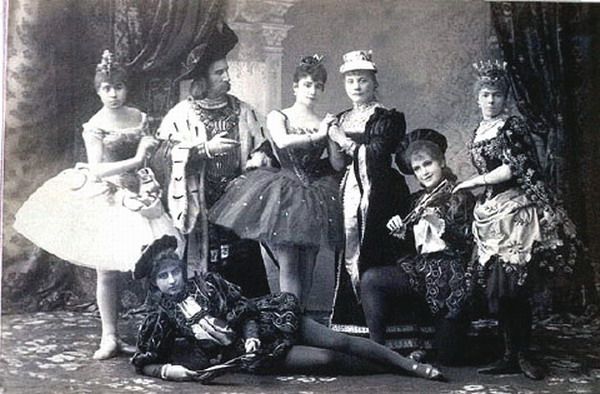 The Sleeping BeautyBallet · 1890Petipa · video
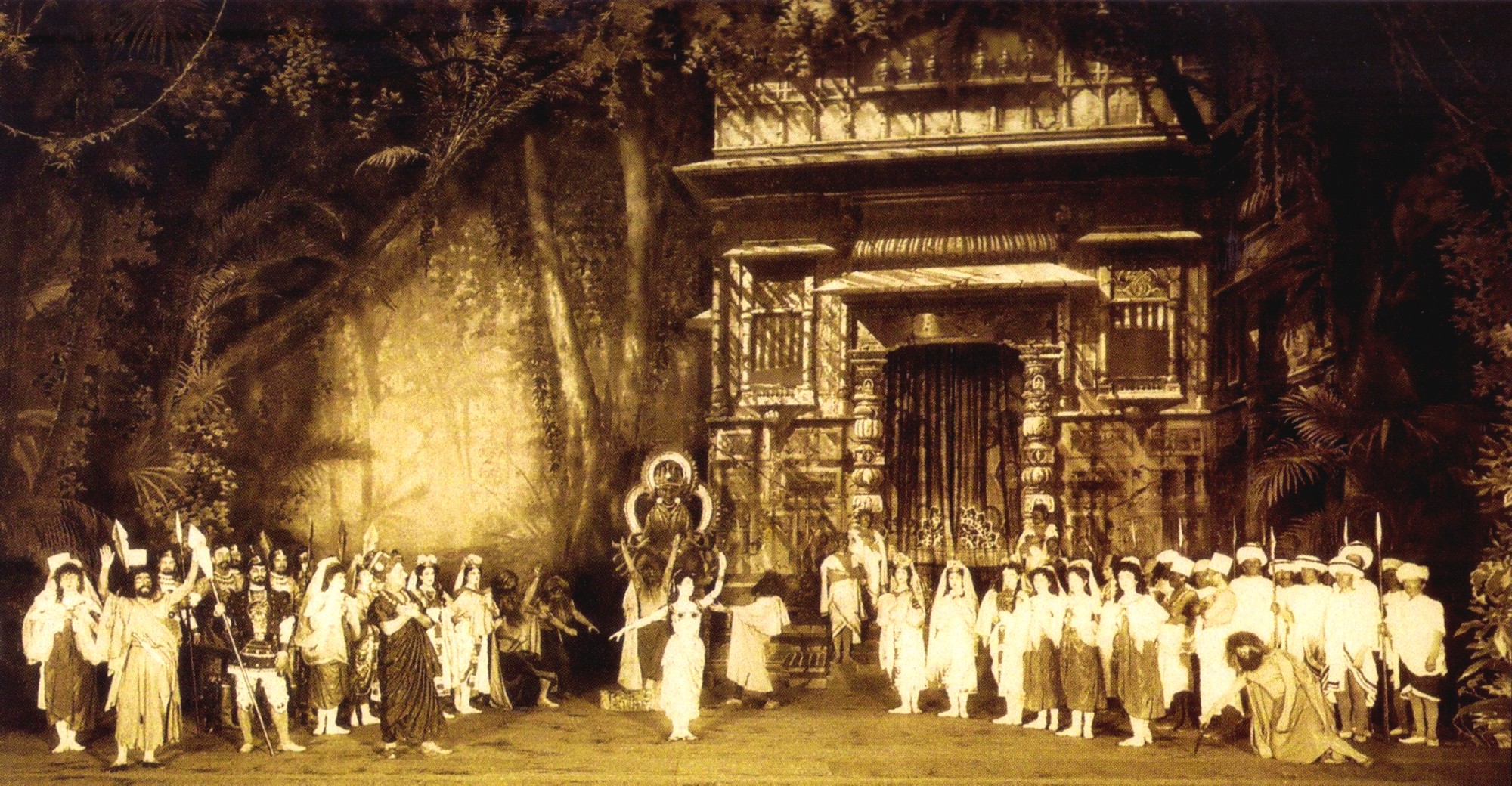 La BayadèreBallet · 1877Petipa · video
 Don QuixoteBallet · 1869Petipa · video
 RaymondaBallet · 1898Petipa · video
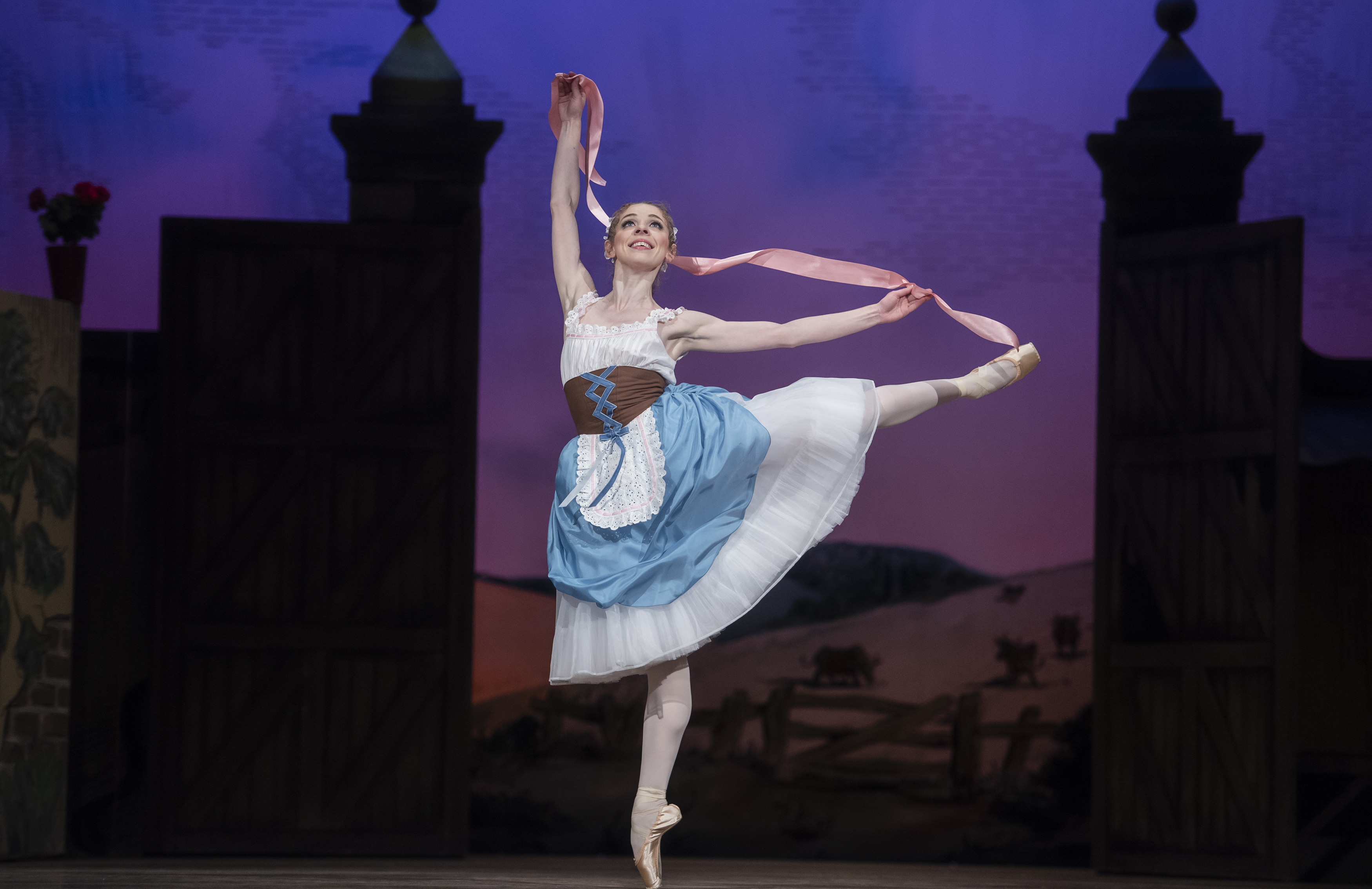 La fille mal gardéeBallet · 1960Same lineage · video
 The Whims of the ButterflyBallet · 1889Petipa