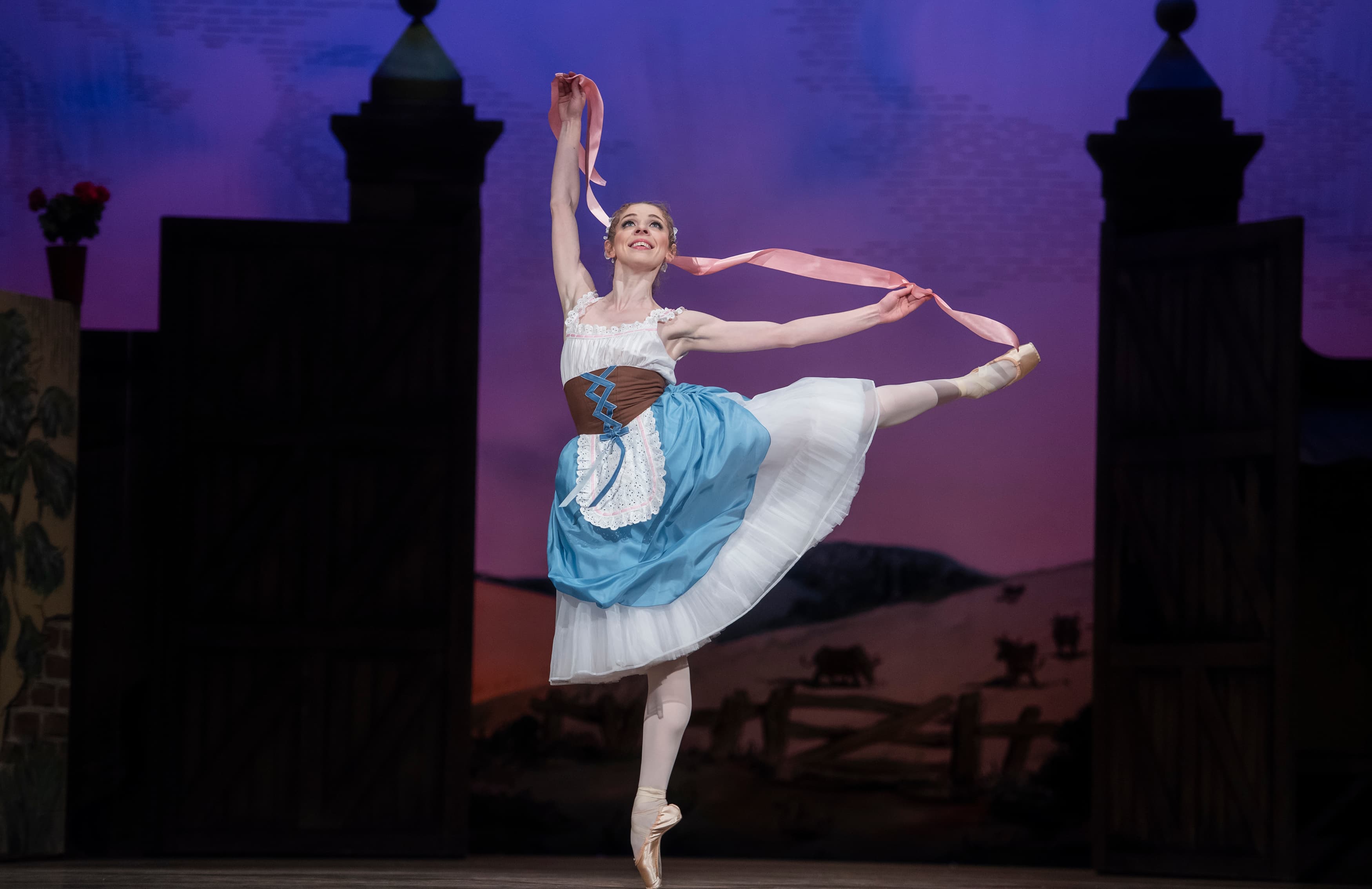
Sergej Gherciu · CC BY-SA 4.0
Frederick Ashton's La fille mal gardée is a two-act comic ballet made for the Royal Ballet, premiered at the company's home stage on 28 January 1960 with Nadia Nerina and David Blair as the young lovers Lise and Colas, and Stanley Holden as the Widow Simone. It reworks a ballet subject that goes back to 1789 (with a well-known 1828 score by Ferdinand Hérold and a rival 1864 score by Peter Ludwig Hertel used in most 19th- and 20th-century revivals), but Ashton and the conductor-composer John Lanchbery effectively built a new score around Hérold's music, borrowed passages from the original 1789 pastiche, and added new numbers by Lanchbery himself.
What it contains
- Classical Ballet · Whole ballet, across both acts — A full-length narrative comic ballet built from classical pas de deux, corps de ballet ensembles, mimed narrative passages inherited from Imperial Ballet practice, and named virtuoso set-pieces (ribbon dance, grand adage) in classical technique. Source: "Ashton created what is considered to be among his most masterful choreography for his new version of La fille mal gardée."
- Clog — No.17a Clog Dance · Act I, the Clog Dance (No.17a) for Widow Simone and four dancers — Simone and four dancers perform in wooden clogs, whirling through steps that are executed sur la pointe while wearing the clogs, directly modelled on a Lancashire clog dancing performance. Source: "She puts them on and whirls into one of Ashton's most celebrated numbers, which also features the dancers using the clogs to perform sur la pointe (on their toes)."
What is danced
The ballet is built around a run of set-piece numbers rather than continuous abstract dancing: a Pas de Ruban for Lise and Colas involving intricate tricks with a length of pink satin ribbon; a Maypole Dance for the corps; a mimed sequence, 'When I'm Married', inherited from Petipa's Imperial Ballet productions via Karsavina and Gerdt, in which Lise pantomimes married domestic life; and the Fanny Elssler pas de deux, described as a grand adage for Lise and Colas with eight women each carrying a ribbon, an expansion of the ribbon motif into a formal classical set-piece. The Widow Simone role is traditionally taken by a male dancer, and her comic Clog Dance — inspired by a real performance of Lancashire clog dancers Ashton took Lanchbery to see — has the character and four other dancers wearing clogs while performing sur la pointe, a deliberate collision of a vernacular percussive dance and pointe technique.
Context
Ashton made this staging in 1959–60 as artistic decisions about a much older ballet subject: rather than default to Hertel's 1864 score, standard in most revivals since the 19th century, he was steered by the musicologist Ivor Guest toward Hérold's 1828 score, and then had Lanchbery rebuild it into something close to a new commissioned score, reaching back further still to the original 1789 pastiche material. The production is widely credited with displacing the Petipa/Ivanov/Gorsky lineage as the standard version of the ballet performed internationally, even though the famous 'La Fille mal gardée pas de deux' drawn from that earlier lineage has survived independently as a competition and gala showpiece.
Staging history
Alexander Grant, the original Alain, inherited the staging rights after Ashton's death and later supervised productions himself, including the role passing to his brother Garry Grant in a 1981 Royal Ballet cast, and a 2007 Paris Opéra Ballet staging at the Palais Garnier. The article also names further major restagings at the Bolshoi Ballet (2002) and American Ballet Theatre (2004), and a first Ukrainian performance by the National Opera of Ukraine in June 2025 following an initiative by Ivan Putrov. The BBC filmed it for television in 1962 with the original cast under a Royal Ballet contract, and further filmed recordings exist from 1984 (Lesley Collier and Michael Coleman) and 2005 (Marianela Núñez and Carlos Acosta), both released on DVD.
How to watch it
Watch for the ribbon work between Lise and Colas as a recurring motif that returns, transformed, in the eight-woman Fanny Elssler pas de deux; and watch the Widow Simone, a comic role traditionally danced by a man en travesti, whose Clog Dance deliberately mixes clog percussion with pointe technique. The mimed 'When I'm Married' sequence is a direct inheritance from 19th-century Imperial Ballet performance practice, passed down through named teachers rather than notation, and is worth attending to as a piece of living performance history rather than free pantomime.
Structure
- Act I · No.3 Lise and the Ribbon – Pas de RubanLise and Colas dance together with a pink satin ribbon, using intricate tricks devised by Ashton.
- Act I · No.16 The Fanny Elssler Pas de deuxA grand adage for Lise, Colas and eight women each holding a ribbon, expanding the ribbon motif into a formal set-piece.
- Act I · No.17a Clog DanceLise tempts her mother, the Widow Simone, with a pair of clogs; Simone puts them on and dances with four other women, using the clogs to perform steps sur la pointe.
- Act I · No.18 Maypole DanceFarm workers dance a ribbon dance around a maypole during the harvest picnic scene.
- Act II · No.25 When I'm MarriedLise, locked in the house, mimes being married with many children; a mimed sequence Ashton took from Petipa's original staging via Karsavina and Gerdt.
Structure read from an encyclopaedia article, not from a libretto or score we hold. Confirm against a programme before treating the numbering as authoritative.
Credits
- composer: Ferdinand Hérold
More from Frederick Ashton
Other staged works in the register connected to this one by author or lineage.
 SylviaBallet · 1876Ashton · video
 Les PatineursBallet · 1937Ashton · video
 Symphonic VariationsBallet · 1946Ashton · video
 Marguerite and ArmandBallet · 1963Ashton · video
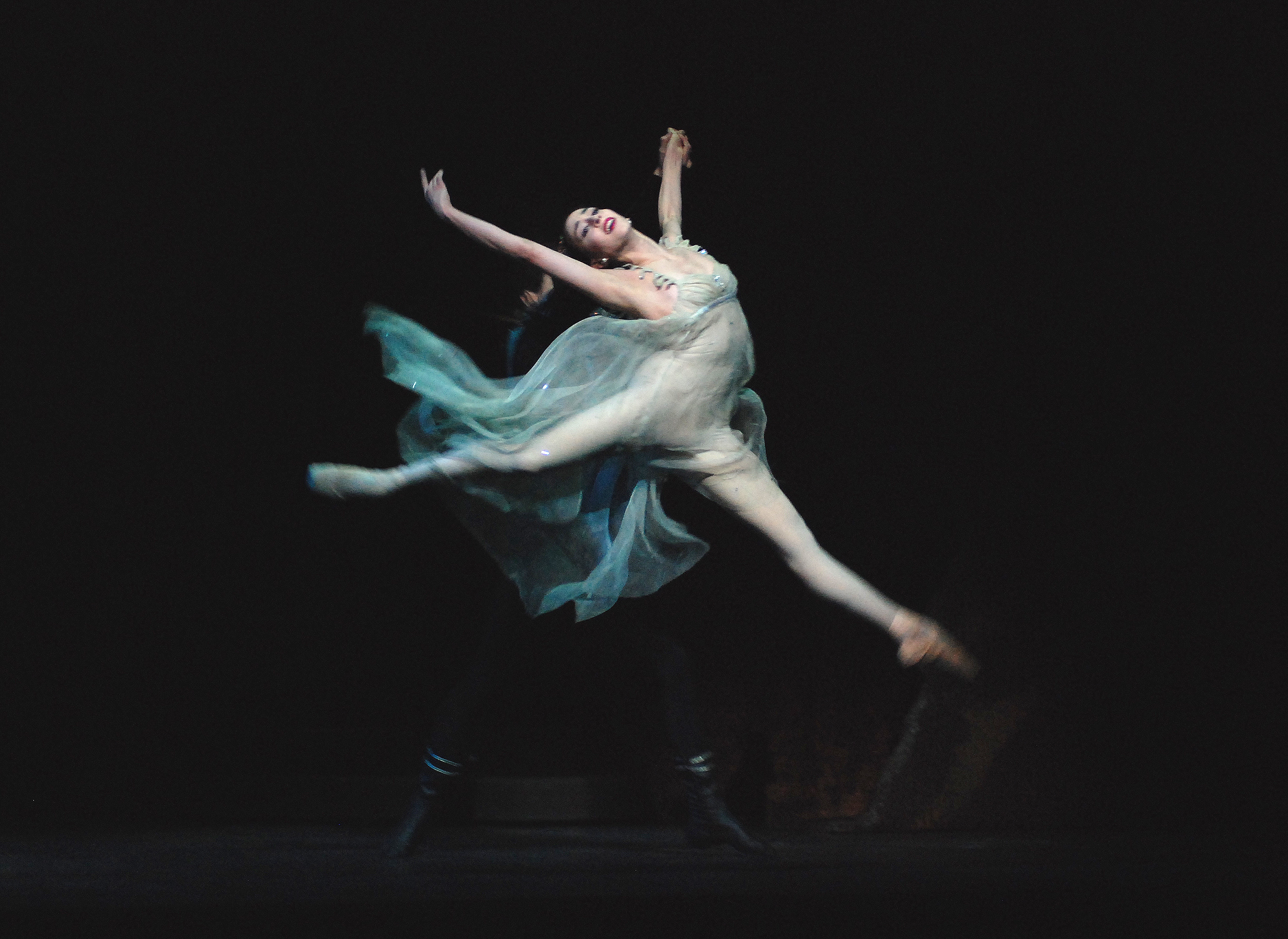 OndineBallet · 1958Ashton · video
 A Month in the CountryBallet · 1976Ashton · video
 MovesBallet · 1959Same lineage · video
 Western SymphonyBallet · 1954Same lineage · video