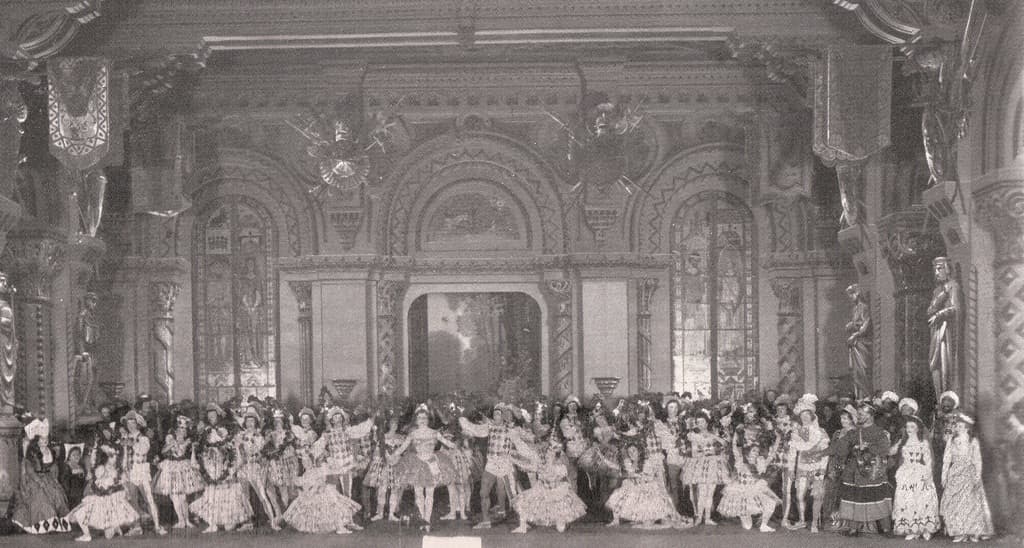
Unknown photographer of the Imperial Mariinsky Theatre. St. Petersburg, Russian Empire. — Мариус Петипа. Материалы. Воспоминания. Статьи, Л., 1971. ("Marius Petipa. Materials, Recollections, Articles"). · Public domain
Raymonda is Marius Petipa's last full-length grand ballet, made to a specially commissioned score by Alexander Glazunov (his Op. 57) and a libretto by Countess Lydia Pashkova. It was created for a benefit performance for the prima ballerina Pierina Legnani and given its first performance by the Imperial Ballet at the Mariinsky Theatre in St. Petersburg in January 1898, on a chivalric-Orientalist plot involving a crusader's bride, a Saracen suitor, and a supernatural protectress, the White Lady.
It sits in the catalogue as one of the last monuments of Petipa's Imperial-era classicism: a three-act, four-scene ballet built from the standard grand-ballet architecture of entrées, grand adages, solo variations and codas, capped by the Hungarian-style divertissement of Act III. Almost no company today performs Petipa's original choreography unaltered — the version in worldwide circulation descends from Konstantin Sergeyev's 1948 Kirov revival, which substantially rewrote the corps de ballet dances.
What it contains
- Classical Ballet — Le festival des noces · Act III, the Pas classique hongrois (Raymonda Pas de dix) — A self-contained classical grand pas — entrée, grand adage, a run of contrasting solo variations for named dancers, and a grande coda — frequently extracted and performed independently of the full ballet. Source: "Among the ballet's most celebrated passages is the Pas classique hongrois (a.k.a. Raymonda Pas de dix) from the third act, which is often performed independently."
- Mazurka — Le festival des noces · Act III, interpolated Mazurka in the Hungarian wedding divertissement — A stylised Mazurka number inserted into the Hungarian-themed wedding festivities, alongside the Palotás and Grand cortège hongrois. Source: "interpolation: Mazurka (Insertion from Glazunov's 1894 Scènes de Ballet, op. 52)"
What is danced
The ballet is structured, in the manner of Petipa's late grand ballets, around alternating scenes of mimed narrative and set numbers of formal classical dance: Pas d'ensemble, Grand pas d'action, Grand adage, named solo variations for principal dancers, and closing codas (see the Résumé of scenes and dances, e.g. No. 06 Pas d'ensemble with its Valse provençale, Pizzicato-Variation and Coda, or No. 22 Pas d'action with its string of named variations for Henriette, Clémence, Béranger and Raymonda). This is pointe-based Imperial classicism: soloist variations built to display virtuosity (the title role was made on Pierina Legnani, famous for the thirty-two fouettés), a grand pas de deux/pas d'action architecture, and a corps de ballet used for large-scale ensemble patterning.
Act I Scene 2 ("Visions") is a dream sequence — a Grand pas d'action with a Grand adage, multiple variations and a coda, plus a "Ronde des follets et des farfadets" (round of imps and elves) — the fantastical, vision-ballet convention Petipa used elsewhere (as in the Kingdom of the Shades). Act II is built around a "Grand divertissement" of character and national numbers — Pas des esclaves sarrasins, Pas des mariscos, Danse sarrasine, Panadéros, Les échansons, Bacchanale — danced by Abderakhman's retinue, distinct in idiom from the classical numbers surrounding Raymonda herself.
Act III is the ballet's most famous and most frequently extracted section: a Hungarian-styled wedding divertissement (Grand cortège hongrois, Rapsodie, Palotás, an interpolated Mazurka, and the Pas classique hongrois/Raymonda Pas de dix, itself built from Entrée, Grand adage, multiple solo variations for named dancers, and a Grande coda). The Pas classique hongrois is singled out in the article as "among Marius Petipa's supreme masterpieces" and is regularly staged on its own, separated from the full-length ballet, by companies including New York City Ballet, the Royal Ballet and American Ballet Theatre.
Context
Raymonda (1898) was made near the very end of Petipa's long tenure as Maître de Ballet of the Imperial Theatres, in the same late-Imperial idiom as The Sleeping Beauty and Swan Lake's 1895 revival — full-length, densely structured grand ballets combining mimed melodrama with extended suites of formal classical and national-character dance. Its Hungarian and 'Saracen' divertissements belong to the same convention of exoticised national-character interludes used throughout Petipa's output to diversify a long evening's classical vocabulary.
The work also became a key document for dance reconstruction: the original staging was recorded in 1905 in Stepanov notation and survives in Harvard's Sergeyev Collection, one of the few near-complete notational records of a Petipa-era Imperial Ballet production, later used by Sergei Vikharev to attempt a historically informed reconstruction for La Scala in 2011.
Staging history
The choreography now performed almost everywhere descends not from Petipa's 1898 original but from Konstantin Sergeyev's 1948 Kirov Ballet revival, which substantially altered and in places entirely replaced Petipa's corps de ballet dances; this Sergeyev text underlies Rudolf Nureyev's productions for American Ballet Theatre (1975) and the Paris Opéra Ballet (1983) and Anna-Marie Holmes's two-act reduction (Finnish National Ballet 2004, then ABT 2004 and Dutch National Ballet 2005). Other noted full-length revivals include Mikhail Fokine for the Ballets Russes (1909), Anna Pavlova for her touring company (1914), George Balanchine and Alexandra Danilova for Ballet Russe de Monte-Carlo (1946), and Yuri Grigorovich for the Bolshoi Ballet (1984).
The Pas classique hongrois/Pas de dix has an independent stage life as an extracted showpiece, restaged separately by Balanchine for New York City Ballet (1955, 1961, 1973), Nureyev for the Royal Ballet Touring Company (1964), and Baryshnikov for ABT (1980, 1987). In 2011 Sergei Vikharev used the 1905 Stepanov notation, made during rehearsals starring Olga Preobrajenskaya, to stage a reconstruction of the original Petipa production with restored 1898 décor and costumes for Teatro alla Scala; more recent reinventions have discarded the original plot entirely, including Stephen Baynes's 1950s Hollywood-set version for the Australian Ballet (2005) and Tamara Rojo's Crimean War version for English National Ballet (2022).
How to watch it
Watch for the shift in idiom between Raymonda's own classical variations (pointe-based, symmetrical, built for the ballerina Legnani's technical display) and the character-dance divertissements given to Abderakhman's retinue and the Hungarian wedding guests — these use different footwork, port de bras and shoes from the classical numbers around them. In the Act III Pas classique hongrois, look for the standard grand pas architecture of entrée, adagio, a run of contrasting solo variations, and a full-ensemble coda, since this sequence is the part most often performed as a standalone display piece outside the full ballet.
Structure
- Act I · Scene 1 · La fête de RaymondeAt Raymonda's name-day feast, a messenger announces her fiancé Jean de Brienne's imminent return; an uninvited Saracen knight, Abderakhman, arrives and falls for her; danced numbers include the Pas d'ensemble (Valse provençale, Pizzicato variation, coda) and solo variations for Raymonda.
- Act I · Scene 2 · VisionsIn a dream, the White Lady leads Raymonda through a vision of Jean de Brienne turning into Abderakhman, who tries to force his attentions on her; built as a Grand pas d'action (adage, waltz, variations, coda) with a 'Ronde des follets et des farfadets'.
- Act II · Cour d'amourAt the courtyard feast for Jean de Brienne's arrival, Abderakhman drugs the guests and tries to abduct Raymonda before being killed in a duel; features a Grand divertissement of national/character dances (Saracen slaves, Danse sarrasine, Panadéros, Bacchanale) alongside a Pas d'action with named variations for Henriette, Clémence, Béranger and Raymonda.
- Act III · Le festival des nocesRaymonda and Jean de Brienne's wedding, celebrated in Hungarian fashion with the Grand cortège hongrois, Palotás, an interpolated Mazurka, and the Pas classique hongrois (Raymonda Pas de dix), ending in a Galop général and Apotheosis.
Structure read from an encyclopaedia article, not from a libretto or score we hold. Confirm against a programme before treating the numbering as authoritative.
Credits
- composer: Alexander Glazunov
More from Marius Petipa
Other staged works in the register connected to this one by author or lineage.
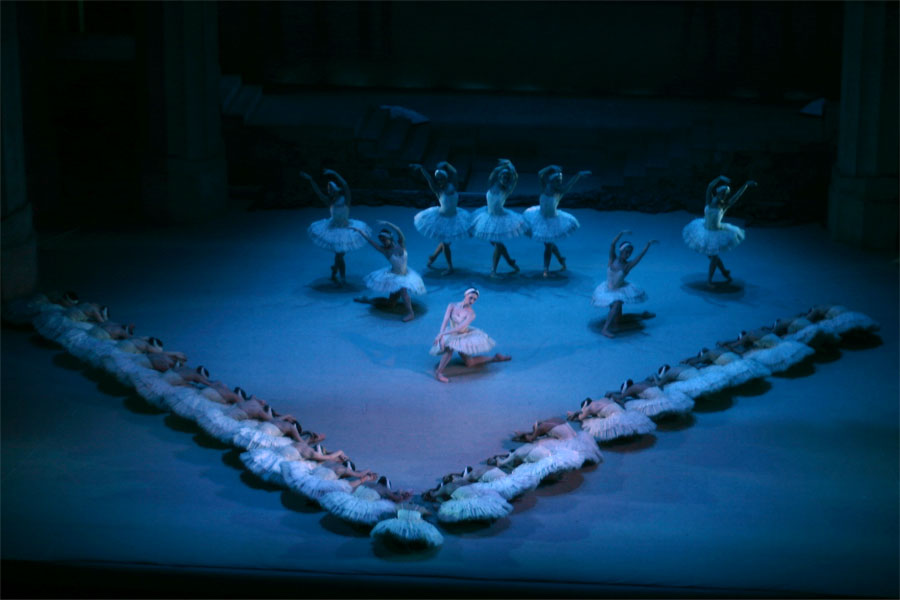 Swan LakeBallet · 1877Petipa · video
 The NutcrackerBallet · 1892Petipa · video
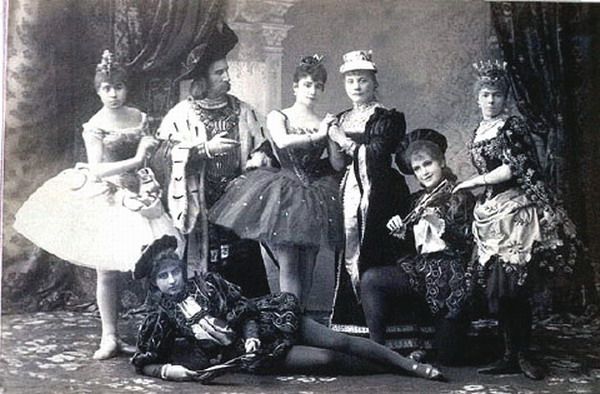 The Sleeping BeautyBallet · 1890Petipa · video
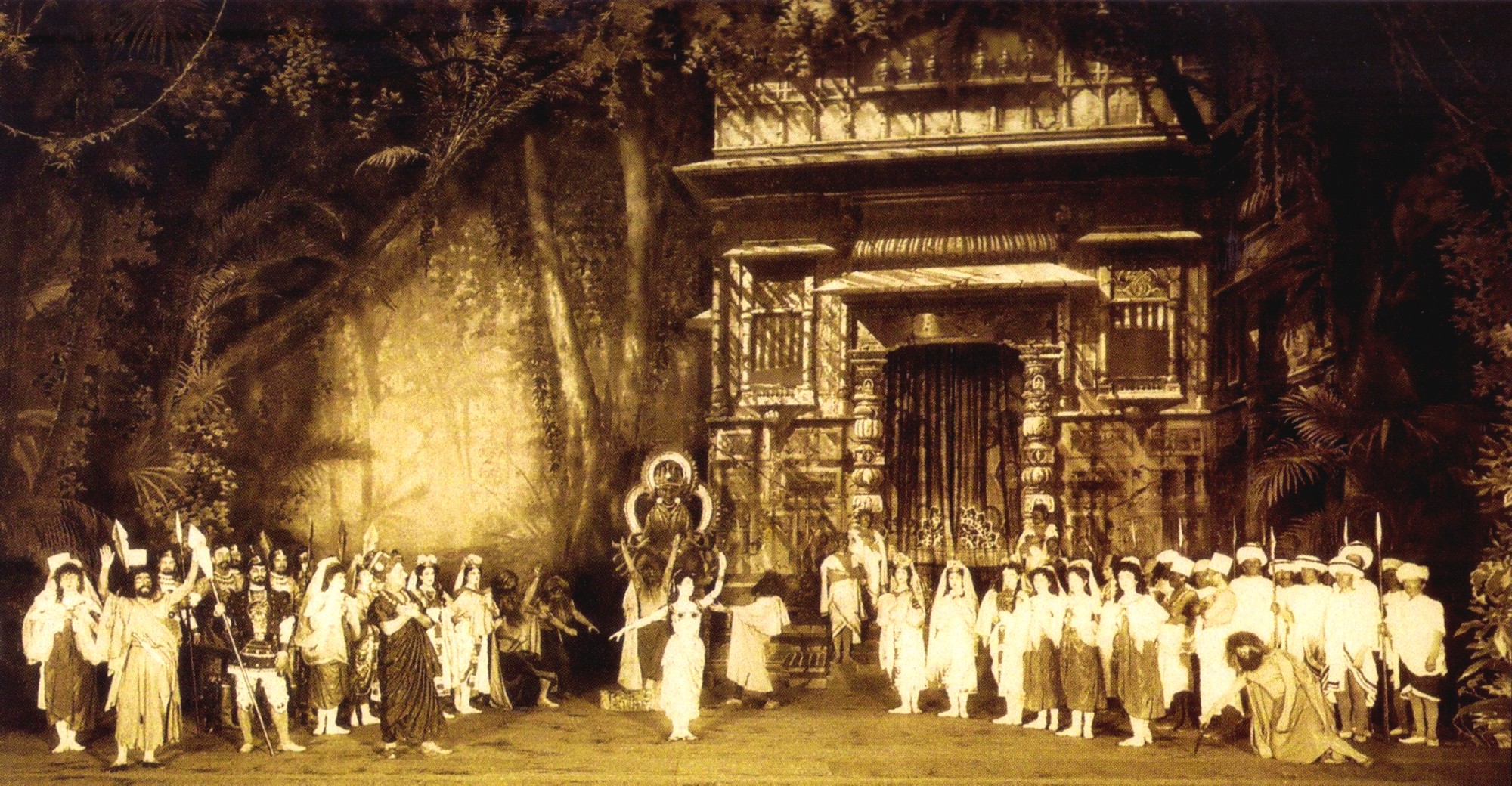 La BayadèreBallet · 1877Petipa · video
 Don QuixoteBallet · 1869Petipa · video
 PaquitaBallet · 1846Petipa · video
 Les RendezvousBallet · 1933Same lineage · video
 ZenobiaBallet · 1936Same lineage · video