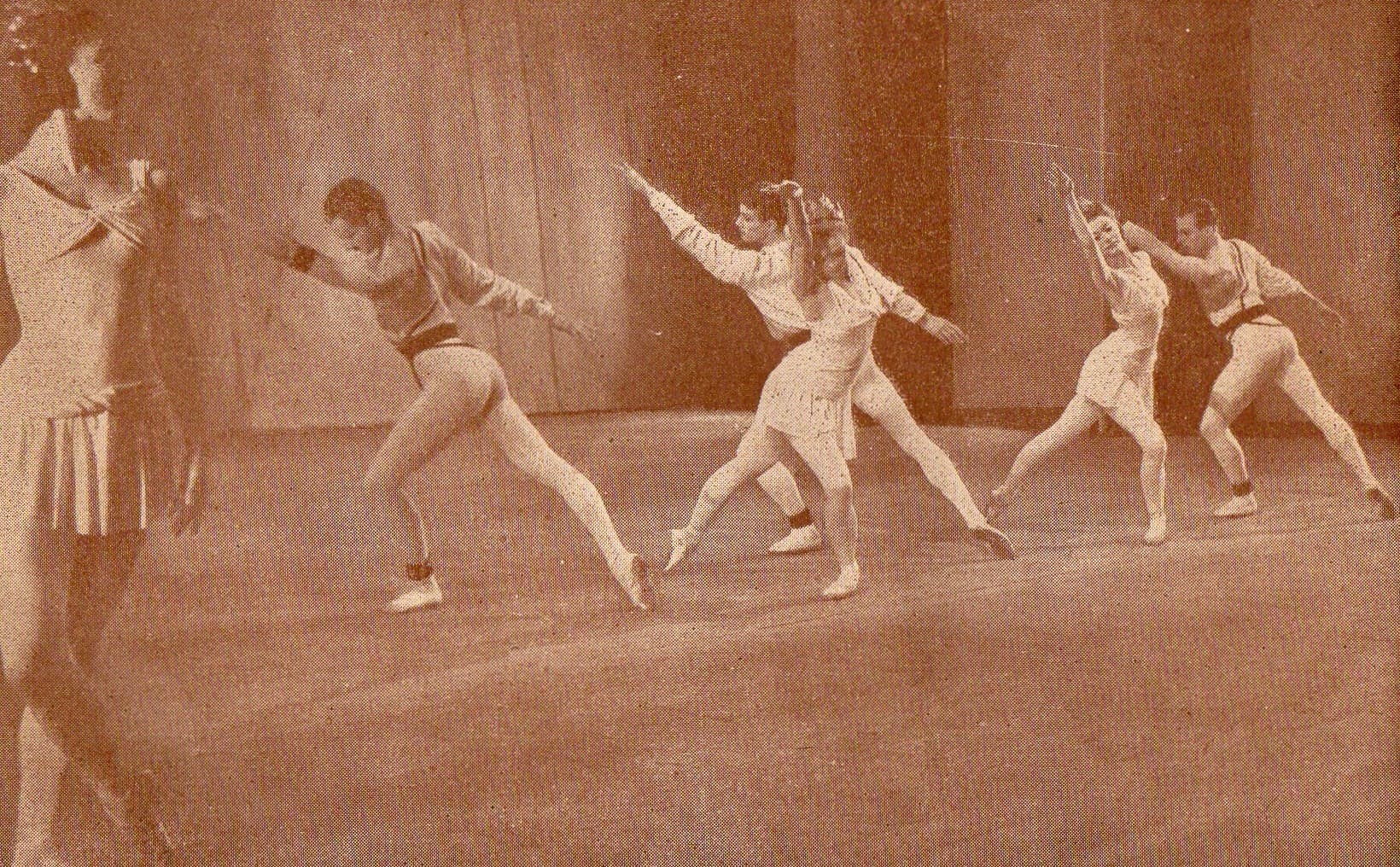
Symphonic Variations is a one-act, plotless ballet made by Frederick Ashton to César Franck's Symphonic Variations (M. 46), premiered by the Sadler's Wells Ballet at the Royal Opera House, Covent Garden, on 24 April 1946, on a triple bill with Ashton's own Les Patineurs and Robert Helpmann's Adam Zero. It uses only six dancers — three men and three women — against a bare, deep backcloth designed by Sophie Fedorovitch, with Constant Lambert conducting the premiere.
What it contains
- Neoclassical Ballet · the whole one-act ballet — Six dancers perform a plotless, abstract ballet built entirely around musical structure rather than mime or character; ensemble roles are near-equal rather than star-led, staged against a bare backcloth with no narrative or scenic 'effect'. Source: "Mr. Frederick Ashton has devised a ballet for six dancers without drama and without characterisation – a "pure" ballet, in which the interest is wholly concentrated upon the dance and its relation to the music."
What is danced
The ballet has no plot, place, character or story: six dancers work in continuous relation to Franck's score on an otherwise empty stage. A.V. Coton's contemporary description, quoted in the article, records the work opening on 'six immobile and minute dancers, clad all in white, with a little black relief here and there', a stillness that recurs at the close as 'the dancers sink into repose again'. The Times review is explicit about what is being danced: Ashton devised 'a ballet for six dancers without drama and without characterisation – a "pure" ballet, in which the interest is wholly concentrated upon the dance and its relation to the music' — i.e. structure, pattern and musical response replace mime, plot and character dancing.
The six roles are treated near-equally rather than as a ballerina-and-corps hierarchy: the Manchester Guardian's contemporary reservation was that the concertante piano writing in the score was 'not mirrored in a similarly prominent part for the prima ballerina', which tells us the choreography deliberately resists a conventional star-vehicle structure. Despite (or because of) this lack of overt display, dancers found the piece extremely demanding physically — Margaret Dale called it 'an absolute marathon' that was 'a test of sheer stamina that very few British dancers could stand at that time' — and in early performances the six principals danced nothing else on the same bill because of the toll it took.
The article gives no scene-by-scene or numbered structure to cite — there is no synopsis, since the work has none — so no internal sections can be listed beyond the work as a whole.
Context
Ashton made the ballet immediately after the Second World War, during which he had listened repeatedly to Franck's score and initially planned an elaborate narrative scenario for it; when Constant Lambert objected to using the music that way, Ashton discarded the plot and built an abstract piece instead. The article frames this as a deliberate reaction against the wartime Sadler's Wells repertory, which the company felt had become 'increasingly literary' — Ashton's aim, on this account, was 'to counteract this' by setting six dancers loose on the vast Covent Garden stage 'uncluttered with scenery and effect', rather than to display 'ingenuity of invention'.
Staging history
The Royal Ballet revived the work in November 1967 in a triple bill with Les Patineurs and Persephone, with a new cast (Merle Park, Ann Jenner, Jennifer Penny, Donald MacLeary, Graham Usher, Michael Coleman). It has since been toured by the Royal Ballet and Birmingham Royal Ballet, with productions in 1970 (Antoinette Sibley and Anthony Dowell) and 1992 (staged under Michael Somes' direction), and taken into the repertories of the Dutch National Ballet (1989), American Ballet Theatre (1992), the National Ballet of Canada (1996), San Francisco Ballet (2004) and The Australian Ballet (2015). The University of North Carolina School of the Arts performed it in 2018, described in the article as the only school ever to have staged the work.
How to watch it
Watch how the choreography returns repeatedly to stillness and tableau — the ballet opens and closes with the dancers motionless — and how the six roles stay in close formal relation to one another rather than resolving into a lead couple and supporting corps. Because there is no mime or narrative to follow, attention naturally shifts to geometry, timing against Franck's orchestral-and-piano score, and the sheer sustained control required across an unbroken, undramatized stage picture.
More from Frederick Ashton
Other staged works in the register connected to this one by author or lineage.
 SylviaBallet · 1876Ashton · video
 Les PatineursBallet · 1937Ashton · video
 Marguerite and ArmandBallet · 1963Ashton · video
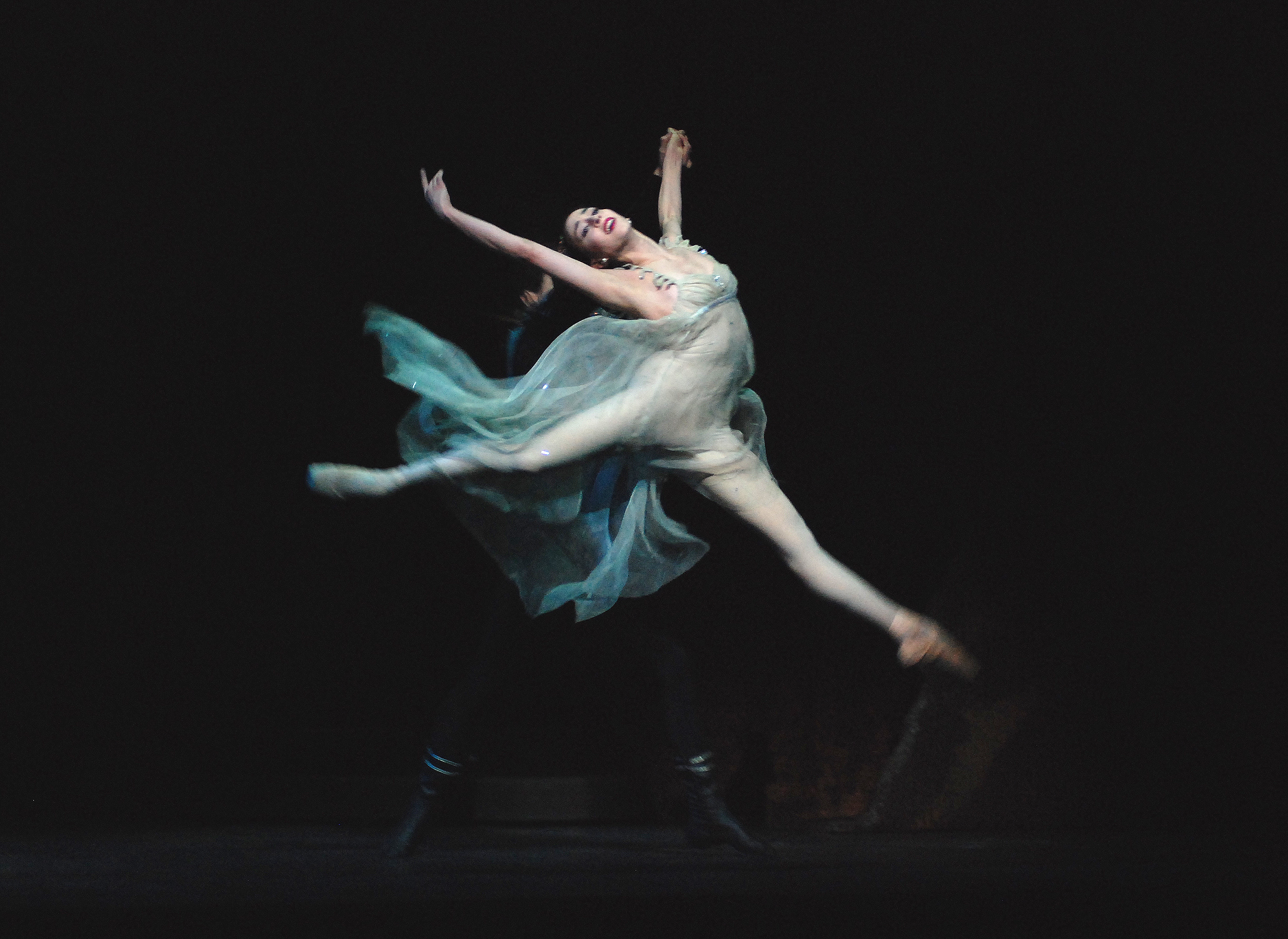 OndineBallet · 1958Ashton · video
 A Month in the CountryBallet · 1976Ashton · video
- A Tragedy of FashionA Tragedy of FashionBallet · 1926Ashton
- ÉlégieÉlégieBallet · 1948Same lineage
 Danses concertantesBallet · 1944Same lineage · video