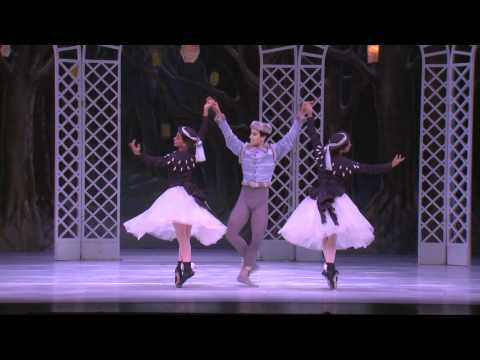
Les Patineurs is a one-act, plotless divertissement ballet made by Frederick Ashton for the Vic-Wells Ballet, premiered at Sadler's Wells Theatre, London, on 16 February 1937. It stages a Victorian ice-skating party — a frozen pond, a Chinese-lantern-lit set by William Chappell, snow falling at the close — using pure dance numbers (entrée, pas seul, pas de deux, pas de six and so on) rather than narrative, its patter of steps built to mimic the glide, spin and bravura tricks of real skaters in classical ballet vocabulary.
It belongs in this catalogue as one of the foundational works of the English classical repertoire: a deliberate showpiece Ashton built to demonstrate that the young British company could match the virtuosity London had just seen from Colonel de Basil's touring Ballets Russes, and a piece that has stayed continuously in the Royal Ballet's active repertory for most of a century.
What it contains
- Classical Ballet · The whole ballet, across all named divertissement numbers — Classical ballet steps and forms (entrée, pas de huit, pas seul, pas de deux, pas de trois, pas de six) reshaped to suggest ice-skating glides, spins and jumps; Ashton translated demonstrated skating movements into balletic vocabulary. Source: "Transforming them into balletic vocabulary, he set out to create a ballet that would reveal the virtuosity of the burgeoning English ballet and win the public's approval."
- Classical Ballet — Pas seul (Blue Boy) · Pas seul for the Blue Boy — A virtuoso solo built on turning and elevation for the technically strongest male dancer in the company, described as one of the hardest roles in the repertory. Source: "The Blue Boy is an exceptionally difficult role to perform, and the Blue Girls hardly less so."
- Classical Ballet — Entrée and pas de huit (Brown Couples) · Entrée and pas de huit for the Brown Couples, danced by the Brown Boys — Corps-level male dancing pitched at soloist difficulty, demanding sustained jumping elevation and stamina rather than standard corps de ballet material. Source: "the Brown Boys are given choreography more usually performed by soloists than members of the corps de ballet, as their bounding, buoyant dances require considerable elevation and stamina."
What is danced
The ballet has no story to carry, so its content is entirely the sequence of set numbers named in the article: entrée and pas de huit for the Brown Couples, a pas de patineurs for the Blue Girls and Brown Couples, a pas seul for the Blue Boy, a pas de deux for the White Couple, a full-ensemble section, a pas de trois, two separate pas de deux filles, a pas de six, and a closing finale for the whole cast. Each number is built as a display piece for a particular grouping — Brown Couples, Blue Girls, Red Girls, the solo Blue Boy, the central White Couple — rather than as illustration of plot, which is what makes this a divertissement ballet rather than a story ballet.
The vocabulary throughout is classical ballet vocabulary deliberately reshaped to suggest skating: gliding traveling steps, sustained turns, and repeated whirling spins (the ballet ends with the Blue Boy 'whirling like a top in the middle of the pond'), all danced on pointe/in classical technique rather than as literal skating mime. Ashton derived this from watching dancer Elizabeth Miller demonstrate real skating moves and tricks, then translated them into balletic steps and jumps. The Blue Boy's pas seul is the technical centrepiece — 'an exceptionally difficult role to perform' — built around virtuoso turning and elevation, while the Blue Girls' material is nearly as demanding. Unusually for a corps role, the four Brown Boys are given soloist-level choreography requiring 'considerable elevation and stamina,' meaning the piece makes technical demands well outside the usual corps/soloist hierarchy. The White Couple's pas de deux is the one moment of sustained lyrical partnering and adagio work amid an otherwise bravura, ensemble-driven structure.
Context
Les Patineurs was made in 1937 for the Vic-Wells Ballet, the company (under Ninette de Valois, with Constant Lambert as music director) that would become the Sadler's Wells Ballet and then the Royal Ballet — the formative years of a distinctively English classical style. Ashton created it explicitly to answer the technical spectacle London audiences had just seen from a visiting Ballets Russes company, using a compiled Meyerbeer score Lambert had assembled after finding a program for an 1849 Paul Taglioni skating ballet. De Valois had originally been slated to choreograph it; Ashton took it over after hearing Lambert play the score.
Staging history
The ballet was performed in London every season from 1937 to 1968 (bar 1960) by the Vic-Wells Ballet, the Sadler's Wells Ballet, and the Royal Ballet in succession, and by 2011 had had more than 350 performances at the Royal Opera House alone; touring companies took it around Britain from the 1950s into the 1980s. It has also been mounted in the United States, Canada, South Africa, Australia, New Zealand, Germany, France, and Turkey. A 1946 American Ballet Theatre production used new designs by Cecil Beaton in place of William Chappell's originals, a change the article notes was 'universally considered an unfortunate departure.' The most recent documented staging is a December 2010 Royal Ballet performance at Covent Garden, released on DVD by Opus Arte in 2011.
How to watch it
Watch the structure as a sequence of contrasting display numbers rather than a plot: each costume colour (brown, blue, red, white) identifies a distinct grouping with its own number, building to the ensemble finale. Pay attention to how the steps suggest skating — sustained gliding phrases, repeated spins, sudden held balances — without ever becoming literal skating mime, and note how much harder the Brown Boys' corps material is than typical corps choreography of the period.
Structure
- Entrée and pas de huit (Brown Couples)Opening number for the four Brown Couples.
- Pas de patineurs (Blue Girls and Brown Couples)Ensemble skating number combining the Blue Girls with the Brown Couples.
- Pas seul (Blue Boy)Solo virtuoso showpiece for the Blue Boy, the technical peak of the ballet.
- Pas de deux (White Couple)Romantic duet for the central White Couple, danced at the premiere by Fonteyn and Helpmann.
- Ensemble, de suite par groupeFull-cast ensemble section performed group by group.
- Pas de trois (Blue Boy and Blue Girls)Trio combining the Blue Boy with the two Blue Girls.
- Pas de deux filles (Red Girls)Duet for the two Red Girls.
- Pas de six (Brown Boys and Red Girls)Sextet combining the four Brown Boys with the Red Girls.
- Pas de deux filles (Blue Girls)Second girls' duet, this time for the Blue Girls.
- Finale (entire cast)Closing ensemble number for the full company; the ballet ends with the Blue Boy left alone, whirling as snow falls.
Structure read from an encyclopaedia article, not from a libretto or score we hold. Confirm against a programme before treating the numbering as authoritative.
Credits
- composer: Constant Lambert
- composer: Giacomo Meyerbeer
More from Frederick Ashton
Other staged works in the register connected to this one by author or lineage.
 SylviaBallet · 1876Ashton · video
 Symphonic VariationsBallet · 1946Ashton · video
 Marguerite and ArmandBallet · 1963Ashton · video
 OndineBallet · 1958Ashton · video
 A Month in the CountryBallet · 1976Ashton · video
- A Tragedy of FashionA Tragedy of FashionBallet · 1926Ashton
 The Whims of the ButterflyBallet · 1889Same lineage
 CinderellaBallet · 1893Same lineage