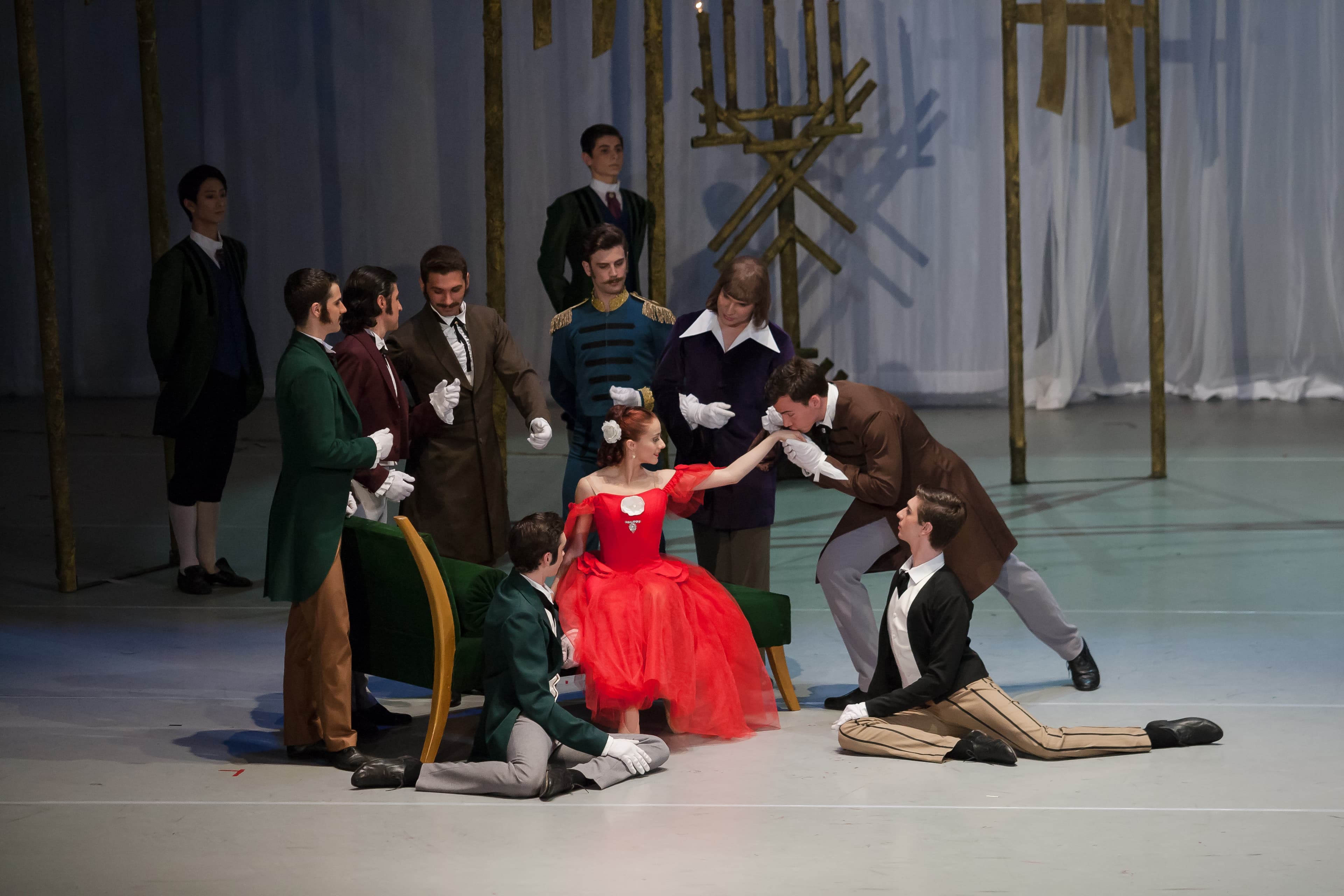
Cristina Dijmaru · CC BY-SA 4.0
Marguerite and Armand is a one-act narrative ballet made in 1963 by Frederick Ashton, built as a vehicle for the newly formed partnership of Rudolf Nureyev and Margot Fonteyn and danced to an orchestral arrangement of Liszt's B minor piano sonata. It compresses Alexandre Dumas fils's La Dame aux Camélias (also the source of Verdi's La traviata) into a single continuous span, told as a dying woman's flashback rather than as a conventional multi-act narrative.
What it contains
- Classical Ballet · The whole ballet, built as a single continuous flashback structure centred on the Marguerite–Armand duet — The work is organised around an extended dramatic pas de deux rather than ensemble or divertissement dancing; the flower-drop, necklace-tearing and final-embrace episodes are staged as danced confrontation and reconciliation between the two principals, and later revivals are referenced by the same central duet. Source: "Marguerite and Armand. Pas de deux by Tamara Rojo and Sergei Polunin"
What is danced
The article's plot summary describes the work almost entirely through dramatic incident rather than named steps: Marguerite tests Armand's devotion by dropping a flower for him to retrieve, Armand publicly humiliates her by tearing off the necklace given by her protector and throwing money at her, and the ballet closes with her death in his arms. These are staged as danced, mimed encounters rather than pantomime interludes, and the piece is structured around the central relationship rather than divertissements or corps set-pieces — the external references cited in the article single out 'Pas de deux' performances by later casts (Rojo/Polunin, Guillem/Le Riche) as the identifiable unit of the work.
Beyond confirming that the ballet is duet-centred and was made for a single principal pairing, the article gives no detail on lifts, pointe work, partnering holds or specific vocabulary, so a fuller technical picture cannot be drawn from this source alone.
Context
The ballet was created in 1963, early in the Fonteyn–Nureyev partnership, and later served as one of the vehicles for their joint farewell performances on Broadway. The article does not otherwise situate it within a broader movement in dance history, so no claim beyond what it states should be made.
Staging history
Originally created for Nureyev and Fonteyn, the ballet has since been revived for successive generations of partnerships, including Sylvie Guillem and Nicolas Le Riche, Zenaida Yanowsky and Roberto Bolle, Alessandra Ferri and Federico Bonelli, and Tamara Rojo and Sergei Polunin (Polunin also performed it opposite Svetlana Zakharova). In November 2015 The Sarasota Ballet became the first American company given permission to stage it, presented on a triple bill with MacMillan's Concerto and Peter Wright's Summertide; Victoria Hulland and Ricardo Graziano, and later Danielle Brown and Juan Gil, danced the leads, with Hulland and Graziano noted as the first American woman and Brazilian man to take the roles.
How to watch it
Watch the central pas de deux as the dramatic engine of the piece: the flower-drop, the necklace-tearing, and the final embrace are staged as danced action carrying the plot, not as mimed asides between dance numbers. Because the ballet compresses a whole love affair into a single continuous flashback structure, pacing and the emotional arc built across one unbroken sequence matter more here than any set-piece variation.
More from Frederick Ashton
Other staged works in the register connected to this one by author or lineage.
 SylviaBallet · 1876Ashton · video
 Les PatineursBallet · 1937Ashton · video
 Symphonic VariationsBallet · 1946Ashton · video
 OndineBallet · 1958Ashton · video
 A Month in the CountryBallet · 1976Ashton · video
- A Tragedy of FashionA Tragedy of FashionBallet · 1926Ashton
 Stars and StripesBallet · 1958Same lineage · video
 FaçadeBallet · 1931Ashton · video