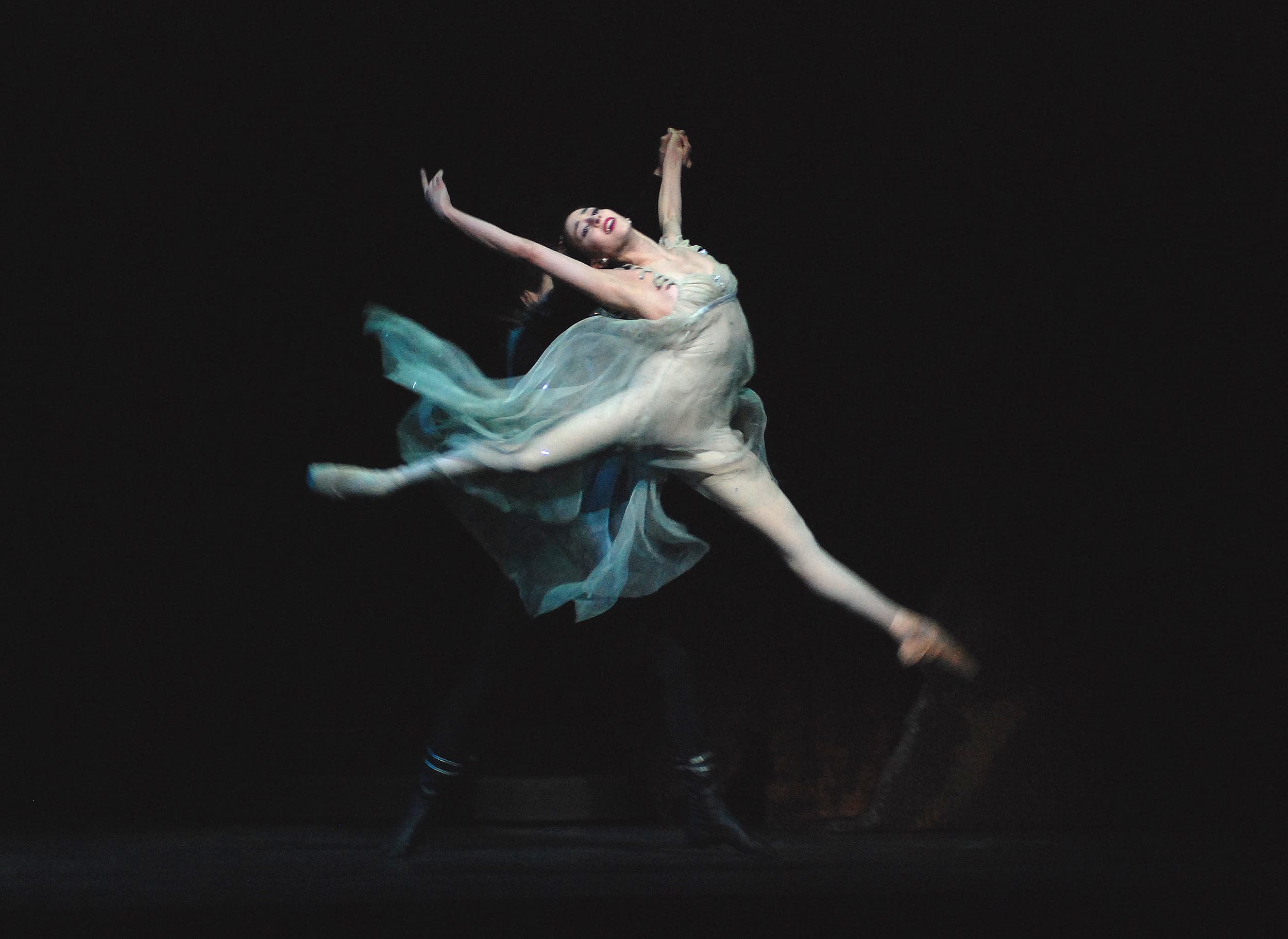
JRPHOTO · CC BY-SA 3.0
Ondine is a three-act narrative ballet made by Frederick Ashton for the Royal Ballet, premiered at the Royal Opera House, Covent Garden, on 27 October 1958, with a specially commissioned score by Hans Werner Henze (published separately as Undine). It adapts Friedrich de la Motte Fouqué's novella about a water nymph who marries a mortal, relocating the story from its northern-European origins to a Mediterranean, 'gothic-revival' setting devised by Ashton, Henze and designer Lila De Nobili.
It matters to the catalogue chiefly as the only full-length ballet Ashton choreographed to music written for it from scratch, and as a title role built entirely around Margot Fonteyn, whose performance dominated the work's reputation for its first eight years in repertory. Critics at the time argued about whether Henze's modernist score belonged in a ballet at all; the resulting friction between a Romantic plot, a mid-20th-century score, and Ashton's classically rooted but structurally unconventional choreography is a large part of why the work is still discussed.
What it contains
- Classical Ballet · Throughout the ballet — Classical pointe vocabulary and partnering are used throughout but arranged as continuous, through-composed flow rather than in 19th-century numbered set pieces; group movement is built on undulating arm and body lines evoking underwater plant life and currents. Source: "The work uses classical ballet vocabulary, but the form varies a great deal from the 19th century classics."
- Classical Ballet — Divertissement · Act III, the wedding divertissement — The one conventional classical set-piece sequence in the ballet: pas de seize, pas de six, two pas de trois, a pas de dix-huit, a valse d'ensemble and a closing pas de deux, contrasting with the looser, flowing structure elsewhere. Source: "Ondine is not a classical construction with great set pieces (except for the wedding divertissement in the third act) or grand formal pas de deux, but a continuous, flowing narrative."
What is danced
Ashton described his aim as suggesting 'the ebb and flow of the sea' by removing the distinction between aria and recitative, so Ondine is through-composed: there are no built-in pauses for bows and, outside the third-act divertissement, few self-contained bravura variations. The article states plainly that 'the work uses classical ballet vocabulary, but the form varies a great deal from the 19th century classics' — pointe technique and classical partnering are present throughout, but arranged as continuous flowing narrative rather than the numbered set pieces of 19th-century full-length ballets. The dominant stage image is submarine: 'sinuous mass movements in which the undulation of arm and body suggested forests of sea plants stirring to unseen tides,' reinforced in the final tableau by corps ondines whose 'arms drifting like seaweed' evoke underwater currents.
Ondine's own vocabulary opens with her dancing 'in the cold air as we would in water' and then with her own shadow — a solo built on discovery and unfamiliar sensation rather than steps borrowed from convention — and closes with an act-three 'swimming' solo the article calls 'thin and transparent as watercolour.' The one substantial classical showcase is the wedding divertissement of Act III (pas de seize, pas de six, two pas de trois, a pas de dix-huit, a valse d'ensemble and a final pas de deux), described as the ballet's exception to its otherwise loose, non-set-piece construction. The role of Tirrenio, created for Alexander Grant, combined 'classical virtuosity' with pantomime characterisation and was singled out by contemporary critics as the most fully worked-out dancing in the piece.
Context
Ashton had originally intended to collaborate again with William Walton (his partner on The Quest, 1943) on a ballet for Fonteyn, considering Macbeth and then The Tempest before Fonteyn's resistance to both subjects and Walton's unavailability pushed the commission to Henze, on Walton's own recommendation. The result sat awkwardly between two eras: a Romantic narrative subject staged with 19th-century-style divertissement conventions, set to a score that mixed early German Romanticism with the Neoclassicism of Stravinsky and Ravel — a combination the article says made the music 'anathema to the avant-garde of the 1950s' while simultaneously alienating ballet critics used to more danceable scores.
The premiere reception split cleanly along this fault line: unanimous praise for Fonteyn, De Nobili's designs and the supporting mime-dance of Tirrenio, against widespread critical distaste for a score seen as unsuited to classical dancing ('little understanding of the needs of classical dancing,' one critic wrote). The ballet is presented in the article as an unusual case of a 20th-century full-length ballet score being taken seriously as concert music independent of the choreography it was written for.
Staging history
Ondine was effectively a vehicle piece: from 1958 until it left the Royal Ballet repertory in 1966, Fonteyn danced the title role in nearly every performance, with only occasional exceptions (Nadia Nerina, Svetlana Beriosova). It returned to the stage in 1988 at Anthony Dowell's instigation, with Maria Almeida becoming the first ballerina to dance Ondine outside a Fonteyn-era cast and Dowell himself reviving Palemon; the role of Palemon later passed to Jonathan Cope, and Ondine to Viviana Durante and, in the 2008/09 Royal Opera House season, to Tamara Rojo opposite Edward Watson. Ashton's choreography has had only one full production outside the Royal Ballet — Teatro alla Scala, Milan, in 2000 — a rarity the article attributes partly to the ballet's roughly 100-minute length.
Henze's score, separately, has been used by other choreographers for wholly different productions under the title Undine: Youri Vámos for Deutsche Oper Berlin (1987), Torsten Händler in Chemnitz, and a production staged regularly from 1989 by Semperoper Ballett Dresden, plus a 2009 Rostock staging. These are distinct choreographic works from Ashton's, sharing only the music.
How to watch it
Watch for the absence of conventional breaks: Ashton removes the usual pauses for applause and stitches the narrative into continuous, undulating group movement meant to read as water rather than as formal dance architecture. The Act III wedding divertissement is the one place classical set-piece structure (pas de seize, pas de six, grand valse, final pas de deux) reasserts itself, so it is worth comparing its formality against the looser vocabulary of the rest of the ballet. Tirrenio's role rewards attention as the ballet's other technical showcase, combining dancing with mime characterisation rather than pure virtuosity.
Structure
- Act IOndine emerges from a fountain and dances first with the sensation of cold air, then with her own shadow, before meeting and enchanting Palemon, who abandons Berta for her.
- Act IIAt sea during a storm raised by the vengeful ondines, Ondine is lost overboard; Palemon survives the shipwreck and, believing her dead, marries Berta.
- Act III · DivertissementA wedding divertissement (pas de seize, pas de six, pas de trois, valse d'ensemble) precedes Ondine's return; when she kisses the unfaithful Palemon he dies, and she carries his body into the sea forever, while Tirrenio wreaks destruction on the wedding guests.
Structure read from an encyclopaedia article, not from a libretto or score we hold. Confirm against a programme before treating the numbering as authoritative.
Credits
- composer: Hans Werner Henze
More from Frederick Ashton
Other staged works in the register connected to this one by author or lineage.
 SylviaBallet · 1876Ashton · video
 Les PatineursBallet · 1937Ashton · video
 Symphonic VariationsBallet · 1946Ashton · video
 Marguerite and ArmandBallet · 1963Ashton · video
 A Month in the CountryBallet · 1976Ashton · video
- A Tragedy of FashionA Tragedy of FashionBallet · 1926Ashton
 The White-haired GirlBallet · 1945Same lineage · video
 Allegro BrillanteBallet · 1956Same lineage · video