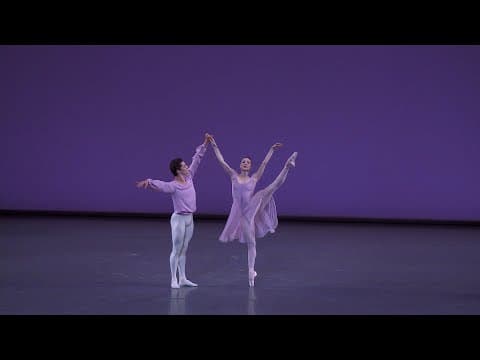
Piano Pieces (1981)
Piano Pieces is a plotless, ensemble-and-soloist ballet made by Jerome Robbins for New York City Ballet's 1981 Tchaikovsky Festival, using a selection of Tchaikovsky's piano works (including excerpts from The Seasons) rather than orchestral or ballet scores. It belongs to the wave of festival works commissioned by Balanchine that year, and sits alongside Robbins's other output for NYCB as a large-scale, structurally episodic piece built around a corps, seven principals, and a live pianist on stage.
What it contains
- Neoclassical Ballet — Solos and pas de deux · The solo and pas de deux block among the principal dancers — Described by a contemporary critic as advancing Robbins's partnering technique to 'a new peak', with dense, inventive pas de deux work for the seven leads Source: "Piano Pieces is a brilliant step forward in the art of the pas de deux."
- Neoclassical Ballet · The whole ballet: opening ensemble, central solo/pas de deux block, and full-cast finale — Structured as plotless festival ballet for corps, seven principals, and live piano, built from folk-inflected steps, comic jump sequences, and dense pas de deux partnering rather than a narrative Source: "The ballet starts with pieces for the ensemble, followed by solos and pas de deux performed by the principal dancers."
What is danced
The ballet is built in blocks: it opens with ensemble material for a corps of six couples, moves into a sequence of solos and pas de deux for the seven principal dancers, and closes with the full cast reassembled for a finale led by a male dancer. Critics described the vocabulary as drawing on 'playful Russian folk-dance moves, goofy sequences of jumps and a hint or two of competition,' set against Russian-style costuming for the whole cast, so the folk inflection is layered onto a classical ballet base rather than replacing it. Contemporary reviewers singled out the pas de deux writing specifically, with the New York Times calling it 'a brilliant step forward in the art of the pas de deux' for Robbins, suggesting the partnering work is denser or more inventive here than in comparable Robbins ensemble ballets. Beyond the general shape (ensemble, solo/duet block, ensemble finale) and the folk/competitive/jump vocabulary noted by critics, the article does not itemize specific steps, lifts, or formations, so a full step-by-step account cannot be built from it.
Context
The piece was made under specific pressure: Robbins has said he did not want to choreograph to Tchaikovsky and only did so because Balanchine, who conceived the festival, wanted him to; he ended up making three works for the event. This tension between reluctant obligation and eventual creative satisfaction is part of the ballet's own history, and Robbins reportedly found the process more rewarding than expected once rehearsals began, having abandoned an initial 'dancers rehearsing a ballet' framing in favor of a plotless celebration of dancing itself. The Tchaikovsky Festival itself was a major moment for NYCB, gathering multiple choreographers to respond to a single composer's catalogue in one season, and Piano Pieces is one data point in how differently Balanchine-era choreographers handled that brief compared to, e.g., Robbins's earlier Chopin-based Dances at a Gathering, to which contemporary critics explicitly compared it.
Staging history
The article documents only the 1981 festival run: after its initial performance(s), the ballet was brought back later in the same festival when injuries forced the cancellation of other scheduled works, indicating it was treated as a repertory-ready piece rather than a one-off festival novelty. No later revivals, company transfers, or restagings are described in the source.
How to watch it
Watch the shape rather than a story: ensemble patterning opens the work, narrows into a run of solos and pas de deux for the seven principals, then widens back out into a full-cast finale steered by one male dancer. Look for the folk-dance and jump vocabulary critics flagged as distinctly Robbins ('playful Russian folk-dance moves, goofy sequences of jumps and a hint or two of competition') threaded through what is otherwise a plotless, musically-driven festival showcase, and note the live piano rather than an orchestra pit.
Structure
- Ensemble openingThe ballet opens with pieces danced by the full corps of six couples.
- Solos and pas de deuxThe seven principal dancers perform a sequence of solos and pas de deux.
- FinaleThe full cast returns, with a male dancer leading the ensemble to close the ballet.
Structure read from an encyclopaedia article, not from a libretto or score we hold. Confirm against a programme before treating the numbering as authoritative.
Credits
- composer: Pyotr Ilyich Tchaikovsky
More from Pyotr Ilyich Tchaikovsky
Other staged works in the register connected to this one by author or lineage.
 Swan LakeBallet · 1877Music by Tchaikovsky · video
 The NutcrackerBallet · 1892Music by Tchaikovsky · video
 OneginBallet · 1965Music by Tchaikovsky · video
 JewelsBallet · 1967Music by Tchaikovsky · video
 SerenadeBallet · 1934Music by Tchaikovsky · video
 Danse des petits cygnesBallet · 1895Music by Tchaikovsky · video
 Stravinsky Violin ConcertoBallet · 1972Same lineage · video
 Kammermusik No. 2Ballet · 1978Same lineage · video