Five Brahms Waltzes in the Manner of Isadora Duncan (1975)
Choreography by Frederick Ashton
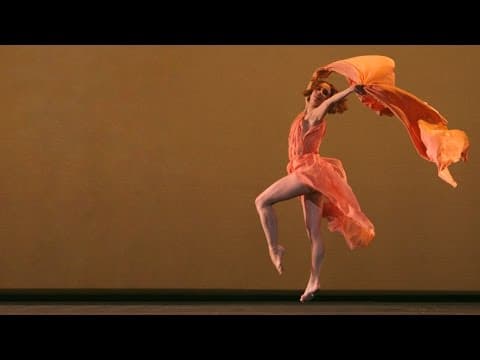
Five Brahms Waltzes in the Manner of Isadora Duncan is a solo choreographed by Frederick Ashton as a deliberate homage to Isadora Duncan, made for Lynn Seymour. It exists in two forms: a shorter piece titled Brahms Waltz, set to a single Brahms waltz and premiered in Hamburg in 1975, and an expanded five-waltz version premiered the following year at a Ballet Rambert anniversary gala, which is the version usually meant by the full title and is dedicated to Marie Rambert.
What is danced
The solo does not use classical ballet vocabulary. Ashton set out to evoke, rather than reconstruct, the effect Duncan had produced on him as a teenager watching her perform in 1921 - unpointed, flowing, personality-driven movement rather than turned-out, codified steps. He deliberately borrowed one piece of actual Duncan choreography: a 'petal dance' that opens the solo, in which the dancer runs forward scattering rose petals from her hands, matching what Ashton had seen Duncan do to a Brahms waltz decades earlier. The expanded version is structured musically as much as danced: Brahms' Waltz No. 1 is played as an instrumental prelude before the soloist even enters, and the dancing proper unfolds across Waltzes Nos. 2, 8, 10, 13 and 15, the last being the waltz used for the original petal dance.
Ashton worked from visual research rather than notation - photographs of Duncan by Arnold Genthe, watercolours by André Dunoyer de Segonzac and Abraham Walkowitz, and a surviving Duncan programme on which he marked the peachy-pink shade of her costume. The costume in performance (red wig, transparent pink chiffon) was built to match. This makes the piece a choreographic act of memory and portraiture as much as a set of steps, and a dancer taking it on is essentially required to channel a persona and an era rather than execute a ballet vocabulary.
Context
By the mid-1970s Ashton was working outside the daily choreographic pressures of running a company, and this solo belongs to a strand of his late career devoted to tribute and reminiscence rather than large narrative ballets. It was occasioned by two overlapping commemorative events - a Hamburg Ballet gala honouring Nijinsky (for whom Duncan was a major influence) in 1975, and Ballet Rambert's fiftieth-anniversary gala in 1976 - both contexts in which a piece explicitly reaching back to the early twentieth-century free-dance tradition made sense on the bill. It also marked Ashton and Seymour's first collaboration since The Two Pigeons in 1961, after Seymour's intervening period working closely with Kenneth MacMillan.
Staging history
The 1975 single-waltz version, Brahms Waltz, premiered at the Hamburg State Opera. The expanded five-waltz version premiered on 15 June 1976 at Sadler's Wells Theatre during Ballet Rambert's 50th anniversary gala, and is dedicated to Marie Rambert, who reportedly confirmed after an early viewing that it matched her memory of Duncan. The solo has since been revived by Rambert Dance Company, the Royal Ballet, Birmingham Royal Ballet, American Ballet Theatre, the Joffrey Ballet and the National Ballet of Canada, with Lynn Seymour herself staging some of these productions. A 1977 performance by Seymour was broadcast in the United States on PBS's Dance in America: Trailblazers of Modern Dance.
How to watch it
Watch for the opening petal-strewing run, which Ashton copied directly from what he saw Duncan do rather than invented; it is the one moment of literal quotation in an otherwise impressionistic piece. Notice that the movement avoids turnout, pointe work and ballet's usual geometry in favour of running, scattering and free arm and torso movement, in keeping with Duncan's own break from academic technique. The costume - loose pink chiffon and a red wig - and the use of Brahms waltzes (including an instrumental prelude before the dancer appears) are both direct references to specific, remembered details of Duncan's own performances.
Structure
- Waltz No. 1 (prelude)Brahms' Waltz No. 1 is played before the dancer enters, functioning as a musical prelude to the solo.
Structure read from an encyclopaedia article, not from a libretto or score we hold. Confirm against a programme before treating the numbering as authoritative.
More from Frederick Ashton
Other staged works in the register connected to this one by author or lineage.
 SylviaBallet · 1876Ashton · video
 Les PatineursBallet · 1937Ashton · video
 Symphonic VariationsBallet · 1946Ashton · video
 Marguerite and ArmandBallet · 1963Ashton · video
 OndineBallet · 1958Ashton · video
 A Month in the CountryBallet · 1976Ashton · video
 FaçadeBallet · 1931Ashton · video
 Les RendezvousBallet · 1933Ashton · video