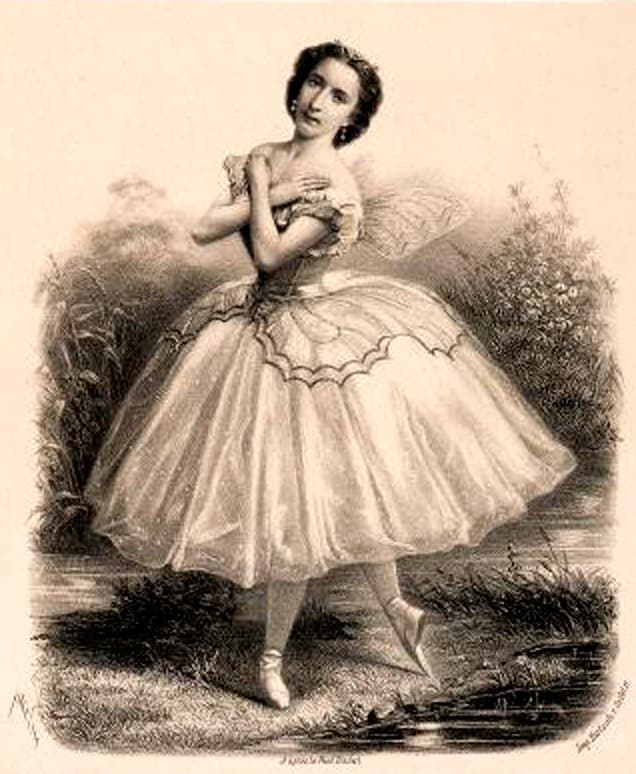
Jacotin (18.. - ?) — Bibliothèque nationale de France · Public domain
Le papillon is a two-act, four-scene 'fantastic ballet' first given by the Paris Opera Ballet at the Salle Le Peletier on 26 November 1860, with choreography credited to Marie Taglioni, a score by Jacques Offenbach, and a libretto by Jules-Henri Vernoy de Saint-Georges. It belongs in the catalogue as one of the very few full-length ballets Taglioni is credited with making herself, rather than dancing in, and as the only stand-alone ballet score Offenbach ever wrote — a work that sits at the hinge between the Paris Opera's Romantic repertory and its later Second Empire spectacle.
What it contains
- Mazurka · Act I, first tableau, at Hamza's castle during the hunting-rest scene — A partnered couple dance performed between Prince Djalma and Farfalla within the mimed narrative, immediately followed by a kiss of thanks and Hamza's jealous reaction that triggers the plot's first transformation Source: "The prince dances a mazurka with the maid and thanks her with a kiss."
What is danced
The article's synopsis is built almost entirely around pantomime and magical stage transformation — Hamza's crutch, the box that turns Farfalla into a butterfly, the net, the freezing spell, the burning wings, the final petrification into a statue — rather than named danced numbers. The one explicit piece of vocabulary the source gives is social/character rather than balletic: 'The prince dances a mazurka with the maid and thanks her with a kiss', placed in the opening tableau at Hamza's castle during the hunting-rest scene, danced by Prince Djalma and Farfalla before her transformation.
Beyond that, the article describes stage effects rather than steps: swarms of dancers as butterflies entering 'from doors, windows and even the chimney', a corps used for mass transformation tableaux, and a final scene built around 'a band of golden harps, and a torch carrier'. These are strong evidence of the ballet-blanc-adjacent staging convention typical of the period (dancers en masse as a natural/supernatural corps), but the article does not specify pointe work, mime codes, or partnering technique in enough detail to support further style claims.
A dancer approaching this work today would mostly encounter it at one remove, through later reconstructions: Pierre Lacotte's 1977/1982 version (built from 'contemporary critical accounts' rather than a surviving score of steps), Frederick Ashton's short 'Scène dansante' pas de deux drawn from the score, and Ronald Hynd's re-scenarioed, re-scored production for Houston Ballet and Sadler's Wells Royal Ballet. None of these reconstructions' actual choreographic vocabulary is described in the article beyond casting and provenance.
Context
1860 falls after the classic peak of the Romantic ballet era at the Paris Opera (usually dated to the 1830s–40s), and Taglioni — herself the era's defining ballerina — here appears in the unusual role of choreographer rather than performer. The 'fantastic ballet' genre label and the plot's chain of magical transformations (a servant girl turned butterfly, an old fairy made young by a stolen kiss, a final petrification) place the work squarely in the fairy-tale, supernatural-transformation tradition that had defined Romantic ballet staging.
Staging history
Offenbach's score outlived Taglioni's choreography: individual numbers were recycled by the composer himself (the Valse facile des rayons went into Die Rheinnixen in 1864 and a Bohémiana became a solo in Les Contes d'Hoffmann), and the Valse des rayons had a second life as a Moulin Rouge Apache dance and in the 1927 musical Show Boat. Marius Petipa staged an entirely separate version at the Imperial Ballet in St Petersburg in 1874, to a new score by Ludwig Minkus, after the Paris Opéra and Offenbach refused to license the original music to the Imperial Theatres. In the twentieth century the ballet was approached piecemeal: Elsa-Marianne von Rosen used the score for a new work, Utopia (Gothenburg, 1974); Frederick Ashton extracted a pas de deux, Scène dansante, for Merle Park and David Wall (Aldeburgh, 1975; Adelphi Theatre gala, 1977); Ronald Hynd made a re-scenarioed, re-orchestrated (by John Lanchbery) version for Houston Ballet (1979), also danced by PACT in Johannesburg and by Sadler's Wells Royal Ballet in Leeds (1980); and Pierre Lacotte reconstructed a full version, from critical accounts rather than notation, for Paris (1977, pas de deux) and the Rome Opera (1982, complete ballet).
How to watch it
Because the original steps are not preserved, most performances a viewer will encounter are one of several competing reconstructions or extractions rather than a single authoritative text — worth checking which version (Lacotte, Ashton, Hynd/Lanchbery, or Petipa/Minkus) is being given, since scenario, ordering of numbers, and even the score differ between them. Watch for the mime-driven transformation sequences (the box, the crutch, the net, the burning torch) that carry the plot, the corps used as a butterfly swarm, and the single named social dance, the mazurka Djalma dances with Farfalla before her first transformation.
Structure
- Act I · Scene 1At Hamza's castle, Prince Djalma and his hunting party arrive; he dances a mazurka with the servant girl Farfalla and kisses her hand, provoking the jealous fairy Hamza to transform Farfalla into a butterfly.
- Act I · Scene 2In a forest clearing the butterflies (including Farfalla) appear; Djalma pins one to a tree and it becomes the crying girl again; Hamza is frozen by her own stolen magic crutch and captured in a net.
- Act II · Scene 1At the Emir's palace, Farfalla is revealed as the Emir's daughter; Hamza steals a kiss meant for Farfalla and is rejuvenated, then in fury sends Djalma to sleep and turns Farfalla back into a butterfly.
- Act II · Scene 2 · Last tableau (gardens)Djalma wakes among a swarm of butterflies; Hamza and her sisters stage a mock wedding rehearsal with golden harps and a torch, Farfalla burns her wings and regains human form, Hamza is turned to stone, and the couple marry.
Structure read from an encyclopaedia article, not from a libretto or score we hold. Confirm against a programme before treating the numbering as authoritative.
Credits
- composer: Jacques Offenbach
More from Jacques Offenbach
Other staged works in the register connected to this one by author or lineage.
- Gaîté parisienneBallet · 1938Music by Offenbach · video
 Swan LakeBallet · 1877Same lineage · video
 CoppéliaBallet · 1870Same lineage · video
 RaymondaBallet · 1898Same lineage · video
 PaquitaBallet · 1846Same lineage · video
- La Boutique fantasqueBallet · 1926Same lineage · video
 L'Île EnchantéeBallet · 1864Same lineage
 NamounaBallet · 1882Same lineage · video

