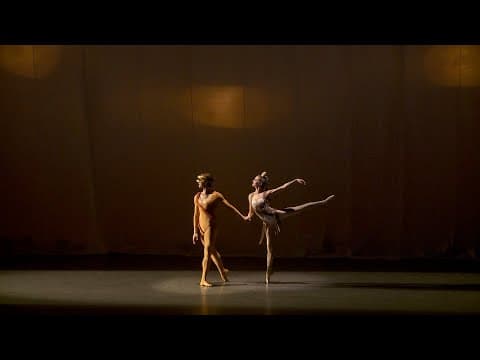
Orpheus is a thirty-minute neoclassical ballet in three tableaux, made by George Balanchine to a score Igor Stravinsky composed for the collaboration in 1947, with sets and costumes by Isamu Noguchi. It retells the myth of Orpheus's descent to the underworld to reclaim Eurydice, his loss of her a second time, and his death and apotheosis at the hands of the Bacchantes.
What it contains
- Neoclassical Ballet · The whole ballet, across all three tableaux — The ballet is built from named formal ballet set-pieces — Pas des furies, Pas d'action, Pas de deux, and a closing Apothéose — rather than continuous mime, the structural hallmark of Balanchine's neoclassical practice. Source: "Orpheus is a thirty-minute neoclassical ballet in three tableaux"
- Neoclassical Ballet · Tableau II, the central Pas de deux — A formal pas de deux for Orpheus and Eurydice set among named episodes (Pas des furies, Pas d'action, Interlude), the classical duet unit around which the tableau's action is structured. Source: "Pas d’action; Pas de deux; Interlude; Pas d’action."
What is danced
The article does not describe the choreography step by step, but it gives the ballet's formal skeleton: twelve numbered dance episodes across three tableaux, using the vocabulary of named classical set-pieces rather than free pantomime — a Pas des furies, a Pas d'action, a Pas de deux, and a closing Apothéose. This is the structural language of neoclassical ballet: duets, corps ensembles for the Furies and Bacchantes, and a large cast of thirty built around principal and character roles (Orpheus, Eurydice, the Dark Angel of Death, Apollo, leaders of the Furies and Bacchantes) surrounded by corps groupings of Lost Souls, Nature Spirits and attendant figures.
Context
Made in 1947 for the Ballet Society — the chamber-scale, subscription-based enterprise Balanchine ran with Lincoln Kirstein before either had a permanent company — Orpheus belongs to the postwar moment when Balanchine and Stravinsky were consolidating a stripped-down, musically driven classicism against the narrative and decorative excess of nineteenth-century ballet. Stravinsky's score matches that ambition: a chamber-sized 'neo-classical' orchestra with paired woodwinds, only two trombones, no tuba, and a single timpanist, built around a prominent harp part that stands in for Orpheus's lyre, in a lineage the article traces back through Gluck's Orfeo and Liszt's Orpheus.
Staging history
The premiere on April 28, 1948 at New York's City Center of Music and Drama had consequences beyond the performance itself: it prompted City Center's chairman, Morton Baum, to invite Balanchine and Kirstein to found a resident company, which became New York City Ballet. Orpheus, alongside Concerto Barocco and Symphony in C, opened that company's first program on October 11, 1948, conducted by Stravinsky himself, and Noguchi's design for Orpheus's lyre was subsequently adopted as City Ballet's official emblem.
How to watch it
Watch for the shift in scale and dynamics the article flags in the score — long stretches of quiet, chamber-like orchestration (the harp standing in for Orpheus's lyre) erupting into fortississimo only at the Bacchantes' dismemberment of Orpheus — and see how the choreography's formal units (Pas des furies, Pas d'action, Pas de deux, Apothéose) track that musical architecture rather than mime out the myth scene by scene. Noguchi's spare sets and the sculptural lyre prop are part of the same neoclassical economy as the choreography and score.
Structure
- Act IOrpheus mourns Eurydice; a dance episode follows before the Angel of Death appears, framed by episodes titled Orpheus Weeps for Eurydice, Air de Danse, Dance of the Angel of Death, and an Interlude.
- Act IIThe Furies confront Orpheus in a Pas des furies, followed by Airs de danse, a Pas d'action and a central Pas de deux (Orpheus and Eurydice), separated by an Interlude and closed by a second Pas d'action.
- Act III · Apothéose d'OrphéeThe ballet closes with the apotheosis of Orpheus.
Structure read from an encyclopaedia article, not from a libretto or score we hold. Confirm against a programme before treating the numbering as authoritative.
Credits
- composer: Igor Stravinsky
More from George Balanchine
Other staged works in the register connected to this one by author or lineage.
 CoppéliaBallet · 1870Balanchine · video
 ApolloBallet · 1928Balanchine · video
 AgonBallet · 1957Balanchine · video
 Le chant du rossignolBallet · 1920Balanchine · video
 The Prodigal SonBallet · 1929Balanchine · video
 The Seven Deadly SinsBallet · 1933Balanchine · video
 Union JackBallet · 1976Balanchine · video
 Raymonda VariationsBallet · 1961Balanchine · video