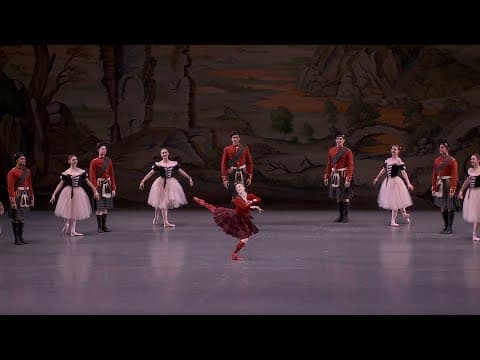
Scotch Symphony is a plotless three-movement ballet George Balanchine set to Mendelssohn's Symphony No. 3, "Scottish," made for New York City Ballet and first given on November 11, 1952 at the City Center of Music and Drama. It is a deliberate homage to the Romantic ballet era, staged as a Scottish-atmosphere piece in the lineage of La Sylphide, whose hero is himself a Highlander.
What it contains
- Classical Ballet — Third movement (finale) · Third movement finale — Lead couple perform a formal pas de deux and variations before soloists and corps de ballet join for a classical ensemble finale. Source: "the two lead dancers perform a pas de deux and variations, before the soloists and corps de ballet join them for the finale"
- Classical Ballet · Lead ballerina role, throughout — The central female role demands high classical technique disguised as lightness and grace rather than overt virtuosity. Source: "requires a high level of technique tempered by lightness, grace, and the quality of an otherworldly vision"
- Romantic Ballet · Throughout the ballet, most explicitly in the second-movement adagio — Steps, gestures and poses are deliberately allusive of the Romantic ballet era, with the ballerina role built as a light, otherworldly vision in the manner of La Sylphide's Sylph. Source: "evokes the style of the romantic ballet era, particularly La Sylphide"
- High Caul Cap — First movement · First movement ensemble, and general stylization of footwork throughout — Dancers work on pointe styled to suggest Scottish Highland dance carriage and footwork, wearing kilts, in a balletic evocation rather than literal folk technique. Source: "Balanchine asked the dancers to be on their toes to emulate Scottish highland dancing"
What is danced
The ballet unfolds in three movements danced to Mendelssohn's score with its first movement omitted by Balanchine as "not appropriate for dance." The opening movement is an ensemble section for a girl and a group of boys in kilts, built around a pas de trois and a solo for the girl. The second movement is a romantic adagio for the lead ballerina and her partner, explicitly conceived to evoke "the general mood and atmosphere of the romantic ballet as epitomized in such ballets as La Sylphide" -- light, floating, otherworldly partnering rather than bravura display. The third movement brings the lead couple back with the full ensemble for a pas de deux and variations, building to a finale that adds soloists and corps de ballet.
Technically, the lead ballerina role is described as demanding "a high level of technique tempered by lightness, grace, and the quality of an otherworldly vision," placing it closer to the Romantic-era Sylph type than to the brilliant, extroverted heroines of Balanchine's more overtly neoclassical works. Dancers were also asked to work on pointe in a manner meant to suggest Scottish Highland dance footwork and carriage -- a stylization rather than literal folk technique, but one that reportedly caused real strain ("terrible calf cramps and shin splints"), which tells you the demand was genuine and not merely decorative. Costuming reinforces the borrowed idiom: kilts for the men, designed by David Ffolkes, against Karinska's women's costumes evoking Romantic-ballet tulle.
Context
The ballet dates from 1952, mid-career for Balanchine at New York City Ballet, and follows directly from a real encounter: he attended the Edinburgh Military Tattoo and Highland dance and bagpipe performances while NYCB was touring Scotland, and decided on the spot to make a Scottish ballet. Rather than invent a Scottish-themed neoclassical showpiece, he chose to look backward, deliberately quoting the vocabulary and mood of the Romantic era and its Scottish-set founding work, La Sylphide -- an unusual move for a choreographer more associated with stripping ballet down to music and line.
Staging history
Beyond its 1952 NYCB premiere, the ballet became historically significant in 1989 when it was performed by the Kirov Ballet in St. Petersburg alongside Theme and Variations, marking the first Balanchine ballets staged there -- notable given Balanchine had trained and worked in that city before leaving for the West. It has also entered the repertories of San Francisco Ballet, Washington Ballet, Joffrey Ballet, Pennsylvania Ballet, Atlanta Ballet and Kansas City Ballet, and is performed by students of the School of American Ballet in its annual workshop.
How to watch it
Watch for the contrast between literal Scottish signifiers -- kilts, a corps evoking Highland dance footwork on pointe -- and pure Romantic-ballet convention in the central adagio, where the ballerina is meant to read as a Sylph-like vision rather than a virtuoso. The structure mirrors the symphony's three remaining movements exactly: ensemble and pas de trois, sustained pas de deux, then a cumulative finale that gathers soloists and corps around the leads.
Structure
- First movementAn ensemble section for a girl and boys in kilts, featuring a pas de trois and a solo for the girl.
- Second movement (adagio)A romantic adagio for the lead ballerina and her partner, evoking the mood of La Sylphide.
- Third movement (finale)The lead couple dance a pas de deux and variations, joined progressively by soloists and corps de ballet for the finale.
Structure read from an encyclopaedia article, not from a libretto or score we hold. Confirm against a programme before treating the numbering as authoritative.
Credits
- composer: Felix Mendelssohn
More from George Balanchine
Other staged works in the register connected to this one by author or lineage.
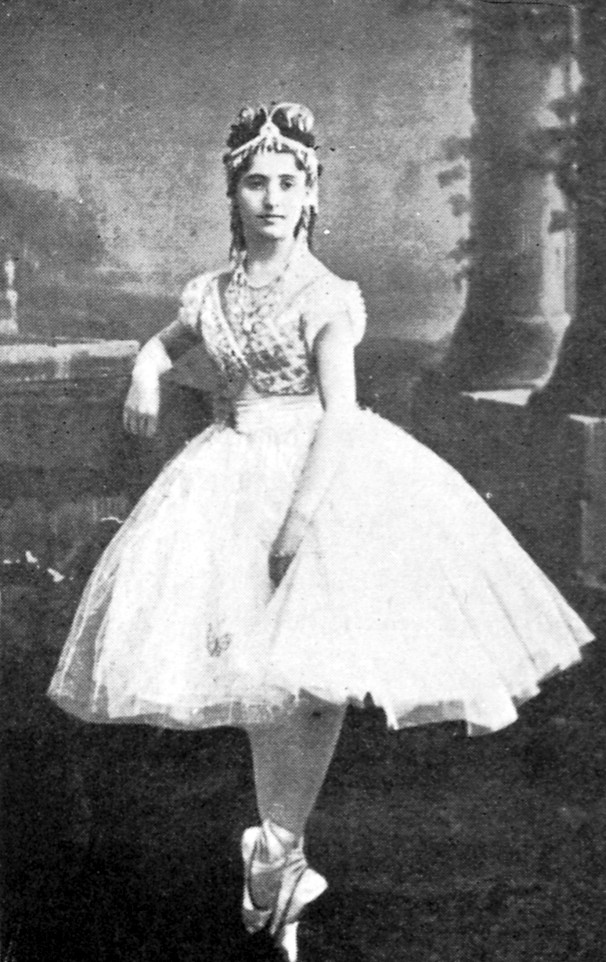 CoppéliaBallet · 1870Balanchine · video
 ApolloBallet · 1928Balanchine · video
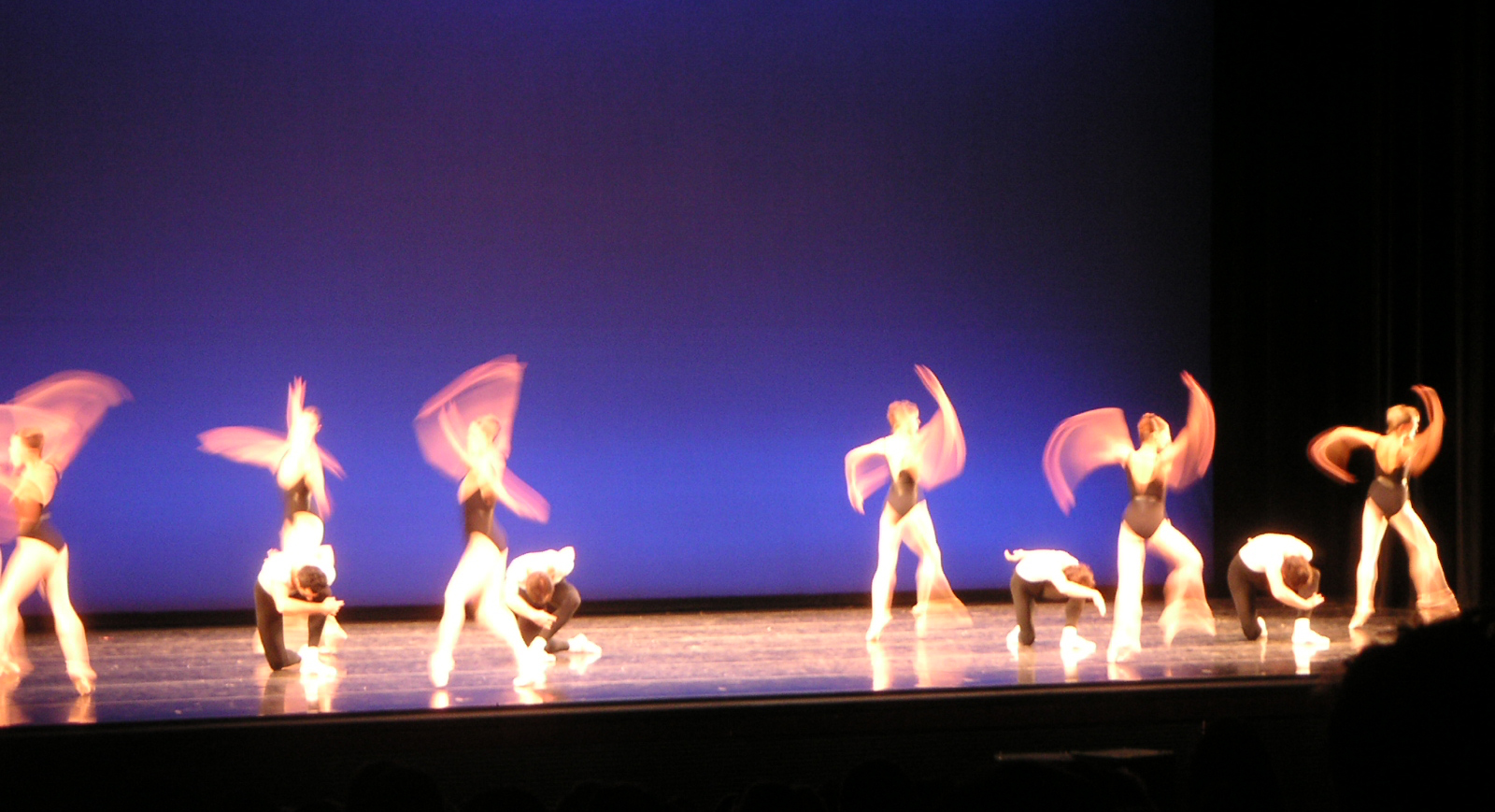 AgonBallet · 1957Balanchine · video
 Le chant du rossignolBallet · 1920Balanchine · video
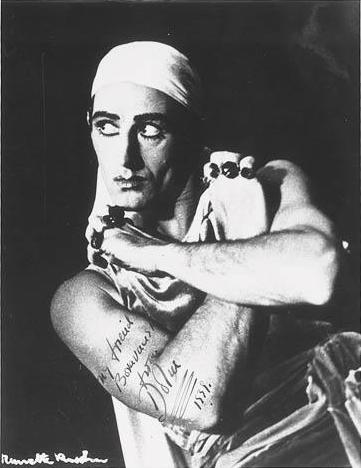 The Prodigal SonBallet · 1929Balanchine · video
 The Seven Deadly SinsBallet · 1933Balanchine · video
 The VestalBallet · 1888Same lineage
 NamounaBallet · 1882Same lineage · video