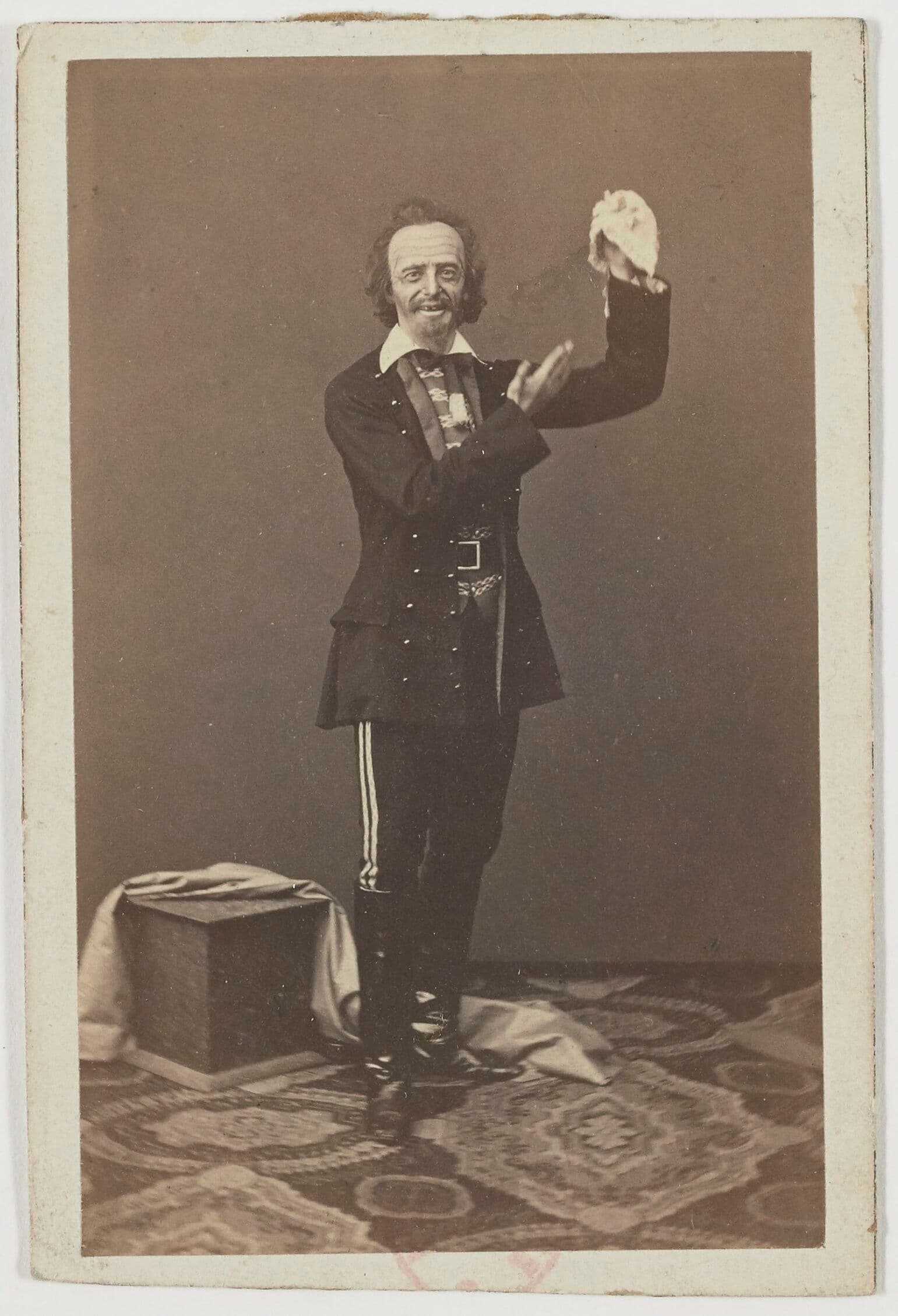
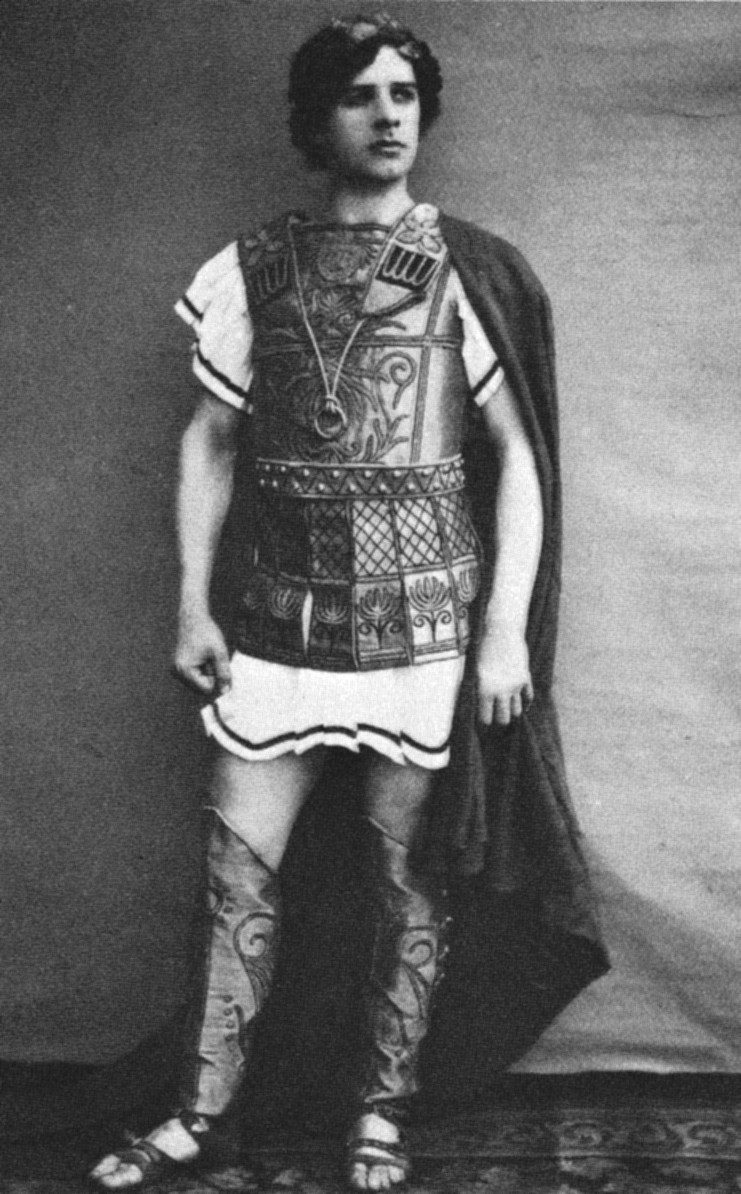
Bergamasco, Charles (1830-1896 ; photographe). Photographe — Bibliothèque nationale de France · Public domain
The Blue Dahlia (Le Dahlia bleu) is a two-act ballet made by Marius Petipa to a score by Cesare Pugni, first given by the Imperial Ballet on 12 May [30 April O.S.] 1860 at the Imperial Bolshoi Kamenny Theatre in St. Petersburg. Mariia Surovshchikova-Petipa, the choreographer's wife, danced the title role, with Timofei Stukolkin as Beausoleil.
What is danced
The source article gives production credits and revival history but no synopsis, act breakdown, or description of steps, so nothing about the actual choreography can be verified from it. It records only that Petipa reworked the first act in 1875 for the stage debut of his daughter, Marie Petipa, which tells us the ballet contained material substantial enough to serve as a showcase vehicle for a young dancer's debut, but not what that material was. Any claim about specific vocabulary (pointe work, mime passages, character dance interludes typical of Petipa-Pugni collaborations of this period) would be inference from the choreographer's known repertory rather than something this article states, so it is withheld here.
Context
The 1860 premiere places the work in the middle of Petipa's early career at the Imperial Ballet, before his major full-length successes of the 1870s–90s, and in a partnership with Cesare Pugni, the house's principal ballet composer through this period. It belongs to the era in which St. Petersburg's Imperial Theatres were consolidating the multi-act narrative ballet as their dominant form, with leading female dancers such as Surovshchikova-Petipa built into the choreographer's own household and casting.
Staging history
Petipa revised the ballet's first act in 1875 to launch his daughter Marie Petipa's career. It was later revived by Pavel Gerdt for the Imperial Ballet, given at the Imperial Mariinsky Theatre from 5–18 March 1905 with Lubov Egorova in the title role. Petipa himself disliked this 1905 Gerdt revival strongly enough to have his name struck from the program, a detail suggesting a substantial break between the original choreography and Gerdt's version.
How to watch it
Almost nothing about staging or choreography survives in the record used here, so there is no basis for guidance on what to watch for in the choreography itself; a viewer or researcher would need to consult sources on the Gerdt 1905 restaging or on Petipa's 1875 revision specifically.
Credits
- composer: Cesare Pugni
More from Marius Petipa
Other staged works in the register connected to this one by author or lineage.
 Swan LakeBallet · 1877Petipa · video
 The NutcrackerBallet · 1892Petipa · video
 The Sleeping BeautyBallet · 1890Petipa · video
 La BayadèreBallet · 1877Petipa · video
 Don QuixoteBallet · 1869Petipa · video
 RaymondaBallet · 1898Petipa · video
 The Whims of the ButterflyBallet · 1889Petipa
 The VestalBallet · 1888Petipa