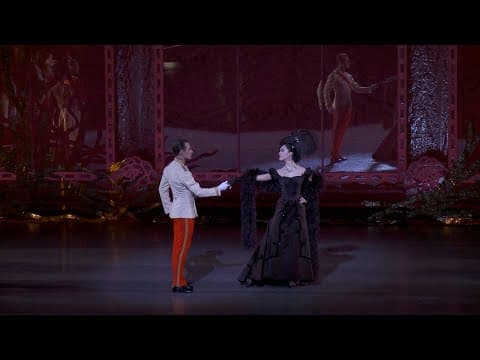
Vienna Waltzes is a five-part ballet Balanchine made for New York City Ballet in 1977, using waltzes and a polka by Johann Strauss II, Franz Lehár's Gold and Silver Waltz, and the opening waltz sequence from Richard Strauss's Der Rosenkavalier. Conceived as a large-scale homage to Austria on the model of his earlier Union Jack (a tribute to Britain), it was, by Balanchine's own description, the last ballet he made in this deliberately crowd-pleasing, celebratory mode, which he called an 'applause machine.'
What it contains
- Neoclassical Ballet · the whole ballet — A Balanchine-choreographed evening ballet built entirely from stylised social dance forms (waltz, polka) reworked into theatrical, plotless or lightly-plotted ensemble and pas de deux structures. Source: "Vienna Waltzes is a ballet choreographed by George Balanchine to music by Johann Strauss II, Franz Lehár and Richard Strauss, made as a tribute to Austria."
- Viennese Waltz · throughout, most explicitly in the woodland sections and the Der Rosenkavalier finale — Balanchine described the waltz partnering as technically demanding, with the woman turning around the man rather than the conventional reverse, running through the couple and corps waltzing of the whole ballet. Source: "Waltzing is very difficult... You cannot waltz if your body is not ready... The man doesn't turn around the girl, the girl turns around the man."
- Classical Ballet — Voices of Spring · Voices of Spring and Tales from the Vienna Woods sections — Corps de ballet formation dancing in pastel tutus alongside a lead couple, using classical ensemble grouping typical of a ballet corps. Source: "They dance with eight women in pastel tutus."
- Polka — Explosion Polka · the Explosion Polka section — A named polka section for a lead couple plus three couples in matching costume, danced to Strauss's polka score at a faster, syncopated tempo distinct from the surrounding waltz sections. Source: "It is followed by "Explosion Polka", Op. 43, led by what Gruen called "a couple of most unexpected appearance," with the woman in a corseted attire and the man in striped tights."
What is danced
The ballet moves through five self-contained sections, each set to a different score and each with its own cast, costume palette and setting, unified only by the underlying pulse of the Viennese waltz. The first three sections, set in a woodland of five specific trees, run through Tales from the Vienna Woods (a lead couple with a corps de ballet of ten couples), Voices of Spring (a couple dancing with eight women in pastel tutus, described as a 'sylvan interlude'), and the Explosion Polka, danced by a couple in eccentric costume (corseted attire for the woman, striped tights for the man) joined by three more couples in matching dress — the one section in the ballet built on a quick polka pulse rather than a waltz.
The fourth section, to Lehár's Gold and Silver Waltz, restages a Merry Widow-like operetta scene: the principal woman, dressed as a hostess/widow figure, is pursued by a suitor in an officer's dress. Balanchine reworked this section repeatedly after the premiere, suggesting it was the most choreographically unresolved part of the piece. The final section, to the Der Rosenkavalier waltz sequence, is essentially an extended solo for the woman in a white ballgown, with her partner functioning as an intermittent, 'somewhat absent' support who appears and disappears rather than partnering continuously — a notably reduced use of the male role that Farrell attributed to Balanchine having run short of available men. The ballet closes with the full company, including twenty additional couples, returning in the Rosenkavalier costumes for a grand finale.
The article does not describe specific steps, but it is explicit that Balanchine treated waltz technique itself as the technical core of the piece: he is quoted calling waltzing 'very difficult' because it depends on partnering in triple time, with the woman turning around the man rather than the reverse — a reversal of conventional waltz partnering that a dancer approaching this role should note.
Context
By the mid-1970s Balanchine had spent decades returning to 3/4 time and waltz vocabulary (Les Valses de Beethoven, La Valse, Valse Fantaisie, Liebeslieder Walzer, Trois Valses Romantiques), and Vienna Waltzes gathers that lineage into one large-scale, unabashedly popular evening-length statement, paired in his output with the earlier national tribute Union Jack. He himself framed it as a closing statement — his 'last word,' in Suzanne Farrell's phrase, 'on the survival of romanticism' — and the last ballet he made in this specific celebratory, large-cast style he privately called an 'applause machine.'
Staging history
The ballet premiered June 23, 1977 at the New York State Theater with New York City Ballet, after a preview a week earlier at which an injury forced a late cast change (Jorge Donn stepping in for the injured Jean-Pierre Bonnefous). It sold out every performance for four seasons and Farrell called it possibly NYCB's single most successful ballet at the box office; she performed it in her farewell performance in 1986. Following Balanchine's death, world rights to the work passed to original cast member Karin von Aroldingen. It has been filmed at least twice for PBS (1983, with much of the original cast, and the Der Rosenkavalier section alone in 1993 at Stephanie Saland's farewell), and NYCB released an archival full recording online in 2021 during the COVID-19 pandemic.
How to watch it
Watch how the waltz hold and turn are handled differently from ballroom convention — Balanchine specified that the woman turns around the man rather than the reverse — and compare the contrasting couple dynamics section by section, from full corps waltzing in the woodland scenes to the near-solo, intermittently partnered final movement. The shift in decor from woodland to Jugendstil-inflected 'salon' to an early-20th-century ballroom tracks the chronological ordering of the scores, so the sets themselves mark the ballet's historical progression through Strauss, Lehár and Richard Strauss.
Structure
- Scene 1 · Tales from the Vienna WoodsA woman in a pink gown and man in military uniform lead a corps de ballet of ten couples through a woodland of five trees.
- Scene 2 · Voices of SpringA couple in bucolic attire dance a 'sylvan interlude' joined by eight women in pastel tutus.
- Scene 3 · Explosion PolkaA couple in unusual costume (corseted attire, striped tights) dance with three more couples in matching dress.
- Scene 4 · Gold and Silver WaltzA Merry Widow-like scene in which a hostess figure in black is pursued by a suitor in red and white, set against Jugendstil-inspired decor.
- Scene 5 · Der Rosenkavalier waltz sequenceA woman in white dances an extended near-solo, her partner in black tailcoat appearing and disappearing; the ballet closes with the full company in matching costumes.
Structure read from an encyclopaedia article, not from a libretto or score we hold. Confirm against a programme before treating the numbering as authoritative.
Credits
- composer: Johann Strauss II
More from George Balanchine
Other staged works in the register connected to this one by author or lineage.
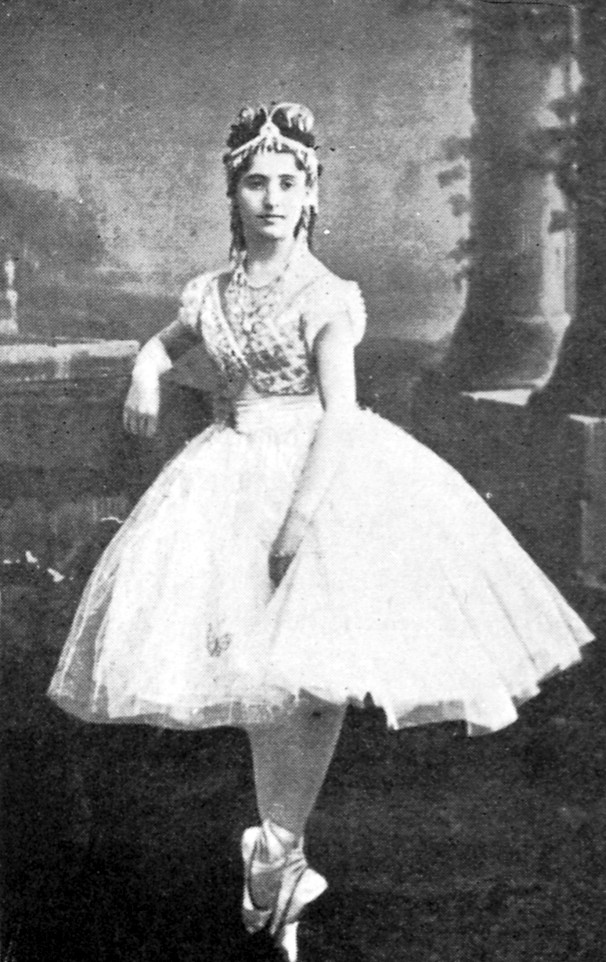 CoppéliaBallet · 1870Balanchine · video
 ApolloBallet · 1928Balanchine · video
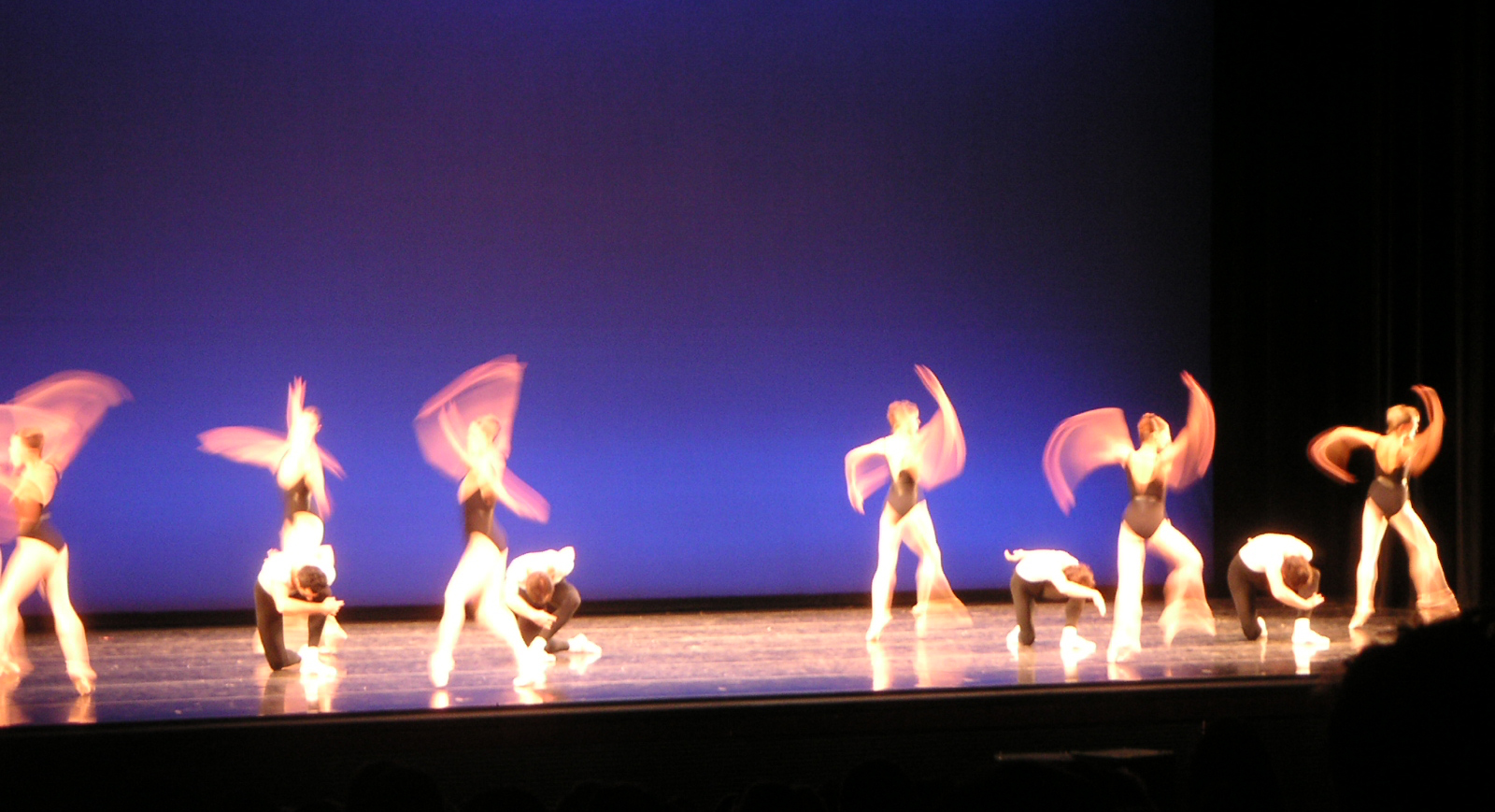 AgonBallet · 1957Balanchine · video
 Le chant du rossignolBallet · 1920Balanchine · video
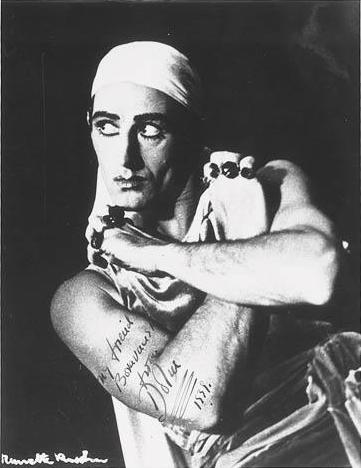 The Prodigal SonBallet · 1929Balanchine · video
 The Seven Deadly SinsBallet · 1933Balanchine · video
 Stravinsky Violin ConcertoBallet · 1972Balanchine · video
 The NutcrackerBallet · 1954Balanchine · video