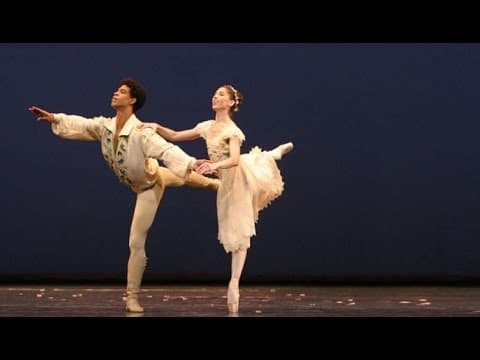
Voices of Spring is a short, plotless pas de deux made by Frederick Ashton to Johann Strauss II's Frühlingsstimmen waltz. It began life as a danced divertissement inside a Royal Opera production of Die Fledermaus and was lifted out to stand on its own within a year, becoming an occasional showpiece for the Royal Ballet rather than a repertory staple.
What it contains
- Classical Ballet · the whole piece — a single continuous pas de deux with no scene divisions — described as having 'a strong sense of effortless and joyful movement, strongly influenced by the boldness of the Bolshoi Ballet', indicating bravura, classically-schooled partnering and technique built to match a lively waltz tempo Source: "It is a lively Viennese waltz and the dance is suited to the music; it has a strong sense of effortless and joyful movement, strongly influenced by the boldness of the Bolshoi Ballet."
What is danced
The piece is built for two unnamed dancers, credited only as 'Dancer' and 'Dancer', and runs about eight minutes to a single continuous waltz. The article characterises the choreography as matched closely to the music's own lift and swing — 'a lively Viennese waltz' rendered with 'a strong sense of effortless and joyful movement' — and explicitly notes the influence of 'the boldness of the Bolshoi Ballet' on its bravura quality, which points to a demanding, high-spirited pas de deux rather than a restrained or narrative one.
Context
The piece dates from the same period Ashton was folding short danced numbers into Royal Opera productions rather than working solely on standalone ballets; the Die Fledermaus staging it came from was itself a company premiere for the Royal Opera, given wide broadcast exposure on New Year's Eve 1977. Extracting a ballroom-scene divertissement and giving it independent life as a gala or mixed-programme pas de deux was a familiar way for choreographers of the period to generate portable showpieces from opera or operetta commissions.
Staging history
The dance premiered independently in the United States before returning to the Royal Ballet's own stage, and has since been revived only intermittently — 1981, 1983, 2004 and 2012 by the article's account, each time as part of mixed or centenary-anniversary programmes rather than as a repertory fixture. Its first cast, Merle Park and Wayne Eagling, reprised it in the 1981 and 1983 revivals, and Park later returned to coach the 2004 centenary staging, giving the piece an unusually direct chain of transmission from creator-cast to later dancers.
How to watch it
Watch for how closely the partnering rides the waltz's own rise and fall rather than working against it — the article frames the appeal as the dance 'suited to the music' rather than counterpointing it. Because it carries no plot and no named characters, the piece is usually read as a display item: attend to lift, turn and phrasing as the content itself, in the tradition of a gala pas de deux extracted from a larger production.
Credits
- composer: Johann Strauss II
More from Frederick Ashton
Other staged works in the register connected to this one by author or lineage.
 SylviaBallet · 1876Ashton · video
 Les PatineursBallet · 1937Ashton · video
 Symphonic VariationsBallet · 1946Ashton · video
 Marguerite and ArmandBallet · 1963Ashton · video
 OndineBallet · 1958Ashton · video
 A Month in the CountryBallet · 1976Ashton · video
 MovesBallet · 1959Same lineage · video
 Theme and VariationsBallet · 1947Same lineage · video