25 works in this view — arrow keys or swipe to move between them.
Dance in Art
Le Bal paré
Augustin de Saint-Aubin
- Medium:
- engraving
- Era:
- 1700s (Enlightenment/Minuet Era)
- Source:
- Wikimedia Commons
- Rights:
- Public domain — free to use, share and adapt.
- Recorded as:
- public_domain
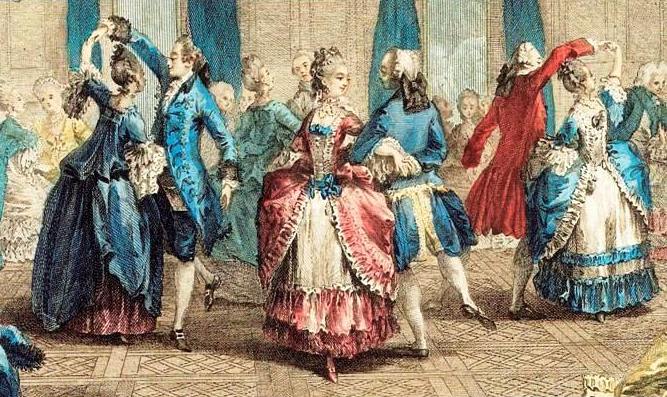
This engraving is one of the most detailed visual records of minuet and quadrille practice from the period. Saint-Aubin was a meticulous observer of social ritual, and his precision in rendering posture, distance, and decorum provides evidence of how these dances were actually performed—not in idealized abstraction, but in the context of a crowded, hierarchical social space. For anyone studying eighteenth-century dance, costume, or court culture, this work is an essential primary source.
What you are looking at
An engraved scene of an eighteenth-century formal ball, likely at court or in aristocratic society. The composition shows a crowded interior space with tall striped pilasters or columns dividing the wall, creating vertical rhythm. In the foreground, couples are positioned in dance formation—some stationary, some mid-movement. A woman in a striking pink silk gown with white underskirt and elaborate trim stands center-right, her posture upright and composed. To her left, a man in deep blue coat with white stockings faces her. Other couples surround them in various attitudes: a woman in dark blue with white trim to the left, a woman in red damask further back, and numerous figures in blues, greens, and flesh tones arranged throughout the space. The women wear the voluminous skirts, tight bodices, and ornate decoration characteristic of mid-eighteenth-century dress; the men wear fitted coats, breeches, and white stockings. The floor is rendered as a geometric tile pattern. The overall impression is one of ordered elegance and social formality, with figures frozen in graceful poses that suggest choreographed movement rather than spontaneous action.
The dancing
The dancers occupy an upright, formal posture throughout. The central woman and her partner face each other at a conversational distance; his hand appears to be offered or held at waist level, her arms rest gracefully. Several other couples maintain similar spacing and frame—bodies erect, arms restrained, heads held with dignity. The positioning suggests a line or set formation rather than constant partner contact; some figures stand sideways to the viewer, others face forward or back, creating a complex spatial arrangement. Weight appears centered and controlled. The overall carriage is one of studied restraint and courtly decorum—no exaggerated limbs, no lifted heels or energetic footwork visible; movement appears to be restricted to the lower body and small steps.
The dance depicted
This depicts a formal court ball of the 1770s, most likely a minuet or quadrille, both of which were central to aristocratic social dance of the period. The upright posture, facing-partner positioning, restrained arm gesture, and formal line arrangement all align with minuet convention. The minuet was the most prestigious social dance of the era and the standard opening dance at formal balls; it emphasized control, elegance, and display of refined manners. A quadrille interpretation is also plausible—the multiple couples arranged in a set-like pattern could suggest the geometric formations characteristic of that group dance. The scene captures not movement in progress but a moment of poise and presentation, which accords with the minuet's emphasis on carriage and grace over vigorous stepping.
How it was made
This is an engraving, a medium that allowed for precise linear definition, fine detail in costume and setting, and broad circulation through print. The technique permitted Saint-Aubin to render intricate architectural details (the pilasters, floor pattern), the texture and sheen of fabrics (the sheen of the pink silk, the stiffness of brocade), and the subtle positioning of figures with clarity. Engravings were reproducible and affordable, making them the primary vehicle for visual documentation of court life and social custom in the eighteenth century. This work likely circulated among the aristocracy and educated bourgeoisie as a record of fashionable society and proper conduct.
About this work
Le Bal paré is a document of aristocratic social dance and dress at the height of the ancien régime. Saint-Aubin captures a moment of formal choreography and courtly display—the minuet or quadrille rendered as a scene of composed elegance. The work is valuable not primarily as a record of choreography in motion (the artist was more interested in the social tableau than in dynamic movement) but as evidence of how dance functioned as a vehicle for the display of rank, refinement, and bodily discipline. It shows the minuet not as an abstract aesthetic form but as a lived social practice, framed within architecture and costume and embedded in a hierarchy of bodies and gazes.
For dance historians and practitioners, the work offers a precise visual record of how the body was held, how partners related, and what proximity and gesture signified in a formal ballroom setting. It is also a record of the elite female body on display—the spectacular architecture of the gown, the precise posture required to wear it, the restraint required to move within it.
How to look at it
Attend to the repetition of postures and the careful spatial arrangement. Saint-Aubin has frozen the dancers in a moment of stillness or between steps—not mid-leap or in dynamic extension, but upright and composed. Note how the women's skirts occupy space without being moved; the artist is interested in the architecture of the dress as much as the body within it. Look at the relationship between the couples and the setting: these dancers are on display, framed by architectural features that emphasize their status. The engraver's choice to show so many figures at once, rather than focus on a single couple, emphasizes that this is a social event governed by rules and protocol, not a display of individual virtuosity.
The artist
Augustin de Saint-Aubin (1736–1807) was a prolific French engraver and draughtsman, celebrated for his acute observations of Parisian and court society. His works are densely detailed, often small in scale, and executed with great fineness of line. Saint-Aubin was preoccupied with capturing the ceremonies and rituals of aristocratic life—his subjects include formal balls, salons, theatrical performances, and street life. He was brother to Gabriel de Saint-Aubin, also an engraver, and the two collaborated on studies of contemporary manners. His works are valued by historians as precise visual documents of eighteenth-century society and etiquette.
The period
In the 1770s, the minuet remained the presiding dance of European courts and aristocratic society, though its dominance was beginning to wane among younger, more fashionable dancers, who were embracing the livelier contredanse and other innovations. The quadrille, which would come to dominate the nineteenth-century ballroom, was already gaining ground as a fashionable group dance. The formal ball depicted here represents the height of ancien régime ceremony—the last decades before revolutionary upheaval would sweep away the rituals and hierarchies that gave these dances their meaning. In art, Saint-Aubin's meticulous engravings belong to a broader eighteenth-century fashion for depicting scenes of social life and manners, influenced by the success of Hogarth and responding to growing bourgeois appetite for images of refined behavior and fashion.
Where it lives
The work is recorded in Wikimedia Commons and is not associated with a specific known holding institution. It is a print, and as such would originally have been one of a series of impressions distributed to patrons and collectors of Saint-Aubin's works.
Dance in this work
Questions about this work
How do I know this is a minuet and not another dance?
The posture, spacing, and formality are consistent with minuet convention—upright carriage, restrained arm gesture, partner facing at a respectful distance. However, the multiple couples arranged in a set also suggest a quadrille, which was equally fashionable in the 1770s. The engraving shows the ceremonial, composed aspect common to both dances rather than distinctive footwork, so a definitive identification is not possible from the image alone. What is clear is that this is a formal, choreographed social dance of the aristocratic repertoire.
Why do the dancers look so stiff?
This is not stiffness but control and courtly restraint. Eighteenth-century aristocratic dance prized upright posture, dignified carriage, and minimal visible effort. The body was held as a composed whole, and the impression of effortlessness was a mark of breeding. The minuet in particular was valued for its grace and elegance, which required precise control of the body. Dancers were trained from childhood in deportment, and this is what Saint-Aubin has captured—not a lack of skill, but the disciplined presentation of the body that defined good society.
What does the dress tell us about the dance?
The voluminous skirts and rigid bodices of the women's gowns required a particular way of moving. The skirts, supported by hoops and panniers, occupied significant space and would have swung and shifted with the dancer's weight shifts and turns. The tight bodice restricted movement in the torso, so stepping and hip and leg movement had to be precise and controlled. The elaborate decoration and weight of these gowns meant that a dancer who could move gracefully in them demonstrated considerable skill and status. For men, the fitted coat and breeches allowed more mobility but still conveyed formality and elegance through the cut and shine of the fabric.
Is this a real ball or an imagined scene?
Saint-Aubin was a keen observer of contemporary society and likely sketched scenes he witnessed at court and in aristocratic salons. However, as a finished engraving made for circulation, the work would have been composed and idealized to present an exemplary scene of fashionable behavior and refined taste. It is both a documentary record (the dress, the architecture, the protocols are accurate) and a constructed image (the arrangement is artfully composed to show the ball at its most graceful and orderly).
More dance artwork