49 works in this view — arrow keys or swipe to move between them.
Dance in Art
America as host to the Ballet Russe
Unknown artist
- Medium:
- Dance:
- Ballet
- Source:
- New York Public Library
- Rights:
- Public domain — free to use, share and adapt.
- Recorded as:
- public_domain
The Ballets Russes transformed modern dance and liberated choreography from nineteenth-century academic conventions; this image documents how that revolution was presented to American audiences. For historians of dance, design, and magazine culture, this page is evidence of how avant-garde European work entered and was legitimized within American visual media.
What you are looking at
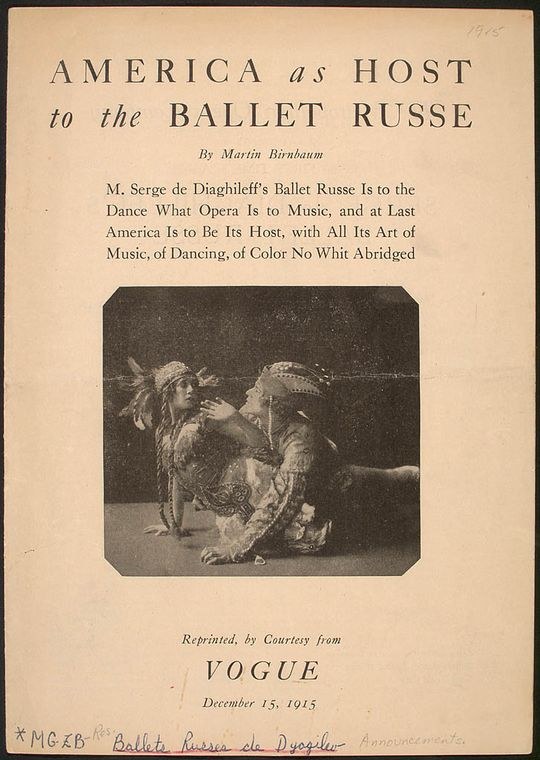
This is a magazine article reprinted from Vogue (December 15, 1915) presenting America's role as host to the Ballets Russes. The page features a striking photograph at its center showing two elaborately costumed dancers in what appears to be an exotic or Oriental-themed ballet production. The figure on the left wears an ornate headdress with plumes and a decorated costume, while the figure on the right is positioned in a dramatic pose. The photograph is framed by typography announcing the article's title and byline (Martin Barnbaum), emphasizing the cultural significance of the Ballets Russes' American tour. The layout is typical of early twentieth-century magazine design, with the photograph as the primary visual anchor. The image quality is characteristic of period photographic reproduction in print media—grainy, high-contrast, and rendered in black and white.
The dancing
Two dancers occupy the frame in close proximity, their bodies angled toward each other in an intimate compositional arrangement. The dancer on the right appears to be in a lunging or kneeling position with forward momentum, while the left figure maintains an upright stance. Both wear heavily constructed costumes that restrict movement and define their silhouettes dramatically. The poses suggest a dramatic narrative moment rather than a formal, symmetrical classical ballet alignment; the bodies are expressively arranged rather than geometrically ordered.
The dance depicted
The costumes and staging suggest this is from one of the Ballets Russes' orientalist or exotic works—likely from productions such as Scheherazade, Cleopâtre, or similar pieces in Diaghilev's 1915 American repertory. The elaborate headdresses, the narrative positioning of the two figures, and the theatrical intensity of the moment are consistent with Michel Fokine's choreographic vocabulary for these works, which emphasized dramatic storytelling and visual spectacle over pure classical technique. The image documents how the Ballets Russes presented dance to American audiences as a total theatrical experience.
How it was made
This is a photographic reproduction, almost certainly a gelatin silver print or similar photomechanical process, reprinted in the December 15, 1915 issue of Vogue magazine. The halftone process used for magazine reproduction accounts for the visible dot pattern and loss of detail characteristic of early twentieth-century periodical printing. As a magazine article, this object circulated widely among educated American readers interested in the arts and fashion, making it a significant document of how the Ballets Russes were marketed to American audiences.
About this work
This page from Vogue announces and celebrates America's role as host to Sergei Diaghilev's Ballets Russes, one of the most influential theatrical innovations of the early twentieth century. The photograph at its center captures the visual extravagance for which the company was renowned—the jeweled headdresses, the intricate costumes, the dramatic lighting and composition that made each production a complete artwork. The article's framing emphasizes that what Diaghilev brought to America was not merely dance but a synthesis of music, visual art, and movement.
This is a primary document of American cultural reception and the machinery of taste-making in the 1910s. Vogue's decision to dedicate editorial space to the Ballets Russes signaled their endorsement as a serious cultural event rather than mere entertainment, and the lavish photography positioned dance as worthy of the same aesthetic attention granted to painting or fashion.
How to look at it
Look first at the costume and headdress: the sheer visual investment in design signals that this is not classical ballet reduced to pure movement, but total theater. Observe the positioning of the two dancers—neither is in an arabesque or classical line, but rather in a moment of dramatic narrative engagement. The photograph captures not the apex of a vertical line but an instant of emotional or narrative intensity. The lighting and composition emphasize silhouette and profile, a photographic strategy that foregrounds the costumes and makes the moment legible to a magazine reader unfamiliar with dance vocabulary.
The artist
The photograph is uncredited, as was common in early twentieth-century theatrical photography; the article is bylined to Martin Barnbaum. The image was likely taken by a professional theatrical or press photographer during a Ballets Russes performance or rehearsal, possibly by one of the house photographers associated with the company or with American theaters hosting the tour.
The period
The Ballets Russes arrived in America in 1916 but had generated intense anticipation and pre-tour coverage from 1914 onward. By 1915, when this article appeared, the company's reputation for revolutionary design and choreography had already spread through European and American art circles. The orientalism evident in the photograph reflects both the aesthetic preoccupations of Diaghilev's early decades and the appetite of Western audiences for exoticized spectacle. The moment coincides with a broader American embrace of modernism and European artistic innovation in the years before the First World War reached American shores.
In dance history, 1915 falls at the height of Michel Fokine's influence on Diaghilev's choreographic direction, before the company's turn toward constructivism and abstraction. The Ballets Russes' American tours would profoundly influence American modern dance and ballet, making this document part of a transmission history.
Where it lives
This is a reproduced page from Vogue magazine, held by the New York Public Library. It is a periodical document from December 15, 1915, and represents the kind of mass-circulation editorial photography through which Americans first encountered the Ballets Russes.
Dance in this work
Questions about this work
Was this photograph taken during an actual performance?
Most likely yes, or during a final dress rehearsal. The costumes, lighting, and staging all suggest a theatrical setting rather than a studio photograph. However, theatrical photographs of this era were often retouched and carefully composed for publication, so this may also represent a specially arranged session for the photographer.
What ballet is this from?
The elaborate orientalist costume and headdress suggest it is from one of Diaghilev's exotic works, most likely Scheherazade or Cleopâtre, both of which were in the Ballets Russes' repertory and featured this kind of visual spectacle. Without a caption, definitive identification is not possible.
Why is this in a fashion magazine?
By 1915, the Ballets Russes were as significant to avant-garde fashion and design as they were to dance. Vogue covered them as major cultural events that influenced costume, silhouette, and aesthetic direction. The extravagant costumes were themselves haute couture objects.
What does 'America as host' mean?
The article emphasizes that the Ballets Russes would tour America, bringing European modernism and artistic innovation to American audiences. 'Host' frames America as a welcoming venue for the company's work and innovations.
More Ballet artwork