28 works in this view — arrow keys or swipe to move between them.
Dance in Art
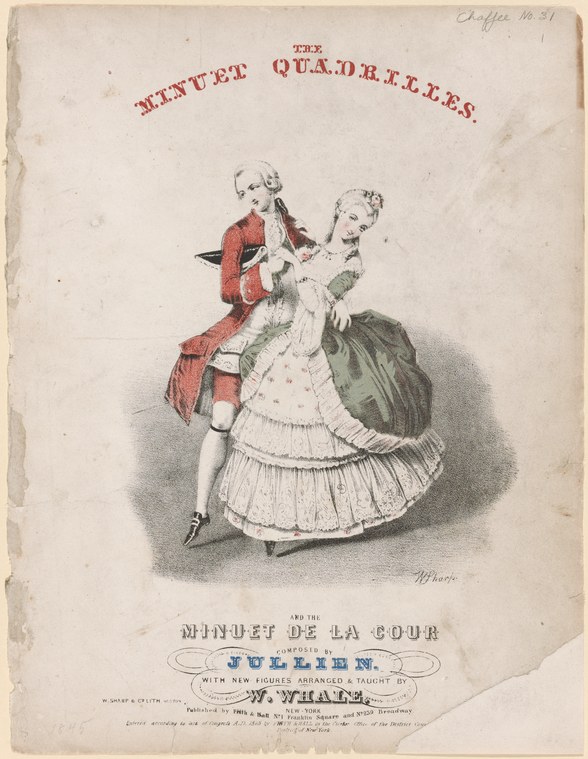
The minuet quadrilles. And The minuet de la cour composed by Jullien
Unknown artist
- Medium:
- Engraving
- Dance:
- Quadrille
- Era:
- 1700s (Enlightenment/Minuet Era)
- Source:
- New York Public Library
- Rights:
- Public domain — free to use, share and adapt.
- Recorded as:
- public_domain
This print documents the visual culture of ballroom dance as a genteel social practice and reveals how dance was taught and disseminated through print. It is evidence of the minuet quadrille as a distinct social form and of the way 19th-century composers and publishers used engraved imagery to standardize and promote dance styles across a broad middle-class audience.
What you are looking at
A colored engraving showing two figures in mid-dance against a plain background. On the left, a man in a red velvet coat with gold braid and lace cuffs stands in profile, his right arm extended toward his partner. On the right, a woman in an elaborate white gown with a full skirt ornamented with ruffled tiers and green silk drapery across the back stands facing slightly toward him, her posture upright and composed. Both figures wear the formal dress of the 18th century—the man's coat cut in the fashionable style of the 1750s–1770s, the woman's gown with the characteristic silhouette of court dress. The woman's hair is styled up in the period manner. The two are positioned in the moment of a formal interaction characteristic of courtly dance, with careful attention to decorum and distance. The engraving uses fine line work and light shading to model the figures and suggest the texture of fabrics.
The dancing
The man's posture is attentive and slightly inclined toward the woman, his extended arm suggesting an invitation or greeting. The woman holds herself upright with an air of composed dignity, her arms at her sides or gathered in her skirt. Neither figure is captured mid-leap or in rapid motion; instead, both are shown in a moment of stilled grace typical of formal court dances of the period. The spatial relationship between them—close but not touching—reflects the protocol of dances such as the minuet or quadrille, where partners interact at measured distances and with prescribed movements.
The dance depicted
The title identifies this as imagery for 'The Minuet Quadrilles' and 'The Minuet de la Cour' (Minuet of the Court), composed by Jullien—likely Louis-Antoine Jullien (1812–1860), the prolific French composer and conductor known for quadrilles and ballroom arrangements. The image depicts the formal presentation style appropriate to these dances as they would have been performed in ballrooms of the mid-to-late 18th century and continuing into the 19th. The minuet quadrille represents a hybrid form, combining elements of the minuet—the slow, ceremonious baroque court dance—with the quadrille, a group dance for four couples arranged in a square. The engraving captures the aesthetic of instruction and courtly ideal rather than a snapshot of movement; it shows how dancers should hold themselves and relate to one another.
How it was made
This is an engraving, a printmaking technique that allowed rapid and repeatable distribution of dance instruction and fashionable imagery. The fine lines incised into a metal plate and inked for printing created a sharp, detailed image suitable for hand coloring, as this example shows. Engravings of this type were commonly issued as covers for sheet music or as standalone instruction sheets accompanying published dances, making them accessible to the ballroom public and to dancing masters across Europe. The technique's precision and linearity suit the formal, measured nature of the subject. The hand coloring—applied after printing—adds specificity to the fabrics and fashions, making the print both a work of art and a practical document of dance costume and deportment.
About this work
This is a colored engraving serving as the title page or cover illustration for a published dance composition by Jullien. It depicts the minuet quadrille, a ballroom form that synthesized the stately minuet of the baroque court with the group structure of the quadrille, both immensely popular in 19th-century ballrooms. The engraving is not a record of a specific performance but an idealization—a visual instruction manual showing the proper dress, posture, and relation between partners that defined refined ballroom practice. The work belongs to a large body of printed dance instruction and fashion imagery that guided the social dancing of the middle and upper classes across the 19th century.
Jullien's compositions were commercial products designed for amateur dancers and professional ballroom venues alike. An engraving such as this would have circulated widely as part of the published score, instructing dancers not only through music and written description but through visual example of how a gentleman and lady should present themselves and interact on the floor.
How to look at it
Observe the careful positioning of the two figures and their relation to one another: neither is in mid-movement, and neither is touching. This is characteristic of formal 18th- and 19th-century ballroom dance, in which grace lay in the control of the body and the observance of spatial and temporal protocol rather than in athletic display. The engraver has chosen to show the figures in a moment of formal presentation—a frozen acknowledgment or greeting—that makes clear the dignity and restraint expected of ballroom dancers. Notice the detail lavished on the fabrics: the red velvet coat with its gold braid, the woman's white silk gown with its elaborate ruffled skirt, and the green drapery. For dancers and dancing masters of the period, such dress was not merely fashion but a requirement of style, a visible sign of participation in refined society. The engraving preserves not a moment of action but a standard of appearance and carriage.
The artist
The engraver is not identified in the catalogue record. The composition was published in conjunction with a musical score by Louis-Antoine Jullien, a French composer and dance-band impresario (1812–1860) who produced hundreds of quadrilles, polkas, and other fashionable dances for the ballroom market. Jullien was known for his business acumen and his ability to capitalize on dance crazes; his scores were accompanied by printed choreography and often by illustrative engravings to guide and entice the dancing public. The artistic style of the engraving—the refined line work, the careful attention to costume detail, and the composition—places it within the conventions of 19th-century dance instruction and fashion print, genres that employed skilled engravers whose individual names often went unrecorded.
The period
The minuet quadrille emerged in the early 19th century, during a period when the quadrille itself had become the dominant social dance of European ballrooms, having eclipsed the cotillion and challenged the waltz for supremacy. The minuet quadrille was a self-conscious revival: it combined the elegant, measured movements and moral associations of the ancien régime minuet with the structure and liveliness of the quadrille, appealing to dancers who valued refinement and historical consciousness. Jullien's prolific output in the 1830s–1850s coincided with the peak popularity of the quadrille and the expansion of print culture devoted to dance. Engravings accompanying musical scores were a standard product: they served to advertise dances, to preserve a visual record of fashionable costume and deportment, and to provide amateur dancers with guidance. This print dates to an era when ballroom dancing was a central marker of social respectability and when the ballroom itself—the public or private space where such dances took place—was a arena for the display of rank, taste, and refinement.
Where it lives
The work is held in the New York Public Library collection. It is a printed engraving, hand-colored, issued as part of the publication apparatus surrounding Jullien's compositions for ballroom dance. Such prints were produced in quantity and distributed widely, making them relatively common historical documents; this particular example entered the NYPL collection as part of a larger assemblage of dance, music, and theatrical prints.
Dance in this work
Questions about this work
Who was Jullien and why did he compose quadrilles?
Louis-Antoine Jullien (1812–1860) was a French composer and bandmaster who became wealthy and famous by producing fashionable dance music for ballrooms across Europe and North America. Quadrilles were the most popular ballroom dance of his era, and Jullien capitalized on the demand by composing hundreds of them, many with novelty themes or variations. He also pioneered the use of printed illustrations and choreographic notation to promote his works, making him as much a savvy publisher as a composer.
What is the difference between a minuet and a minuet quadrille?
The minuet is an elegant, stately baroque court dance performed by a couple in a rising-and-falling rhythm. The quadrille is a group dance for four couples (eight people) arranged in a square, with a lively tempo and a series of distinct figures. The minuet quadrille borrowed the slow, refined style and rising-falling motion of the minuet but applied it to the quadrille's structure and social format. It was a way of adding gravitas and refinement to the quadrille, appealing to dancers who valued historical consciousness and courtly elegance.
Why is the man's coat red and the woman's dress white?
The red velvet coat with gold braid was fashionable formal dress for gentlemen in the mid-to-late 18th century and remained a marker of elegance well into the 19th century. The white silk gown with elaborate ornamentation was the standard for genteel ladies' ballroom dress. These are not arbitrary choices: the colors and fabrics were expensive and conspicuous, and wearing them signaled wealth, taste, and participation in refined society. The engraver's careful rendering of the fabrics—the sheen of the velvet, the texture of the lace—was itself a form of advertisement, showing viewers what fashionable dress looked like.
Is this engraving a record of an actual dance, or an idealization?
It is an idealization and an instruction. The engraving presents the proper form and deportment expected of dancers, showing them in a moment of composed, formal greeting rather than in the midst of dynamic movement. It served as a visual guide for dancers learning from a printed score, showing them how to dress and how to carry themselves. Such prints were produced in quantity and circulated widely, making them more about establishing and promoting a standard of practice than about documenting any single performance.
More Quadrille artwork