49 works in this view — arrow keys or swipe to move between them.
Dance in Art
Horse ballet
Unknown artist
- Dance:
- Ballet
- Source:
- New York Public Library
- Rights:
- Public domain — free to use, share and adapt.
- Recorded as:
- public_domain
Horse ballets are largely absent from dance history, yet they were prestigious court entertainments requiring choreography and training comparable to any human dance form. This image is rare documentary evidence of a performance tradition that shaped Renaissance and Baroque court culture. It expands our understanding of what counted as dance and performance in early modern Europe.
What you are looking at
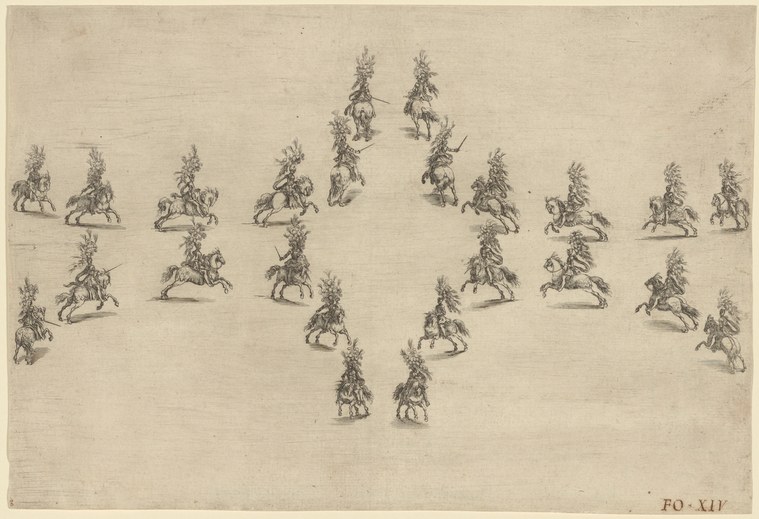
Twenty-five horsemen in ornate military or ceremonial dress are arranged in a loose circular formation across the page. Each rider sits mounted on a horse in a dynamic, elevated posture—the horses rear, prance, or leap with exaggerated, theatrical animation. The figures are rendered in fine pen line with minimal shading, creating a rhythmic visual pattern around the composition. The riders wear plumed headdresses, fitted jackets with decorative details, and appear to be holding implements—possibly lances, swords, or staffs. The scale of the horses is emphasized by their high-arched necks and powerful hindquarters; some animals appear nearly upright. The arrangement suggests choreographed movement rather than a battle or procession—the riders face varied directions and their horses occupy distinctly marked positions, as though placed on an invisible stage.
The dancing
Each mounted figure maintains an upright, controlled upper body despite the horse's animation beneath. The riders sit deep in the saddle with arms positioned for balance or gesture; several appear to hold or brandish objects in one hand while steadying themselves. The horses are the dominant element: they leap, rear, or prance with front legs raised and arched necks—a posture requiring significant training. The composition emphasizes the partnership of rider and horse as a single coordinated unit, with the rider's upper-body poise contrasting against the horse's explosive, elevated movement.
The dance depicted
This appears to document or imagine a horse ballet or equestrian performance art form. Horse ballets were a courtly entertainment, particularly in 16th- and 17th-century European courts, where trained horses executed choreographed movements to music while riders performed stylized gestures. The arrangement here suggests a formal geometric composition typical of court spectacles—the circular or scattered placement of figures implies that each rider's movements were part of an orchestrated whole. The consistent elevation and animation of the horses, combined with the formal dress and apparent choreography, strongly supports that this is a horse ballet rather than a military or hunting scene.
How it was made
This is a fine-line engraving or etching on paper, executed with precision and minimal tonal variation. The artist has used parallel lines and fine hatching to suggest volume and texture—particularly in the horses' musculature and the riders' costumes—while leaving much of the composition open and light. The technique suggests professional production, likely for circulation as a print. The careful composition and evident artistry point to a work created for a wealthy or court audience, possibly to document or promote an actual performance or to serve as a design record for an equestrian spectacle.
About this work
This engraving documents a horse ballet, a courtly performance art in which trained horses and their riders executed choreographed movements as spectacle. The work shows twenty-five mounted figures arranged in a formal composition, their horses captured in elevated, dynamic postures that demonstrate rigorous training. The precision of the line work and the geometric arrangement of figures indicate this was either a record of an actual performance or a design document for one.
Horse ballets occupied a unique position between equestrianism, dance, and theatrical spectacle. They required years of training for both horse and rider, and they served as demonstrations of courtly sophistication, wealth, and control. This engraving is evidence of the performance tradition and of how dance history must be enlarged to include animal partners and the arts of horsemanship.
How to look at it
Attend to the consistent elevation and animation of the horses across all twenty-five figures—this is not naturalistic but choreographed, a trained posture. Notice how the riders remain relatively still and upright while the horses perform: the dancer here is primarily the horse, with the rider as a controlled and decorated passenger. Observe the geometric spacing and varied orientations of the figures, which suggest that they were arranged in a planned sequence rather than occurring naturally. The artist has frozen a moment of display and formality, characteristic of court spectacle where the coordination and control of the animals themselves was the point of wonder.
The period
Horse ballets flourished in Renaissance and early Baroque courts, particularly in Italy, France, and the Holy Roman Empire (roughly 16th–17th centuries). They were part of the broader culture of court spectacle that included masques, ballets, theatrical performances, and equestrian tournaments. The form combined humanist ideals of grace and control with aristocratic displays of wealth and power. By the early 17th century, elaborate horse ballets were documented in courts across Europe; treatises on horsemanship and courtly display (such as those by Federico Grisone and Antoine de Pluvinel) became increasingly formalized. The theatrical arrangements visible here reflect the period's fascination with geometry, order, and the coordination of multiple performers—whether human, equine, or both—into unified spectacles.
Where it lives
The work is held in the New York Public Library collection and is recorded as item PO.XII, indicating it is part of a larger collection of prints or engravings. No artist, date, or medium are recorded in the catalogue, though the image itself reveals it to be a fine-line engraving or etching.
Dance in this work
Questions about this work
What is a horse ballet?
A horse ballet is a courtly performance art in which one or more trained horses and their riders executed choreographed movements as public spectacle. Horses were trained to rear, leap, prance, and move in geometric patterns, often to music. Riders performed stylized gestures and formations. The form combined equestrianism, dance, and theater, and was particularly popular in Renaissance and Baroque courts as a display of wealth, training, and control.
Was this an actual performance or an imaginary design?
The precision of the arrangement and the technical skill required suggest this likely documents or was designed for an actual performance. However, the record does not specify whether the engraving records a performance that took place or was created as a template or theoretical design for one. Either way, it is evidence that such performances were real and valued enough to be documented or planned in print.
Why doesn't dance history usually include horse ballets?
Dance history has traditionally focused on human bodies in motion and has been shaped by written records and later film documentation. Horse ballets required oral transmission, physical training, and the involvement of animals, making them harder to preserve or study. They also occupied an ambiguous category—part equestrian sport, part courtly entertainment, part theater—and may not have seemed to fit the category of 'dance' to later historians. Recent scholarship has begun to recover these forms.
More Ballet artwork