49 works in this view — arrow keys or swipe to move between them.
Dance in Art · 2019
Unidentified ballet
Unknown artist
- Medium:
- Dance:
- Ballet
- Source:
- New York Public Library
- Rights:
- Public domain — free to use, share and adapt.
- Recorded as:
- public_domain
This image documents the visual and technical language of Romantic ballet at a moment when pointe work and the ethereal aesthetic were still innovations being refined and celebrated. It shows how 19th-century dance was preserved and disseminated through print culture, and offers a direct visual record of how the ideal ballet body was constructed and understood in this foundational period. For historians, it is a primary document of the technical and aesthetic values that shaped ballet as we know it.
What you are looking at
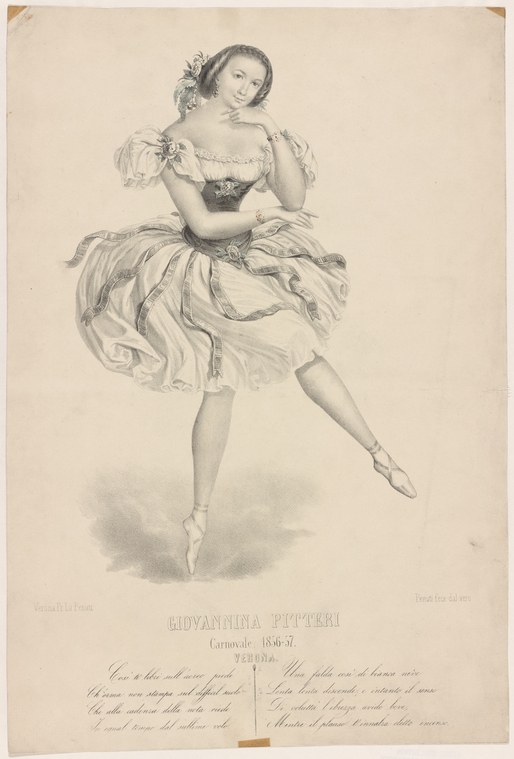
A single female dancer in pointe shoes stands alone against a plain background, captured in a moment of suspended balance. She wears a pale tutu with layered skirts caught mid-movement, revealing her extended legs and the delicate articulation of her feet. Her upper body is composed but animated: one arm is raised with the hand near her head in a graceful port de bras, while the other extends to the side. Her gaze is directed upward and away, following the line of her raised arm. The figure is rendered in fine linear detail—graphite or engraving—with careful attention to the fall and transparency of the fabric and the musculature of her legs. A soft shadow beneath her suggests the ground plane and adds dimensionality to the composition.
The dancing
The dancer is rendered in a supported balance position, likely an arabesque or attitude, with her weight held on the working leg in pointe. Her port de bras is controlled and elegant: the raised arm curves softly, and her other arm extends to balance the line of her body. Her torso remains upright and aligned, demonstrating the postural discipline of academic ballet technique. The angle of her head and the direction of her gaze create a sense of épaulement—the rotation and lift of the shoulders—that shows understanding of classical ballet's aesthetic conventions. She is isolated in the frame, a single figure presented as a study of the ideal dancer's form.
The dance depicted
This is a study of Romantic-era ballet technique, almost certainly from the mid-19th century based on the style of the tutu, pointe work, and the aesthetic values on display. The image belongs to the tradition of ballet portraiture that documented celebrated dancers and the evolving technical vocabulary of the form. The dancer is shown in a moment of controlled extension and balance that demonstrates the refinement of pointe technique—still relatively new when this work was made. The presentation style and the figure's isolation suggest this may be a portrait of a specific dancer or a generic study of the ideal classical line.
How it was made
This is a print, most likely a lithograph or engraving based on the fine linear work, subtle tonal modeling through hatching and light pressure, and the delicate rendering of the tulle. The technique allowed for wide circulation of images of celebrated dancers, making this the likely product of a commercial print shop serving an urban theatrical public. The high finish and careful attention to anatomical and sartorial detail suggests work aimed at a audience of dance enthusiasts and possibly dancers themselves. The print's legibility and technical refinement indicate professional production rather than amateur sketching.
About this work
This is a mid-19th-century ballet portrait: a print study of a single dancer rendered in a moment of technical poise and aesthetic completion. It documents the visual ideal of Romantic ballet at its height—the ethereal, elongated line, the elevation and balance of pointe work, and the refined port de bras that marked the accomplishment of the era's best dancers. The work sits at the intersection of theatrical documentation and artistic print production, serving both as a record of a performed art and as a graphic object for aesthetic consumption by an educated public. For scholars and dancers, it is evidence of how the female ballet body was seen, valued, and circulated in this period.
How to look at it
Look first at the angle of the body and the disposition of the limbs: the dancer is caught in a moment of complete control, held aloft on one point, her line continuous and unbroken from fingertips to the crown of her head. The tutu is the second visual anchor—note how the artist has rendered its transparency and the way it frames the working leg, emphasizing the geometry of the extended body. The face and gaze are the third focus: she looks away and upward, not at the viewer, which was a key convention of the period—the dancer is absorbed in her own aesthetic moment, not performing for an external gaze. The technical achievement on display here is the whole point: the image asks you to recognize the disciplined sophistication of the pose.
The artist
The print is unattributed in the catalogue record. Based on the style and period, it likely comes from a professional ballet print shop of the 1840s–1860s, the era of highest demand for such images. The production values and attention to anatomical precision suggest a trained lithographer or engraver working for a commercial publisher rather than an artist working in fine art modes.
The period
This work dates to the height of Romantic ballet, a period (roughly 1830–1860) when ballet underwent a profound aesthetic and technical revolution. Pointe work, still experimental in the 1820s, had become standard for the female dancer by the 1840s. The tutu shortened and stiffened, revealing more of the leg and emphasizing verticality and weightlessness. The era celebrated the individual dancer—the ballerina as star—in a way that earlier periods had not, and theatrical prints documenting famous dancers became a major commercial and cultural product. This print reflects the period's investment in the dancer's body as the primary site of artistic meaning and its use of print media to extend that star's reach beyond the theater.
Where it lives
This print is held in the New York Public Library collection, one of the major repositories of 19th-century theatrical prints and dance documentation. The library's theatrical collection includes thousands of such ballet portraits, many unattributed, produced for the commercial market in Europe and North America during the Romantic era.
Dance in this work
Questions about this work
Is this a portrait of a real dancer?
It may be, or it may be a generic study of the ideal classical line. The level of finish and the isolation of the figure in the frame suggest professional production, but without a signature or inscription it is not possible to say whether this documents a specific celebrated dancer or represents an idealized type. If there is an inscription below the image, that would settle the question.
Why is she on pointe?
Pointe work had become the visual signature of the female ballet dancer by the mid-19th century, symbolizing ethereality, weightlessness, and technical accomplishment. By the 1840s, when this print likely dates, dancing en pointe was essential to the dancer's professional identity and to the aesthetic of Romantic ballet.
What is the pose?
The dancer appears to be in arabesque or attitude, a position of extended balance on one leg. Both are fundamental to academic ballet vocabulary and both emphasize the elongated line and vertical extension that defined the period's aesthetic ideal.
How was this image used?
Such prints were sold as standalone objects to ballet enthusiasts, dancers, and the general public with access to print shops. They were also collected in albums and displayed in homes. They functioned like modern fan merchandise—a way for admirers to keep an image of celebrated dancers, and for dancers to study and emulate the correct line.
More Ballet artwork