49 works in this view — arrow keys or swipe to move between them.
Dance in Art
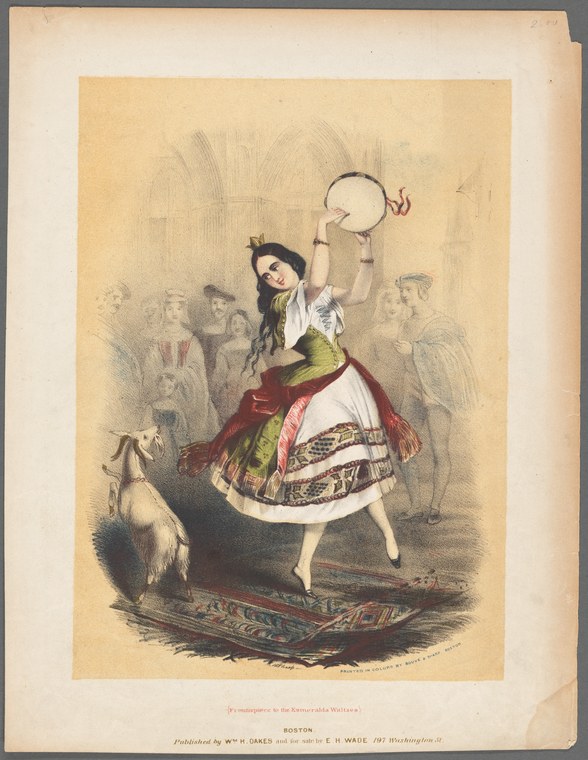
Frontispiece to the Esmeralda waltzes
Unknown artist
- Medium:
- Lithograph
- Dance:
- Waltz
- Era:
- Early 1800s (Waltz Revolution)
- Source:
- New York Public Library
- Rights:
- Public domain — free to use, share and adapt.
- Recorded as:
- public_domain
This image documents how Romantic ballet imagery was mass-produced and distributed through music publishing, shaping popular memory and appetite for theatrical dance. For dance historians, it provides evidence of which ballets generated enough public enthusiasm to be packaged as commercial sheet music, and of how the female dancer's body was marketed and visualized for a domestic market. The leap—a moment of supreme physical effort—is frozen at its moment of greatest extension, a choice that reveals the Romantic cult of the weightless, ethereal female body in motion.
What you are looking at
A young woman in Romantic-era theatrical costume executes a vigorous leap or jump at stage center, her body rising dynamically with one arm raised high and the other extended. She wears a white muslin dress with a fitted bodice and voluminous skirt caught mid-motion, layered over with a deep red or burgundy shawl or overdress trimmed in gold braid. Her dark hair is styled up with a light-colored ornament. The stage floor is suggested by draped fabric in the foreground, with what appears to be a small poodle or similar dog at lower left. Behind her, sketched more lightly, stands a group of five or six figures in formal dress—men in dark coats and women in lighter gowns—suggesting an audience or chorus witnessing the performance. The composition uses fine hand-coloring over lithographic line work, with warm tones dominating the central figure and cooler shadows defining the background spectators. The whole effect is one of spectacle and elevation, the dancer isolated in her moment of greatest extension.
The dancing
The dancer's body is fully extended in what appears to be an allegro jump or leap, with the supporting leg straightened powerfully below and the free leg bent at the knee or extended behind. Both arms are raised—the upstage arm dramatically high, the downstage arm extended sideways—creating a frame of great amplitude. Her torso is held upright and lifted. The weight is clearly distributed through strong legs, and the line from hip through spine to extended arm reads as controlled and balletic. The spectators behind are rendered in silhouette and loose gesture, their poses turned inward toward the central action, a convention that emphasizes the dancer's isolation and importance.
The dance depicted
This is clearly theatrical dance of the Romantic era, specifically ballet. The dancer's dress, pose, musical reference in the title (waltzes), and the presence of a composed audience all point to a professional stage performance, most likely a pas de seul or solo variation within a larger work. The leaping, turned-out carriage, lifted torso, and raised arms are consistent with classical ballet vocabulary of the 1830s–1850s. The title links this to *Esmeralda*, the popular Romantic ballet based on Hugo's *Notre-Dame de Paris*, choreographed by Jules Perrot in 1844. The waltz rhythm referenced in the publication title may indicate a solo performed to waltz accompaniment, which was common in Romantic ballet. This is almost certainly a promotional or commemorative image advertising or documenting an actual ballet performance or a piece of sheet music tied to the work.
How it was made
This is a hand-colored lithograph, a printing technique that allowed for relatively inexpensive mass production while preserving fine linear detail and permitting individualized coloring by hand. The artist drew the composition in lithographic crayon on stone, creating the fine contour lines visible throughout; the image was then printed in black ink and colored afterward in the workshop, likely by multiple hands. This technique was the standard commercial format for theatrical publicity and sheet-music covers in the 1830s–1850s, reaching a broad urban audience of theatergoers, music purchasers, and print collectors. The presence of color and the quality of the work suggest this was a premium publication, not a cheap broadside.
About this work
This is a hand-colored lithographic frontispiece to a published set of dance-inspired waltzes, most likely music derived from or promoted alongside the Romantic ballet *Esmeralda*. The image captures a solo female dancer in mid-leap, surrounded by an imagined audience, rendered in the commercial theatrical-promotional style of 1840s Paris or London. It represents the intersection of three cultural forms of the Romantic era: ballet, concert music (waltz), and popular print. The work is both a portrait of a dance moment and a piece of commercial graphic design—it was meant to sit on piano racks and parlor walls, circulating the aesthetics of theatrical dance to amateur musicians and middle-class households far from the theater itself.
How to look at it
Observe the moment the artist chose: the dancer at the apex of her leap, at the instant of greatest height, when her weight seems suspended. Note how the artist used the white muslin dress and the upward lift of her body to create a visual analogy to the ethereal, rising quality that Romantic ballet prized. Look at the contrast between the sharp, clear rendering of the dancer and the sketchy, barely indicated background figures—a compositional choice that makes the dancer seem present and vital while everyone else becomes a blurred context. The poodle at her feet and the formal audience behind her anchor the scene in a fictional theater space, inviting the viewer to imagine the performance. The red shawl and gold trim add a note of luxurious specificity that makes the costume readable even in hand-coloring.
The artist
The artist is not recorded in the available documentation. However, the work was published by M. H. James, a Boston music publisher active in the 1840s–1850s, working in partnership with E. H. Wade. The lithographic printing and hand-coloring were likely executed in Boston or a major nearby printing center such as New York or Philadelphia. The style—delicate line work, subtle modeling of the background figures, skillful use of color to isolate the central figure—suggests a trained commercial lithographer with experience in theatrical and musical subjects.
The period
The 1840s were the peak of the Romantic ballet era in Europe and America. *Esmeralda* (1844) was one of the most celebrated new works, and its success spawned innumerable spin-off publications—arrangements, piano reductions, dance-inspired waltzes, and commemorative prints. At the same time, the waltz itself was at the height of its fashionable power, dominating the social dance floor and concert hall across Europe and North America. The music industry was booming; piano ownership was climbing among the middle classes, and waltz arrangements of famous melodies were a staple of the market. This image sits at the intersection of three overlapping commercial worlds: the theater, the music publishing industry, and the print trade. It also embodies the Romantic cult of the ballerina—the female dancer as the primary embodiment of an ethereal, weightless, almost supernatural ideal.
Where it lives
The work is held in the New York Public Library collections. It is a commercial music-publishing artifact, a frontispiece issued to accompany a published set of piano waltzes. The title page would have appeared opposite the music inside the bound or folded publication.
Dance in this work
Questions about this work
What is *Esmeralda* ballet?
*Esmeralda* is a Romantic ballet choreographed by Jules Perrot in 1844, based on Victor Hugo's novel *Notre-Dame de Paris*. It was one of the most popular new ballets of its era, performed throughout Europe and North America. The story centers on the gypsy dancer Esmeralda and her tragic love; it featured spectacular ensemble dances and celebrated solo variations, often including waltz rhythms.
Why would a ballet inspire published waltzes?
Waltzes derived from or inspired by famous ballets were a major commercial genre in the 19th century. Audiences who had seen a ballet would purchase piano music that let them recreate its melodies and rhythms at home. Publishers marketed these as 'from the ballet' to capitalize on the work's fame, and composers would arrange memorable tunes in waltz form for the amateur market.
How was this image made and distributed?
This is a hand-colored lithograph, printed from a stone matrix and then colored by hand in the workshop. Lithography allowed relatively inexpensive mass production while preserving fine detail. The colored version was more expensive than plain printed copies, suggesting this was a premium edition. It would have been bound into or pasted onto the front of a music publication and sold through music dealers and bookshops.
What does the dancer's jump tell us about 1840s ballet?
The elevated, fully extended leap, the turned-out carriage, the lifted spine, and the arm frame are all hallmarks of classical ballet vocabulary codified during the Romantic period. The artist demonstrates knowledge of balletic line and balletic timing—freezing the moment at the height of the jump makes the dancer appear weightless and ethereal, a core Romantic ideal.
More Waltz artwork