49 works in this view — arrow keys or swipe to move between them.
Dance in Art
Honolulu dance
Unknown artist
- Source:
- New York Public Library
- Rights:
- Public domain — free to use, share and adapt.
- Recorded as:
- public_domain
This cover reveals how early twentieth-century American entertainment consumed and repackaged non-Western dance traditions through exoticizing frameworks. It also documents the Dunbar Sisters, notable African American performers whose contributions to vaudeville and popular music have been largely forgotten, making this a valuable record of Black women's performance history and visibility during the Jim Crow era.
What you are looking at
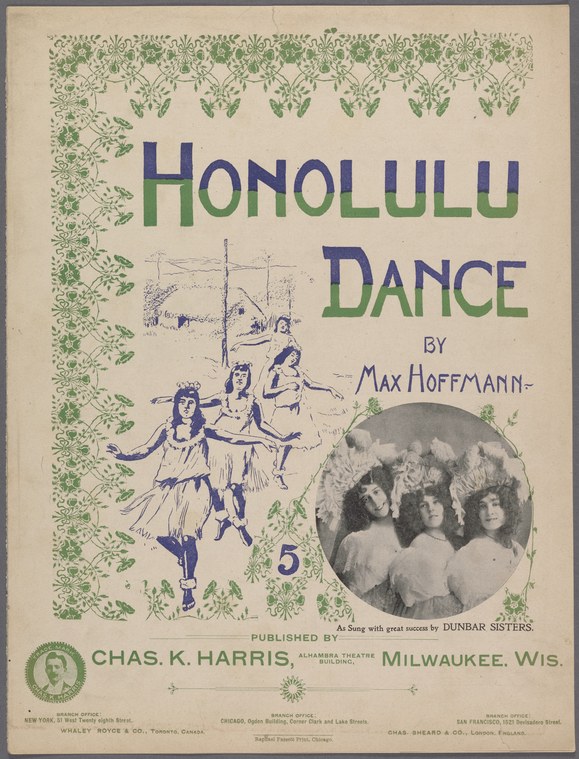
This is a sheet music cover for a composition titled "Honolulu Dance" by Max Hoffmann, published by Chas. K. Harris of Milwaukee, Wisconsin. The cover features a decorative Art Nouveau border in green leaf and vine patterns framing the entire page. On the left side, a pen-and-ink sketch shows four dancers in motion, rendered in blue-black line: they wear loose, flowing garments and are depicted in animated, gestural poses suggesting rapid movement and playfulness. On the right side is a circular photograph showing three young women in white formal dress or lingerie, posed closely together with gentle, intimate expressions. The juxtaposition of the energetic sketch and the composed photograph creates a marked tonal contrast. At the bottom, a credit line notes the song was sung by the Dunbar Sisters. The typography uses bold sans-serif capitals for the title, split between blue and green lettering.
The dancing
The sketch on the left shows four figures in loose, unstructured movement, drawn with quick, expressive lines that emphasize fluidity rather than precision. The bodies appear to be in mid-motion with limbs extended and weight shifted, suggesting folk or social dancing rather than trained technique. The figures wear simple, draped clothing that moves with them. The photograph on the right presents three women in a static, frontal pose—formally dressed and composed for the camera rather than in action. The contrast suggests the cover is advertising both the lively, improvisational spirit of the dance and the performers (the Dunbar Sisters) associated with the piece.
The dance depicted
This is a popular song and dance number from the early 1900s, part of the vaudeville and musical theater repertory. The term "Honolulu Dance" likely refers to a stylized, theatrical interpretation of Hawaiian or Pacific dance adapted for American entertainment stages—not an ethnographic representation. The sketch depicts the kind of expressive, rhythmic social dancing that would have been performed in variety shows or cabarets of the era. The Dunbar Sisters were prominent African American performers in vaudeville, and this number reflects the cross-cultural performance aesthetics of early twentieth-century American popular entertainment, where Pacific imagery and movements were exoticized for white audiences.
How it was made
This is a color lithographic sheet music cover, a standard format for popular song publishing in the early 1900s. Lithography allowed for bold, flat areas of color and expressive line work in combination, making it ideal for eye-catching promotional material. The cover combines a hand-drawn sketch in ink with a halftone or gelatin silver photograph inset, techniques that could be combined in the lithographic printing process. The ornamental border is characteristic of Art Nouveau design, which dominated commercial graphics of the period. As sheet music, this cover was mass-produced and distributed through music stores and theaters, making it a form of popular media designed to promote both the song and the performers.
About this work
This is a sheet music cover for a popular dance number of the early 1900s, advertising both a composition and its famous performers. The cover documents how Hawaiian and Pacific dance imagery was appropriated and adapted for American theatrical entertainment during this period. The contrast between the energetic, abstracted sketch of dancers and the formal photograph of the Dunbar Sisters illustrates the tension between the fantasy of exotic dance and the celebrity of the performers themselves. It is a primary source for understanding how non-Western dance was marketed to American audiences, and how African American women navigated performance roles in an era of rigid racial and cultural boundaries.
How to look at it
Observe the energy and line weight in the sketch—the artist used quick, loose strokes to convey movement and play rather than anatomical accuracy, a choice that emphasizes performance verve over technical precision. The decorative border channels contemporary Art Nouveau aesthetics, signaling modernity and commercial appeal rather than ethnographic authenticity. Notice the stark contrast between the animated sketch and the composed, formal photograph: this juxtaposition is not accidental but deliberate marketing strategy, balancing the promise of lively performance with the celebrity and composure of the named performers. The color palette—earthy green in the border, navy and flesh tones in the figures—was typical of lithographic printing of the era.
The artist
Max Hoffmann was an active composer and music publisher in the early 1900s, producing songs for vaudeville, musical theater, and popular consumption. The cover was published by Chas. K. Harris, a major music publisher based in Milwaukee, Wisconsin, known for distributing popular songs and theatrical material to a national market. Hoffmann's work represents the vast, largely uncredited output of commercial composers who supplied the entertainment industry with music suited to dancers, singers, and theatrical performers.
The period
In the early 1900s, American popular entertainment was consuming exotic imagery and narratives from across the globe as part of imperial expansion and the vaudeville boom. Hawaii, newly annexed by the United States in 1898, became a source of fascination and appropriation in American popular culture. Concurrently, African American performers like the Dunbar Sisters were achieving unusual visibility in entertainment, though always constrained by segregation and stereotyping. The sheet music cover market was at its peak, before radio and recorded music displaced it as the primary medium for promoting popular songs. Lithographic color printing had made such covers affordable and visually striking, turning them into collectible commodities in themselves.
Where it lives
This cover is held by the New York Public Library as part of their extensive collection of American sheet music and popular entertainment materials. The publication information indicates distribution across multiple cities (New York, Toronto, Chicago, London) and three separate publishers, suggesting this was a nationally and internationally circulated commercial product.
Dance in this work
Questions about this work
What is a 'Honolulu Dance' in this context?
It is not a transcription of Hawaiian dance tradition, but a popular theatrical number created for American vaudeville and musical comedy stages. Early twentieth-century entertainment producers used Hawaiian and Pacific imagery as exotic, marketable content for white audiences, often with little historical accuracy. The 'Honolulu Dance' was one of many such stylized numbers that dominated variety entertainment during this period.
Who were the Dunbar Sisters?
The Dunbar Sisters were African American performers active in vaudeville and popular music in the early 1900s. Despite their visibility as entertainers, they have been largely written out of popular music and dance history. This cover is one of few surviving records of their careers and the work they performed.
Why is this cover at the library instead of a museum?
Sheet music covers were popular, mass-produced items distributed through music stores and theaters—commercial media rather than fine art. Public libraries collected them as documents of popular culture and as reference materials for musicians and music history. The NYPL's sheet music collection is one of the largest in the world and an invaluable research resource.
What does the Art Nouveau border tell us about the date?
The flowing, organic leaf and vine patterns are characteristic of Art Nouveau design, which dominated commercial graphics from roughly 1890 to 1910. This stylistic choice helps date the cover to the early 1900s and signals that it was a contemporary, fashionable product when it was published.
More dance artwork