49 works in this view — arrow keys or swipe to move between them.
Dance in Art
Unidentified ballet
Unknown artist
- Medium:
- Dance:
- Ballet
- Source:
- New York Public Library
- Rights:
- Public domain — free to use, share and adapt.
- Recorded as:
- public_domain
This print documents the visual and bodily language of Romantic ballet at its height—the ethereal, weightless quality, the emotional inwardness, the fashion and grooming of the period. For dance historians, it is a primary source showing not only how bodies moved but how movement was idealized, framed, and circulated to the public. The shift from court ballet to commercial theater and lithographic publicity is written into the object itself.
What you are looking at
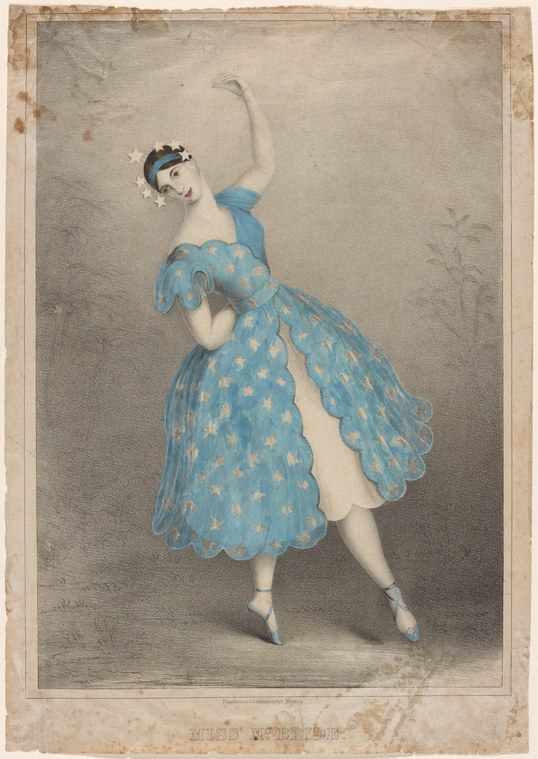
A single female dancer in a balletic pose dominates the composition against a neutral gray background. She wears a striking blue dress patterned with small gold or yellow stars, with a voluminous skirt that extends to mid-calf in a shape characteristic of early 19th-century fashion. The skirt has pronounced scalloped edges at the hem and flows loosely from the bodice. Her upper body is bare-shouldered; she wears a short blue sleeve or epaulette on one shoulder. Her dark hair is arranged on top of her head in an elaborate style typical of the 1830s–40s, adorned with what appears to be a small tiara or jeweled ornament. She stands en relevé (on the balls of her feet), her weight lifted and her body elongated in a graceful line. One arm is raised and curved overhead; the other extends to the side. Her head is tilted back and to one side, her gaze directed upward, creating an ethereal and romantic quality. The print has aged to a warm cream tone, with visible creasing and staining characteristic of 19th-century paper.
The dancing
A single dancer is portrayed in classical ballet position, rising onto her toes with both feet in a lifted stance. Her left arm curves overhead in a soft arc; her right arm extends to the side at shoulder height, both with the relaxed, rounded port de bras typical of Romantic ballet. Her torso is slightly arched backward in a graceful curve, her head tilted back with an expression of dreamy reverie. The pose suggests a moment of weightless elevation and emotional abandon rather than a rigid geometric alignment. The artist has captured the balletic vocabulary of the 1830s–40s period with anatomical plausibility.
The dance depicted
This is a Romantic ballet dancer, almost certainly from the 1830s–40s based on costume and style. The subject and composition are consistent with theatrical lithographs of professional ballet dancers from this era, often produced to publicize performers or document celebrated roles. The pose and costume suggest a sylph-like or supernatural character—a spirit or otherworldly being—which was a stock romantic type in ballets of this period. The dancer's lifted, ethereal quality and the backward tilt of her head convey the transcendent mood central to Romantic ballet aesthetics. Without an inscription identifying the dancer or role, a specific ballet cannot be named with confidence, but the visual language places this firmly within the conventions of Paris or London theatrical practice of the early Romantic period.
How it was made
This is a hand-colored lithographic print, a medium well suited to theatrical publicity in the 19th century. The soft gradations of tone in the background, achieved through lithographic wash, create atmospheric depth, while the darker contours of the figure are drawn with precision. The coloring—applied by hand after printing, as was standard—shows the characteristic uneven edges and slight color shifts that distinguish hand-colored lithographs from modern chromolithography. This technique was economical enough to allow mass production for distribution to theaters and collectors, yet refined enough to serve as a prestigious souvenir of a celebrated performance or dancer. The print's circulation through the New York Public Library collection suggests it was valued as a record of theatrical history.
About this work
This is a hand-colored lithographic print from the early Romantic era of ballet, likely 1830s–40s, depicting a celebrated female dancer in a moment of ethereal, weightless grace. The blue star-patterned dress and hairstyle are consistent with early Romantic period fashion; the pose, footwork, and emotional tone are unmistakably balletic. The work belongs to a substantial tradition of theatrical prints documenting celebrated dancers and roles of the period—objects created for publicity, commemoration, and collection by an emerging audience of ballet enthusiasts. It represents a moment when ballet was becoming the dominant theatrical dance form in Europe and when lithography made possible the wide circulation of images of performers.
How to look at it
Attend to the dancer's weight distribution and the articulation of her feet—the relevé position is achieved not by point shoes alone but by a specific muscular and postural technique that the artist has rendered convincingly. Notice how the arm positions follow the soft curves characteristic of Romantic ballet, neither geometrically rigid nor naturalistic, but stylized toward grace and transcendence. The backward tilt of the head and the upward gaze are not accidental: they anchor the emotional and spiritual content of Romantic ballet, placing the dancer in a trance or reverie. Compare the costume—the star-patterned dress, the bare shoulders, the elaborate hairstyle—to other contemporary prints and fashion plates to see how closely theatrical dress mirrored or exceeded contemporary women's fashion.
The period
The 1830s–40s were the golden age of Romantic ballet in Europe. Works like La Sylphide (Paris, 1832) and Giselle (Paris, 1841) established the grammar of Romantic movement—pointe work, weightlessness, supernatural or melancholic narratives, and the visual dominance of the female dancer. This was also the era in which lithography became the dominant medium for theatrical publicity and souvenir prints. Professional dancers like Marie Taglioni, Fanny Elssler, and Carlotta Grisi achieved international celebrity, and lithographic prints of them in famous roles were collected by fans and sold to theatergoers. The technology allowed rapid, relatively inexpensive reproduction of high-quality images suitable for framing or album preservation. This democratized access to images of elite performers and helped establish ballet as a visual and commercial as well as live theatrical practice.
Where it lives
This print is held in the New York Public Library collection, which acquired theatrical and dance-related images as part of its mission to document American and international performance history. The source notation indicates it was catalogued as a print from an unidentified ballet, suggesting it arrived without inscription or documentation of the specific dancer or role depicted.
Dance in this work
Questions about this work
Is this a real person or an imaginary dancer?
Almost certainly a real professional ballet dancer, depicted in a specific celebrated role or costume. Theatrical lithographs of this era were created to publicize actual performers and their famous parts. However, without an inscription or title, the specific dancer and ballet cannot be identified from the image alone.
What is she wearing, and why does the dress look different from modern ballet costumes?
The blue star-patterned dress is consistent with early Romantic-era theatrical fashion, roughly 1830s–40s. The style reflects contemporary women's dress of the period—the scalloped hem, the loose skirt, the bare shoulders and minimal sleeves—while being somewhat exaggerated for theatrical effect. Modern ballet costumes evolved later, influenced by later Romantic and Classical traditions.
How do I know this is ballet and not another kind of dance?
The relevé position (rising onto the balls of the feet), the port de bras (arm positions), the lift and elongation of the torso, and the emotional register of the pose are all hallmarks of theatrical ballet as practiced in Europe in the 19th century. The costume and setting also reflect ballet's social status and theatrical context at that time.
What is a hand-colored lithograph, and why is it important?
A lithographic print is an image drawn on stone with a greasy crayon, then inked and pressed onto paper—a fast, relatively inexpensive process that could produce many copies. Hand-coloring was then applied by hand to each print. This made theatrical publicity and souvenir images affordable and widely circulated, turning individual performances into collectible commodities and helping establish the modern culture of dance spectatorship and fandom.
More Ballet artwork