49 works in this view — arrow keys or swipe to move between them.
Dance in Art
Unidentified ballet
Unknown artist
- Medium:
- Dance:
- Ballet
- Source:
- New York Public Library
- Rights:
- Public domain — free to use, share and adapt.
- Recorded as:
- public_domain
This work is evidence of the Romantic ballet aesthetic at its point of maximum cultural prestige. It shows the standardized costume, pose, and body ideal that defined the female classical dancer in the 1830s–1840s—a moment that shaped ballet training and female presentation for nearly two centuries. For dancers and historians, it is a primary visual document of how the profession understood itself during its first period of major commercial success.
What you are looking at
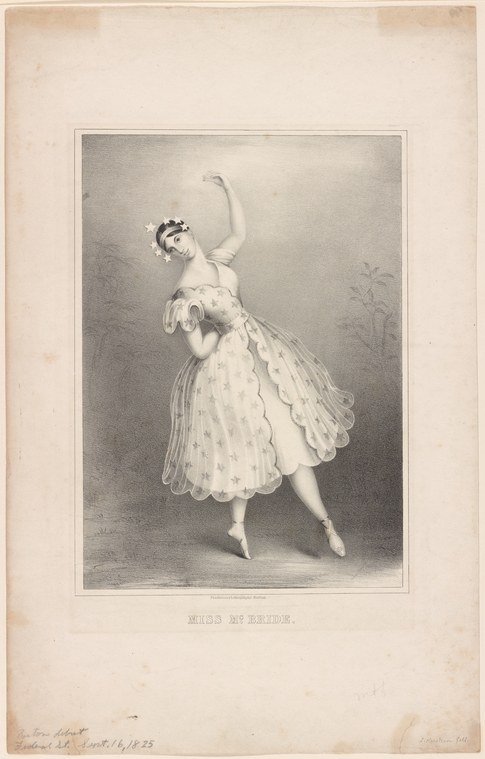
A young female dancer stands alone against a neutral grey background in a three-quarter pose, her body angled toward the viewer's left. She wears a white Romantic-era ballet costume: a fitted bodice with a low décolletage and a voluminous skirt of layered tulle reaching mid-calf, the hem finished with scalloped edges. Her dark hair is styled up and adorned with what appears to be a decorative comb or ornament. Her right arm extends gracefully upward and back, while her left arm is held at mid-height with a soft curve. She stands en relevé on her left leg, with her right leg extended behind and slightly to the side, suggesting movement through space. The figure is rendered as a lithograph in shades of grey and black, with fine hatching to suggest fabric texture and form. The composition is formal and frontal, typical of theatrical portraiture.
The dancing
The dancer displays the characteristic épaulement (épaulement) and arm carriage of Romantic-era ballet, with raised, rounded shoulders and arms held in a graceful, elongated frame. She stands in a clear relevé position on one supporting leg, the other extended in an attitude derrière or similar extension. The head is gently tilted and turned, completing the line of the extended arm. The posture conveys lightness and ethereal quality rather than dramatic virtuosity; the body is upright and elongated throughout. The proportions and the dancer's solitary presentation suggest a principal female role at a moment of stillness or apotheosis within a narrative.
The dance depicted
This is a Romantic-era classical ballet, almost certainly from the 1830s–1840s based on the costume and pose conventions. The tutu length, scalloped hem, and voluminous silhouette are diagnostic of this period. The dancer's pose—the uplifted arm, extended leg, and ethereal quality—echoes the vocabulary of works like La Sylphide (1832) or Giselle (1841). The solitary, portrait-like presentation and the figure's apparent weightlessness and beauty are characteristic of how the ballet sylph or otherworldly female figure was depicted and understood during this moment. The image documents the ideal of the Romantic ballerina at the height of European fashion for the style.
How it was made
This is a lithograph, a planographic print process that allowed finer detail and softer tonal gradation than engraving alone. The subtle modelling of the figure, the delicate rendering of the tulle skirt, and the controlled grey tonality across the background are consistent with lithographic printing of the period. Lithographs of theatrical subjects were a major form of circulation and promotion for opera houses and ballet companies across Europe; they reached a broader public than original paintings and were often sold singly or in series. The presence of a printed title cartouche below the figure (reading 'MISS ST HELENE' or similar) indicates this was an individual portrait-print of an identifiable dancer, a format common in the 1830s–1840s.
About this work
This is a documentary portrait of a Romantic-era prima ballerina, captured in a characteristic pose and costume of her moment. It belongs in a dance gallery because it shows, with precision and elegance, what the ideal female dancer looked like and how she carried her body during the period when ballet became a mass cultural phenomenon in Europe. The Romantic tutu—ankle-length, white, layered, and ethereal—and the dancer's weightless posture on relevé are visual signatures of a revolution in ballet aesthetics, a shift away from the technical display of the Baroque and early 19th-century styles toward an ideal of supernatural beauty, delicacy, and otherworldliness. The print is a historical record of how dancers were dressed, how they stood, and how they were celebrated.
How to look at it
Note the exactness of the costume: the cut of the bodice, the layered transparency of the tulle, the length and proportions of the skirt. These details are historically precise and constitute a visual vocabulary. Observe the pose—the uplifted arm, the extended leg, the turned-out stance—as a grammar of refinement and control rather than virtuosic display. The dancer's face and posture express calm beauty and a kind of noble detachment. The artist has frozen a moment of apparent stillness or composure, not action; this is how the Romantic era chose to represent its ideal female dancer: as a vision rather than an athlete.
The period
This lithograph was produced during the height of the Romantic ballet movement in Europe, a moment when ballet—long a court and noble art form—became a mainstream entertainment for urban middle-class and aristocratic audiences. Works like La Sylphide (1832) and Giselle (1841) were international sensations, and successful dancers became celebrities. The Romantic tutu emerged as the visual signature of this era: a full skirt of white tulle, shorter at the front than the historical theatrical skirt, designed to emphasize weightlessness and the illusion of flight. Lithographic prints of famous dancers became a standard form of theatrical promotion and fan culture. The idealization of female beauty and otherworldliness in Romantic ballet was inseparable from the period's broader artistic obsession with ethereal, supernatural, and melancholy subjects.
Where it lives
This lithograph is held in the New York Public Library collection. It is identified in the library's records as a print from a theatrical collection, likely part of the Library's holdings of 19th-century European dance and theatre ephemera. Prints of this kind were produced in runs and circulated commercially as souvenirs and advertisements.
Dance in this work
Questions about this work
What is the dancer wearing?
A Romantic-era ballet tutu: a fitted white bodice with a low neckline, and a full skirt of white layered tulle reaching to mid-calf with a scalloped hem. Her dark hair is styled up and pinned. This costume is typical of the 1830s–1840s.
What dance or style is this?
Romantic-era classical ballet, most likely from the 1830s–1840s. The costume, pose, and aesthetic are consistent with works like La Sylphide and Giselle, which defined the style. The ethereal, weightless quality and the solitary, portrait-like presentation are diagnostic of Romantic ballet.
Why does the dancer stand on one leg like that?
She is on relevé, with her weight lifted onto the ball of one foot. This technique—standing as high as possible on the toes—creates the visual illusion of lightness and weightlessness that was central to the Romantic ideal. It was one of the technical innovations that defined ballet in this era.
Who was the dancer?
The catalogue record does not identify her by name with certainty. The title cartouche below the figure may carry her name or stage name, but the library's current cataloguing does not record it. She was likely a principal dancer of the 1830s–1840s, famous enough to be commemorated in a lithographic portrait.
More Ballet artwork