49 works in this view — arrow keys or swipe to move between them.
Dance in Art
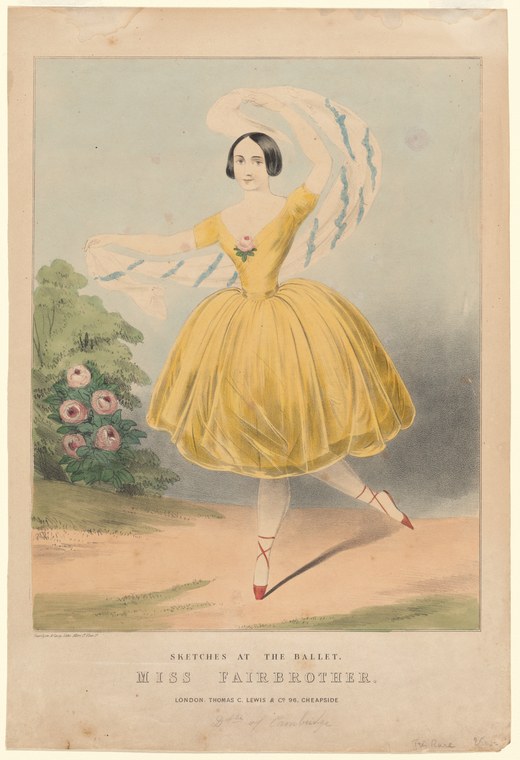
Sketches at the ballet
Unknown artist
- Medium:
- Drawing/Sketch
- Dance:
- Ballet
- Source:
- New York Public Library
- Rights:
- Public domain — free to use, share and adapt.
- Recorded as:
- public_domain
The work captures the visual identity of Romantic ballet at a key moment in its development, showing how the dancer's body, costume, and props combined to create the illusion of weightlessness that defined the era. As a commercial print, it reveals how ballet was consumed and remembered by audiences—not through elaborate documentation, but through affordable, portable images sold in theaters and print shops. The prominence of the parasol as both fashion accessory and choreographic element suggests the period's interest in naturalizing the staged body within contemporary dress and social codes.
What you are looking at
A solitary female dancer in a golden-yellow ball gown dominates the composition, captured mid-movement in a balletic pose against a clouded sky. She wears a voluminous skirt with deep pleating that suggests rapid rotation or suspension, and holds a large feathered parasol aloft in her right hand, its pale fabric catching light. Her posture is balletic—weight lifted through the torso, one leg extended in a controlled line, the other supporting—and her dark hair is styled in a neat coil at the back of her head. To the left, a small topiary or flowering shrub with pink blooms sits on what appears to be a manicured garden terrace, establishing an outdoor theatrical setting. The stage floor is rendered in warm earth tones with green grassed areas, and soft directional lighting casts a delicate shadow beneath the dancer, emphasizing her elevation and the artificiality of the scene. The overall effect is romantic and theatrical—a posed moment rather than documentary.
The dancing
The dancer's body position reads as a controlled balletic moment: her supporting leg is straight and strong, her working leg extended with precision, her torso upright and engaged, her arms positioned to balance the parasol while maintaining upper-body alignment. Her head is held erect, facing the viewer with a composed expression. The parasol, held at an angle away from her body, becomes both costume accessory and compositional element, suggesting movement through space. There is only one figure, isolated within the frame.
The dance depicted
This is a theatrical ballet performer, likely from the Romantic era (mid-19th century) based on the costume, pose, and theatrical setting. The dancer is shown in a classic Romantic ballet moment: elevated, ethereal, and poised in an attitude or arabesque-like position that would be achieved either in a sustained lift or at the peak of a jump. The parasol, an accessory of fashionable dress, has been incorporated into the choreography as a prop, suggesting this may document a specific ballet or a performance number featuring contemporary costume elements. The isolation of the figure against a theatrical backdrop and the emphasis on verticality and lightness align with Romantic ballet's aesthetic priorities, though the work itself is a sketch or illustration rather than notation of an actual performance.
How it was made
This is a hand-colored lithograph or engraving, likely a commercial theatrical print from the mid-19th century. The technique combines line engraving (for the figure and parasol) with hand-applied watercolor or tinted lithographic ink (for the skirt, sky, and landscape elements). The verso and publication line confirm production by Thomas G. Lewis & Co., a London theatrical print publisher, indicating this was a mass-produced souvenir or promotional item for audiences. The style—soft modeling of the fabric, delicate line work, and careful attention to the fashionable dress—is typical of commercial ballet imagery of the 1840s–1860s, designed for sale to theatergoers and collectors.
About this work
This is a mid-19th-century theatrical print documenting a moment from a Romantic ballet performance, likely starring a dancer named Miss Fauberother (as indicated by the title and publication information). The work captures the key visual language of Romantic ballet: the ethereal, elevated female body, the emphasis on lightness and verticality, and the integration of contemporary fashionable accessories into the stage spectacle. The hand-colored print was produced as a commercial souvenir by a London publisher, making it both a record of a specific performance and evidence of how ballet imagery was circulated and consumed by the Victorian theater-going public. For dance historians, it documents the aesthetics, costume practices, and commercial production of mid-century ballet.
How to look at it
Note the moment the artist chose to freeze: not a landing or a line, but a sustained, graceful pose that emphasizes elevation and balance rather than movement. The parasol is held as an extension of the arm, integrated into the bodily line rather than merely carried. Observe how the deep pleating of the skirt suggests it has been set in motion and is now arrested mid-swirl—a convention of ballet imagery that conveys dynamism within stasis. The theatrical setting (the garden, the sky) exists only as backdrop to the body; the real subject is the dancer's silhouette and carriage.
The artist
The lithograph was published by Thomas G. Lewis & Co., a London firm specializing in theatrical prints and portraits during the mid-19th century. The artist's name is not recorded on the image; such commercial prints were often produced by workshop teams of engravers, colorists, and lithographers rather than individual credited artists. The firm's practice of issuing prints of current stage performers was standard theatrical commerce in London during the 1840s–1860s, serving both as promotional material and as souvenirs for attendees.
The period
This print dates to the height of Romantic ballet in Europe, when works like *La Sylphide* (1832) and *Giselle* (1841) had established the aesthetic of the ethereal, supernatural female dancer as the dominant mode. The mid-19th century saw rapid professionalization of lithographic theater portraiture; multiple versions of popular dancers were produced and sold in quantities, creating an early form of celebrity image circulation. This coincided with the rise of the star system in ballet and the increasing popularity of theater-going among the urban middle class, for whom these prints were affordable mementos. The work also sits within a broader Victorian culture of refined amateur drawing and theatrical collecting.
Where it lives
The print comes from the New York Public Library's collection of theatrical imagery and performance documentation. As a commercial lithograph from a London publisher, it was widely distributed and survives in multiple institutional collections. It belongs to a substantial genre of mid-Victorian theater prints, most now held in research libraries rather than museums.
Dance in this work
Questions about this work
Who was Miss Fauberother?
The print identifies her as the performer, but detailed biographical records for mid-19th-century ballet dancers are incomplete. She appears to have been active in London theaters during the 1840s–1860s, a period when many dancers had brief or peripatetic careers. The print itself may be the most durable record of her stage presence; many performers of this era left little trace beyond such theatrical imagery.
Is this a record of a real performance or an idealized image?
It is most likely both. The print documents a specific performance moment—the pose, the costume, and the prop arrangement suggest an actual choreography or performance scene. However, like all theatrical prints of the period, it presents an idealized image: the lighting is softened, the line clarified, and the body positioned at its most flattering angle. The print is not documentary photography but a curated theatrical image designed for sale.
What does the parasol tell us about Romantic ballet?
The parasol represents the period's interest in naturalizing the theatrical body within contemporary bourgeois dress and social codes. Rather than abstract costume, the dancer wears fashionable accessories that audiences recognized from their own lives. This grounding of the fantastic (the elevated, ethereal dancer) in the everyday (the parasol, the garden setting) was central to Romantic aesthetic strategy.
Why are so many copies of this print in collections?
Theatrical prints were mass-produced and inexpensive—well within reach of middle-class theater-goers. They were sold in theaters, at print shops, and through mail order, making them among the most widely circulated images of performers in the 19th century. Multiple copies survive because they were made in quantity and valued as souvenirs.
More Ballet artwork