49 works in this view — arrow keys or swipe to move between them.
Dance in Art · 2023
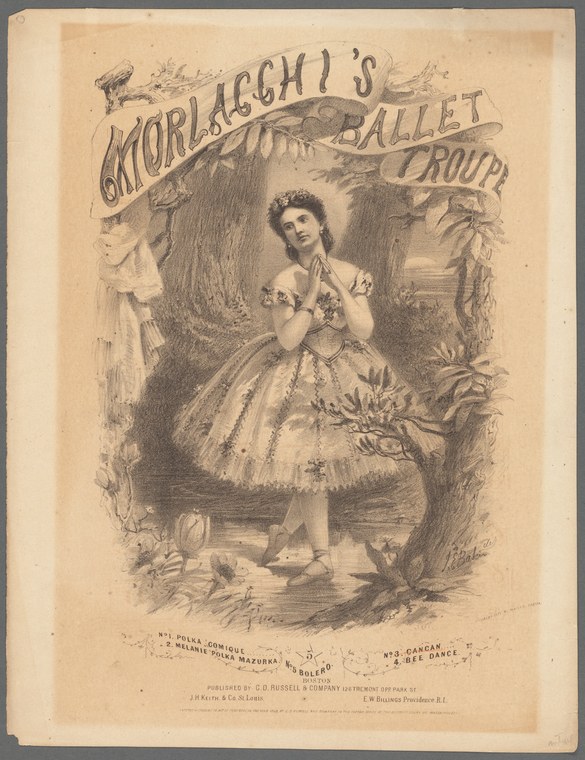
Morlacchi's ballet troupe
Unknown artist
- Medium:
- Dance:
- Ballet
- Source:
- New York Public Library
- Rights:
- Public domain — free to use, share and adapt.
- Recorded as:
- public_domain
This image is primary evidence for how Romantic ballet was marketed and consumed in the 19th century, and for the celebrity culture that surrounded professional dancers. For historians, it documents the costume, pose conventions, and promotional apparatus of the era; for dancers, it shows what counted as the aesthetic ideal of Romantic style—upright carriage, elegant port de bras, and a costume designed for visual spectacle rather than virtuosity.
What you are looking at
A woman in an elaborate mid-19th-century ball gown stands center-stage in a sylvan setting, surrounded by flowering shrubs and draped fabric. She wears a white tulle skirt with floral decoration at the bodice and waist, her posture upright and graceful. The engraving shows her in a moment of theatrical poise rather than active movement—a pose typical of Romantic ballet publicity. Behind and around her are suggestions of landscape: tall trees frame the composition, and what appears to be stage drapery or painted scenery creates depth. The title identifies this as Morlacchi's ballet troupe, and inscriptions at the base name the principal dancer and supporting cast. The overall effect is one of elegance and spectacle designed to advertise the troupe and its star to a theatre-going public.
The dancing
A single female dancer is the focus, posed with weight evenly distributed, arms positioned at mid-frame in a conventional balletic port de bras. Her posture is upright but not strained, the pose suggesting a moment between movements rather than mid-jump or extreme extension. No male partner is visible. The composition emphasizes her silhouette and costume rather than any virtuosic position or moment of exertion.
The dance depicted
This is a Romantic-era ballet publicity print, almost certainly depicting classical ballet technique. The woman's costume—the tulle skirt, fitted bodice, and overall silhouette—is standard for mid-19th-century Romantic ballet. Morlacchi was known to be a prominent dancer of this period, though the figure depicted here is shown in a posed moment of theatrical elegance rather than in performance of a specific step or phrase. The print was designed to circulate the dancer's image to audiences and promote the troupe's productions.
How it was made
This is an engraving on paper, printed commercially. The technique allowed fine linear detail in the costume and delicate rendering of the fabrics, particularly the tulle skirt and floral accents. Commercial engraving of this kind was the standard medium for theatrical celebrity portraiture in the 19th century—affordable to print in quantity, suitable for sale to theatre patrons and publication in programmes, and capable of capturing the flattering likeness and costume detail necessary to advertise a star performer. The quality and finish suggest professional theatrical promotion rather than fine art.
About this work
This is a 19th-century theatrical publicity engraving advertising a Romantic-era ballet dancer and her troupe. It belongs to the tradition of celebrity portraiture in dance: an image designed not for exhibition but for circulation—sold in theatres, kept by enthusiasts, and used in promotional materials. It documents both the costume and the public persona of Romantic ballet, a crucial moment when ballet became a major commercial entertainment and dancers became stars whose faces and bodies were commodified and circulated to a mass audience. The print records not how the dancer danced but how she wanted to be seen.
How to look at it
Notice the pose: upright, graceful, but static. This is not a moment of virtuosity or narrative drama, but a presentation pose designed to show off the costume and the dancer's bearing. Attend to the costume in detail—the structure of the tulle skirt, the floral decoration, the fitted bodice—as these details were what audiences paid to see and what performers were famous for. The landscape setting, sketched in lightly behind, is theatrical artifice: a backdrop suggesting romance and otherworldliness, the standard scenic frame for Romantic ballet.
The artist
The artist is not recorded. The engraving bears a printer's mark (C.D. Bossell & Company, Fetter Lane, London) and was published commercially, likely by a specialist theatrical print publisher. Such prints were created by professional engravers working from portraits or sketches, often without individual attribution.
The period
This engraving dates to the peak of Romantic ballet in Europe, a period (roughly 1830–1850s) when ballet became a major theatrical form and male choreographers created narrative ballets designed to showcase female dancers. La Sylphide (1832) and Giselle (1841) were defining works of the era. The costume and pose conventions visible here reflect the aesthetic ideals of the period: the emphasis on the ethereal, the pointe shoe as a new technical standard, and the female dancer as the primary focus of attention. Commercial dance portraiture exploded during this period as part of a broader theatrical celebrity culture.
Where it lives
The print is held in the New York Public Library collection. It is a commercial theatrical publication, one of thousands of such promotional prints produced for public sale in the 19th century.
Dance in this work
Questions about this work
Who was Morlacchi?
Giuseppina Morlacchi was an Italian-American dancer prominent in 19th-century theatrical dance. She was known for her performances in both ballet and popular theatrical dance, and toured extensively in the United States and Europe. This print advertises her troupe during her active career as a star performer.
Why is this a print and not a painting?
Commercial engraving was the standard technology for theatrical publicity in the 19th century. It allowed a single image to be printed in large quantities and sold cheaply to theatre patrons, making it an effective and economical form of celebrity promotion. Fine art paintings were not suitable for this purpose.
Is the dancer actually performing here?
No. This is a posed portrait, designed to show off the dancer's costume and elegant carriage. It is not a record of a specific moment in a performance, but rather a flattering image created for publicity purposes.
What does the costume tell us?
The white tulle skirt, fitted bodice, and floral details are standard Romantic-era ballet costume. The emphasis on the skirt and its silhouette reflects the aesthetic priorities of the period—the ballerina's body was framed and displayed through costume, and the lightness and flow of the tulle was a key part of the theatrical effect.
More Ballet artwork