39 works in this view — arrow keys or swipe to move between them.
Dance in Art · 1911
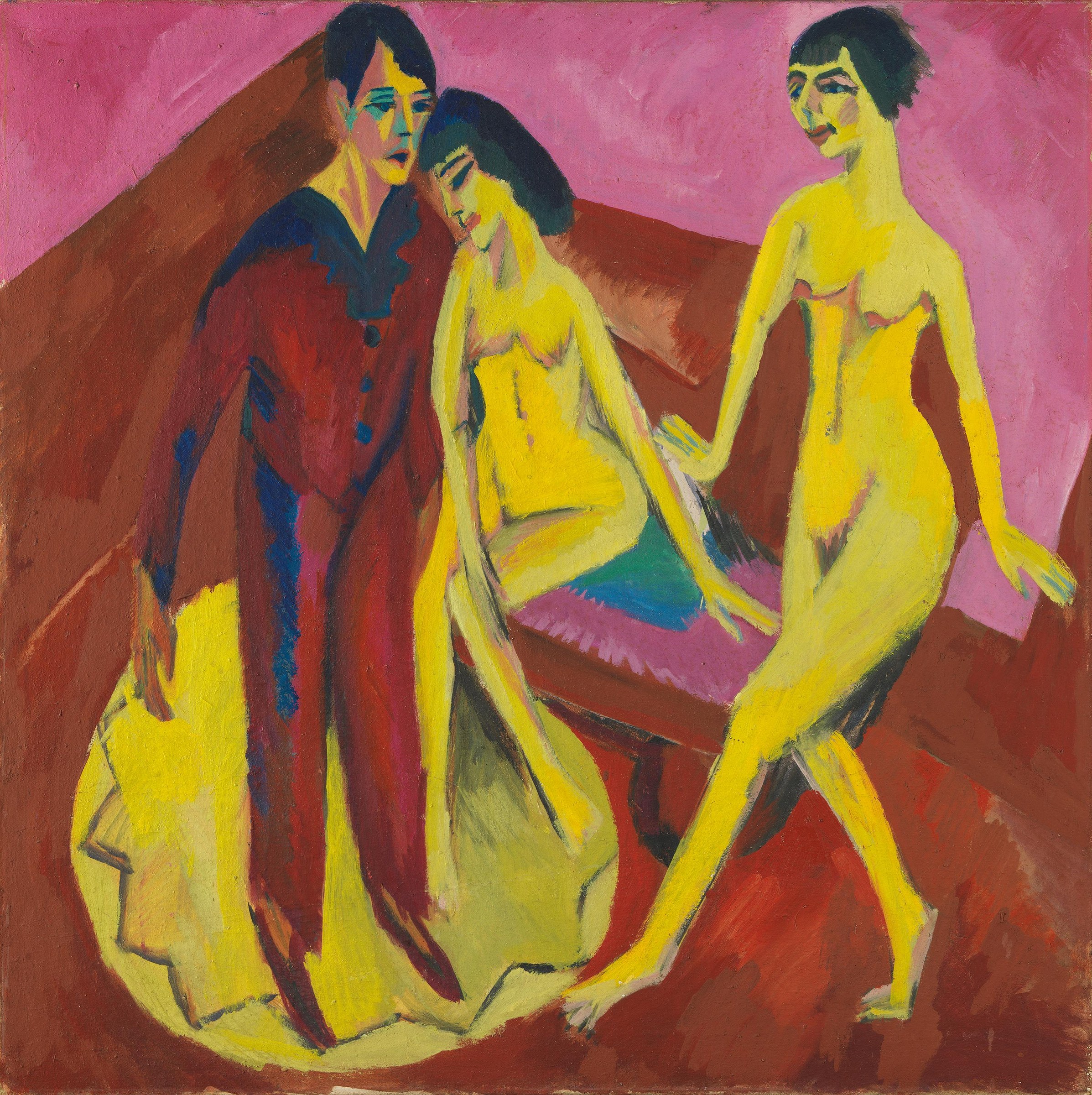
1911 Kirchner, Ernst Ludwig Tanzszene anagoria
Ernst Ludwig Kirchner
- Medium:
- Oil Painting
- Era:
- 1900-1920 (Ragtime/Early Jazz)
- Source:
- Wikimedia Commons
- Rights:
- Public domain — free to use, share and adapt.
- Recorded as:
- Public Domain
Kirchner's *Tanzszene* is a key document of how early 20th-century visual artists engaged with popular dance as a subject of aesthetic and social significance. For dance historians, it offers insight into the visual culture of the dance hall, the costumes and accessories of Weimar cabaret, and the way modernist artists understood dancing bodies as vehicles for expressing modernity, sexuality, and urban experience.
What you are looking at
A vivid, crowded cabaret or dance hall scene rendered in expressionist style, dominated by warm terracottas and deep reds. Five figures fill the composition: two couples dancing in the upper portion, their bodies intertwined in close contact, and a fifth figure in the lower left wearing formal dark dress. The dancers are nude or nearly so, rendered in warm flesh tones against the warm background. Two of the dancing figures wear striking accessories—one sports a white fan-like collar or ruff, the other a prominent red feathered headdress. The paint is applied with visible, gestural brushwork; outlines are drawn in dark blue or black, creating a sense of movement and emotional intensity. The setting is claustrophobic and indoor, the background texture suggesting walls or drapery rather than open air.
The dancing
All five figures are shown in close proximity, pressed together in a tightly composed space. The two main couples are in direct contact—bodies touching, limbs intertwined. The upper couple's pose suggests an embrace or waltz hold, with one figure's arm raised. The woman in the red headdress leans into or against her partner. The figures are frontal and profile, their faces simplified and expressive rather than naturalistic. Weight appears to shift between partners; the poses suggest active motion rather than static positioning, though the exact footwork is not legible.
The dance depicted
This is most likely a German cabaret or ballroom scene, possibly a Tango or social ballroom dance, depicted in the early modernist idiom of German Expressionism. The close partner contact, the formal dress accessories (the collar and headdress suggest Weimar-era nightclub costume), and the theatrical setting all point to urban social dancing of the 1910s–1920s. The embrace and the couple's orientation suggest a Latin or ballroom hold. Kirchner was fascinated by Berlin's dance halls and cabarets; this work belongs to his practice of documenting and transforming the sexuality and energy of modern urban nightlife into high art.
How it was made
Oil painting on canvas. The artist has used bold, gestural brushstrokes and a limited palette dominated by reds, blues, yellows, and flesh tones. Dark linear outlines define forms and create visual rhythm. The paint is applied with visible directional strokes that enhance the sense of movement and psychological intensity characteristic of German Expressionism. The technique allows for rapid, emotional representation rather than descriptive detail—bodies are simplified into color and gesture.
About this work
Ernst Ludwig Kirchner's *Tanzszene* is an expressionist representation of modern urban dance, likely a cabaret or ballroom scene from early 20th-century Berlin. The painting condenses multiple dancers into a claustrophobic, emotionally charged interior, using distorted bodies, garish color, and expressive line to convey the sensuality and social energy of the dance hall rather than to document the specific movements of a dance form. Kirchner's work belongs to the intersection of modernist art and modern social dance—the painting is as much about modernity and liberation as it is about what the dancers are actually doing.
How to look at it
Look first at the pressing together of the figures and the way Kirchner uses color and line to suggest movement without depicting specific footwork. The red background and the flesh tones create visual warmth and intimacy; the dark outlines fragment and energize the forms. Notice the accessories—the white collar and red headdress—which are rendered with particular vividness and seem to be markers of modernity and sexual display. The painting captures a moment of social and sensual encounter; the viewer is placed inside the dance hall, surrounded by bodies, rather than observing from a distance.
The artist
Ernst Ludwig Kirchner (1880–1938) was a founder of Die Brücke, a crucial expressionist movement in early 20th-century German art. He was obsessed with Berlin's nightlife, particularly its dance halls, cabarets, and street scenes, which he represented repeatedly in paintings, drawings, and prints. His work is characterized by distorted human forms, vivid or acid color, and emotional intensity; he sought to convey psychological states and social energy rather than naturalistic appearance. Dance was central to his subject matter and his understanding of modern life.
The period
In the 1910s, social dance was undergoing rapid modernization and sexualization in urban Europe. The Tango, arriving from Argentina, shocked and fascinated European audiences with its close hold and hip movement. German cabaret culture was flourishing, offering venues for new forms of dance and music-hall performance. Simultaneously, German Expressionism was emerging as a major artistic movement, using distortion, bold color, and emotional intensity to represent psychological and social experience. For Expressionist artists like Kirchner, the modern dance hall represented both the liberation and the anxiety of contemporary urban life.
Where it lives
The work is recorded in the catalogue as sourced from Wikimedia Commons, with no collection or holding institution specified in the record.
Dance in this work
Questions about this work
What kind of dance is this?
The painting most likely depicts a ballroom or cabaret dance—possibly a Tango or a fashionable social ballroom dance of the 1910s. The close partner contact and formal dress accessories support this reading. However, Kirchner was not interested in documenting specific dance technique; he was representing the social and sexual energy of the modern dance hall.
Why are the figures distorted and simplified?
This is German Expressionism. Kirchner distorts bodies and uses bold, non-naturalistic color to convey emotional and psychological states rather than visual accuracy. The distortion suggests movement, intensity, and the subjective experience of being inside a crowded, sexually charged space.
Who were the dancers in Berlin's dance halls?
Berlin's 1910s and 1920s dance halls and cabarets served a mixed urban clientele—sex workers, bohemians, students, artists, and middle-class pleasure-seekers. Dance was a form of entertainment, social interaction, and sometimes survival. Kirchner's paintings document this world with fascination and a critical eye.
Why is this in a dance history resource?
This painting is evidence of how modern social dance was understood, represented, and valued in early 20th-century art and culture. It shows what a major artist chose to represent about dance, how he depicted the body in motion, and what the modern dance hall meant to visual modernism.
More dance artwork