29 works in this view — arrow keys or swipe to move between them.
Dance in Art · 1846
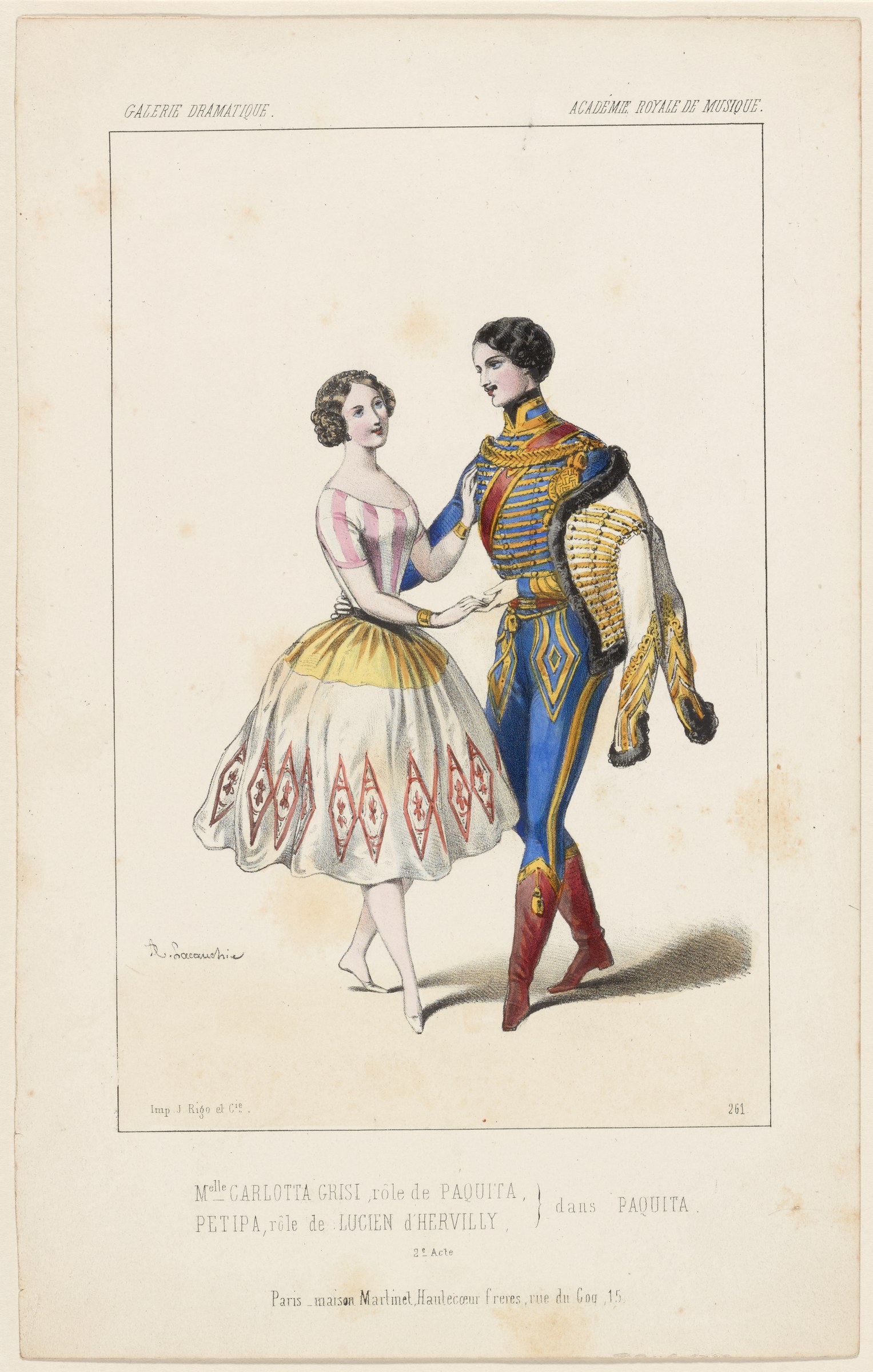
Academie Royale de Musique. Melle Carlotta Grisi, rôle de Paquita, Petipa, rôle de Lucien d'Hervilly, dans Paquita 2e acte (NYPL b12149136-5239637)
Unknown (NYPL collection)
- Medium:
- Oil Painting
- Era:
- Mid 1800s (Polka Era)
- Source:
- Wikimedia Commons
- Rights:
- Public domain — free to use, share and adapt.
- Recorded as:
- Public Domain
Paquita was one of the defining works of romantic ballet, and this image documents Carlotta Grisi, one of its greatest stars, in the moment that audiences came to see. For any student of romantic ballet's narrative conventions, female costuming, or the role of pantomime, this engraving provides primary evidence. The work also illustrates how 19th-century dance was documented and circulated through reproductive prints—a crucial precursor to photography.
What you are looking at
A hand-colored engraving depicts two dancers in an intimate moment during the second act of the ballet Paquita. A young woman in a pale pink corsage and voluminous white skirt with red ornamental designs along the hem stands facing left, gazing toward her partner. A male dancer in an ornate military-style jacket of deep blue with gold braiding, epaulettes, and white cartridge pouches across the chest stands beside her facing right, his arm extended toward her in a gesture of courtship or connection. The woman's skirt is rendered with delicate shading to suggest its volume and movement; the man's costume is rendered in jewel tones with meticulous detail of military ornamentation. The composition is set against a plain cream background with minimal setting, focusing all attention on the two figures and the narrative moment between them.
The dancing
The male dancer (Petipa as Lucien d'Hervilly) stands in a confident contrapposto with one leg supporting his weight, his torso turned toward the woman, one arm extended in a gesture of attention or courtship. The female dancer (Grisi as Paquita) faces away slightly, her posture upright and dignified, her arms positioned to receive or acknowledge his gesture. Both dancers maintain an upright carriage typical of romantic-era ballet. The spatial relationship between them—close but not in contact—suggests the moment of romantic encounter that defines the act.
The dance depicted
This is a scene from Paquita, a romantic-era ballet first performed in 1846 at the Académie Royale de Musique (Paris Opera). The work was choreographed by Joseph Mazilier, with music by Édouard Deldevez. Carlotta Grisi, one of the most celebrated ballerinas of the romantic period, danced the title role, while Lucien Petipa (brother of the more famous Marius) danced the male lead. The second-act scene depicted here emphasizes the romantic pantomime and courtship narratives central to romantic ballet: the moment when the two leads first meet or declare their feelings. The costumes—the woman's romantic tutu and pointe work implied by her posture, the man's military dress signifying his social status—are typical of the genre's conventions.
How it was made
This is a hand-colored engraving, a reproductive print technique that allowed wide circulation of images of popular theatrical performances. The engraving was likely made from a drawing or painting executed during or after a performance, capturing the specific moment and costumes as audiences would have seen them. Hand-coloring—applied after the engraving was printed—allowed for the careful rendering of the pink corsage, blue military coat, and gold details. This technique was a primary means of documenting and promoting dance performances in the mid-19th century, circulating images of celebrated dancers to a broader public than could attend the theater.
About this work
This engraving records a moment from one of the most successful ballets of the 1840s, frozen in the romantic pantomime tradition. It documents not only the choreography and narrative content of Paquita but also the precise costumes and staging of a specific production at the Paris Opera, where Carlotta Grisi's performance made her an international star. The image is a window into how romantic ballet was staged, promoted, and imagined by audiences of the period. For historians of dance, it provides concrete visual evidence of how the romantic ideal—the encounter between a mortal woman and a man of noble or military status—was choreographed and presented on stage.
How to look at it
Notice the careful positioning of the two bodies: the man's stance is active and reaching, the woman's is receptive but contained. The artist has captured the romantic ideal of male pursuit and female acquiescence through posture alone, with no physical contact. The ornament on the man's costume—the gold braiding, the cartridge pouches—speaks to the symbolic language of romantic ballet: his military status justifies his right to court the woman. The shading on the woman's skirt suggests both its weight and the possibility of movement; this is not a static portrait but a moment of narrative action. The empty background is typical of theatrical prints and keeps focus entirely on the bodies and their interaction.
The artist
The catalogue record attributes this work to an unknown artist. The signature visible in the lower left of the engraving is not clearly legible in reproduction. The work was printed by Imp. J. Rigel et Cie and published by Maison Martinet at rue du Bon 15, Paris, a commercial publisher of theatrical and fashion prints. This was a significant house for the circulation of dance imagery in the mid-19th century, producing hundreds of portraits and scenes from Paris Opera productions.
The period
Paquita premiered in 1846, at the height of the romantic ballet era. This was the period of Carlotta Grisi, Marie Taglioni, and the expansion of the corps de ballet into a visual and narrative element. The 1840s saw the perfection of the romantic tutu, pointe work becoming standard for female dancers, and the integration of pantomime narrative (derived from the ballet d'action tradition) with pure dance spectacle. The military costume of the male lead reflects the romantic fascination with exotic or elevated social contexts—the soldier, the nobleman, the foreign prince—as frames for the central female dancer. The engraving medium itself was at its height as a means of theatrical documentation; within a generation, photography would begin to replace it.
Where it lives
This print is held in the New York Public Library's collection of dance and theatrical imagery, catalogued as part of their extensive holdings of 19th-century theatrical prints and documents. It is a commercial reproductive print, one of many such images documenting celebrated Paris Opera performances of the period.
Dance in this work
Questions about this work
Was Carlotta Grisi really dancing Paquita in 1846?
Yes. Grisi created the role of Paquita in the premiere of the ballet at the Académie Royale de Musique on 4 April 1846. She continued to dance it throughout her career and was strongly associated with the role. This engraving documents one of her performances in the second act.
What was the story of Paquita?
The ballet tells the story of Paquita, a young Spanish woman of mysterious noble birth, who is protected by a group of Spanish gypsies. She falls in love with a French officer (Lucien d'Hervilly) and is eventually revealed to be the daughter of a Spanish grandee. The second act, shown here, is often the moment of their romantic encounter or declaration. The ballet combines Spanish-flavored exoticism with romantic ballet conventions.
Who was Lucien Petipa?
Lucien Petipa (1815–1898) was a French dancer and choreographer, and the older brother of the more famous Marius Petipa. He was a principal dancer at the Paris Opera and had a long career as a performer and later as a ballet master. While Marius went on to achieve greater fame in Russia, Lucien remained an important figure in French ballet.
How were theatrical prints like this one made and used?
These were commercial prints made by engraving a design onto a metal plate, printing it on paper, and hand-coloring each copy. They were sold in print shops and theatrical foyers, allowing audiences to take home images of celebrated performers in famous roles. They were also used in theater programs and as promotional material. Before photography became reliable, they were the primary way of documenting and circulating images of performances.
More dance artwork