49 works in this view — arrow keys or swipe to move between them.
Dance in Art · 1895
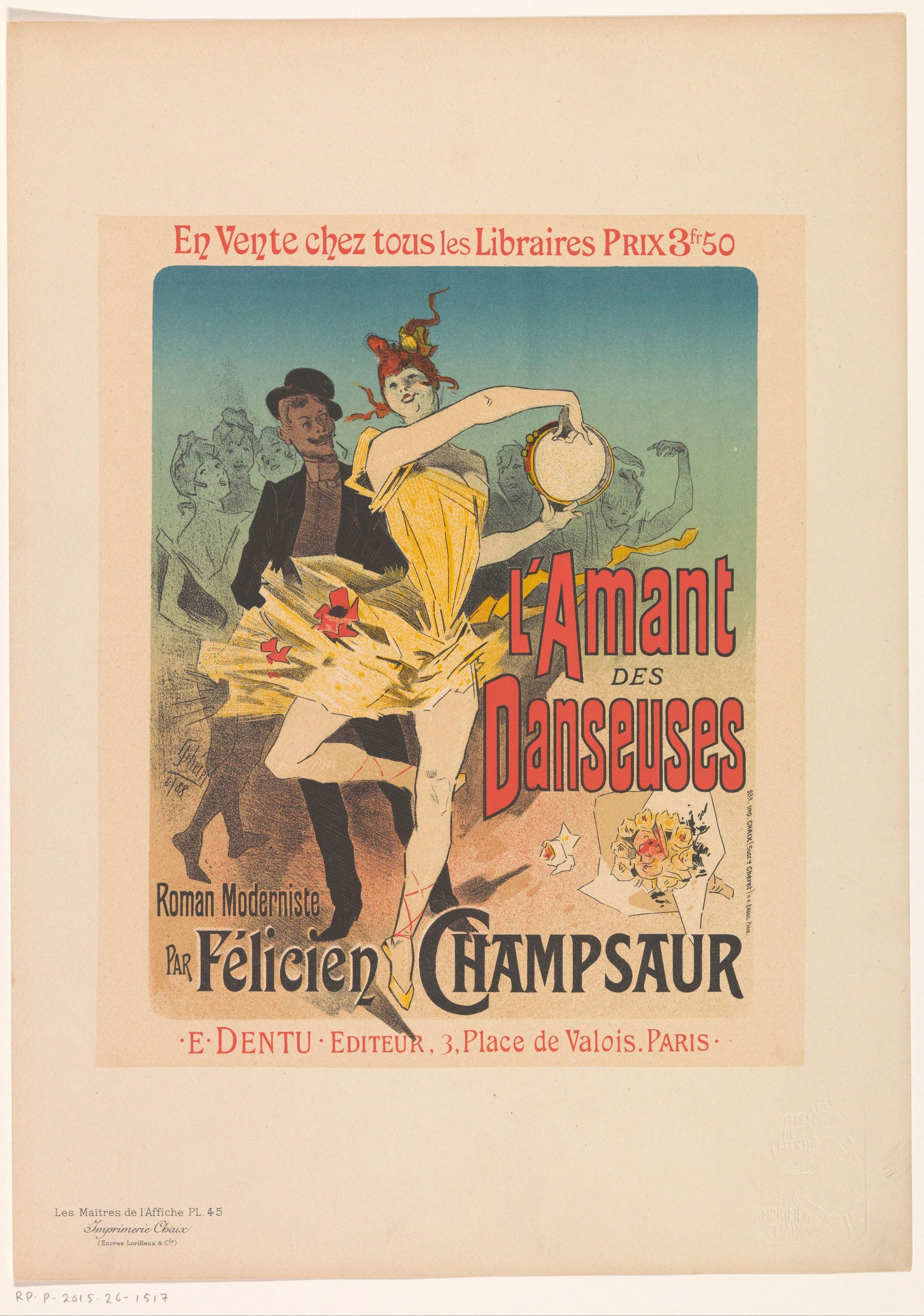
Advertentie voor de roman L'amant des danseuses door Félicien Champsaur Les Maîtres de l'Affiche (serietitel op object), RP-P-2015-26-1517
Unknown (Rijksmuseum collection)
- Medium:
- Ink
- Era:
- Late 1800s (Victorian Ballroom)
- Source:
- Wikimedia Commons
- Rights:
- Public domain — free to use, share and adapt.
- Recorded as:
- CC0
This work is essential to understanding how dance was consumed and represented in the urban popular imagination of the 1890s. The poster reveals the gap between the disciplined, classical ballet world and the commercialized, eroticized world of music-hall and cabaret performance—a distinction that shaped the social meaning of the dancer's body and her labor. It is also a vivid example of how chromolithographic advertising shaped the visual language of modernity and made dance a staple of commercial visual culture.
What you are looking at
A satirical advertisement poster for Félicien Champsaur's novel *L'Amant des Danseuses* (The Lover of Dancers), rendered in the vivid chromolithographic style characteristic of 1890s Paris. The composition centers on a young female dancer in a yellow costume, her body arched backward in an exaggerated pose, one leg extended high, her arms raised—one holding a tambourine aloft. A man in formal evening dress (dark jacket, top hat) leans in behind her, his face turned toward hers in an attitude of flirtation or seduction. In the background, five additional female dancers are sketched in lighter tones, creating a sense of theatrical depth and the milieu of a dance hall or cabaret. Scattered flowers appear in the foreground, reinforcing the romantic and erotic charge of the scene. The typography is bold and playful, with the title in red capitals superimposed over the figures. At the top, a red banner announces the price (3 fr 50) and that the book is for sale at all bookshops.
The dancing
The primary dancer's body is in a dramatic backward arch—a movement that emphasizes flexibility and display rather than trained classical technique. Her weight appears to rest on one leg while the other extends upward and back. Her arms are raised asymmetrically, one holding the tambourine as both prop and accent. The male figure's posture is proprietary and intimate, leaning in from behind rather than engaging her as a partner in shared movement. The background dancers are rendered sketchily, posed in attitudes of walking or standing rather than dancing in formation.
The dance depicted
This is not a representation of a specific dance form or technique, but rather a satirical image of the *danseuse* as a figure of desire and entertainment in the Parisian popular imagination. The exaggerated arch and the tambourine gesture suggest cabaret or music-hall entertainment—the world of the *cancan* dancer and similar theatrical spectacles—rather than ballet or ballroom. The artist has chosen to emphasize the erotic appeal and the asymmetrical power dynamic between the male patron and the female performer. This is dance as social spectacle and object of male consumption rather than as a disciplined art.
How it was made
This is a chromolithograph, a color printing process that became the dominant medium for advertising posters in the 1890s. The technique allowed for bold, layered color (the vibrant yellow of the costume, the warm flesh tones, the pale blue sky) and permitted fine drawing of detail (faces, feathered hat, sketched background figures) alongside broad areas of flat color. Chromolithography was industrially produced and relatively inexpensive, making it the ideal vehicle for mass-market advertising. The fluidity of the line and the soft modeling of forms are characteristic of the period's decorative style.
About this work
This is a commercial advertisement poster for a novel about dancers and desire in late 19th-century Paris. It belongs in a gallery of dance in art not because it documents a real dance or dance practice, but because it reveals how dance—and the dancer's body—functioned as a fantasy object in the visual culture of the Belle Époque. The figure of the *danseuse* was central to the period's sense of modernity, eroticism, and theatrical spectacle, and this poster captures that charged intersection. It is a document of how dance was *imagined* and *sold* to a mass audience, and how the female dancer's body could be mobilized for commercial purposes and male desire.
How to look at it
Observe the exaggeration of the backward arch and the raised leg—a movement that emphasizes flexibility and display but that would be impossible to sustain in actual performance. Notice how the man's presence frames the woman's body as an object to be admired from behind. Compare the finished detail of the central figures with the sketchy, background dancers, which suggests that the viewer's attention is meant to focus on the erotic transaction at the center. The bright colors and bold typography are designed to attract attention from a distance, on the street or in a bookshop window.
The artist
The work is listed as anonymous, though it may be identified through stylistic analysis or archival research in the Les Maîtres de l'Affiche collection. The style is consistent with the Parisian poster tradition of the 1880s–1890s, when artists such as Jules Chéret and Henri de Toulouse-Lautrec pioneered the use of chromolithography for theatrical and commercial advertising. The treatment of the dancing figure and the erotic charge suggest familiarity with that tradition.
The period
The 1890s saw an explosion of dance imagery in commercial advertising, especially in Paris. The *cancan*, the *chahut*, and other forms of cabaret and music-hall performance had become central to the city's identity as a site of pleasure and modernity. At the same time, the classical ballet tradition, represented by the Opéra, remained a marker of high culture and artistic discipline. Champsaur's novel belongs to a long tradition of French literature that eroticized and romanticized the figure of the dancer. The poster exemplifies how commercial printing technologies made dance imagery available to a mass audience and how it functioned as a fantasy of access to the world of theatrical performance and female beauty.
Where it lives
This work is part of the Les Maîtres de l'Affiche collection in the Rijksmuseum, Amsterdam. It is one of 256 prints in a series devoted to masterworks of the poster art of the period. The collection was assembled in the early 20th century and represents an effort to establish the poster as a legitimate subject of art historical study.
Dance in this work
Questions about this work
What is the tambourine for?
The tambourine is both a prop and a symbol. It identifies the figure as a dancer and a performer, but it also serves the composition—raised high, it creates a visual accent and emphasizes the exaggerated arch of her body. Tambourines were used in music-hall and cabaret performance, especially in scenes designed to evoke exotic or erotic themes. Here it is part of the fantasy of the *danseuse*.
Is this based on a real dance?
Not on a specific, named dance form. The pose—the backward arch, the high leg extension—is a highly exaggerated, fantasy version of the kind of movement that might appear in cabaret or music-hall performance. The artist has pushed it to the limits of the body to emphasize flexibility, display, and eroticism rather than to represent actual technique. It is a dream image rather than a document of practice.
Why is the man in evening dress?
His formal attire marks him as a wealthy patron or gentleman—a man of the middle or upper class who frequents dance halls and cabaret. His position behind and leaning toward the dancer suggests both intimacy and purchase: he is the consumer of the spectacle. The contrast between his dark formal clothing and her bright, decorative costume emphasizes the social and economic power dynamic between them.
What is chromolithography and why does it matter here?
Chromolithography is a color printing process that allowed for bold, layered color and fine detail. It was cheaper than earlier methods and allowed posters to be produced in large quantities for public display. This technology democratized access to advertising imagery and made it possible for a novel to reach a mass audience through eye-catching visual spectacle. The poster's effectiveness as advertising depended entirely on the vivid colors and bold design that chromolithography made possible.
More dance artwork