49 works in this view — arrow keys or swipe to move between them.
Dance in Art · 1899
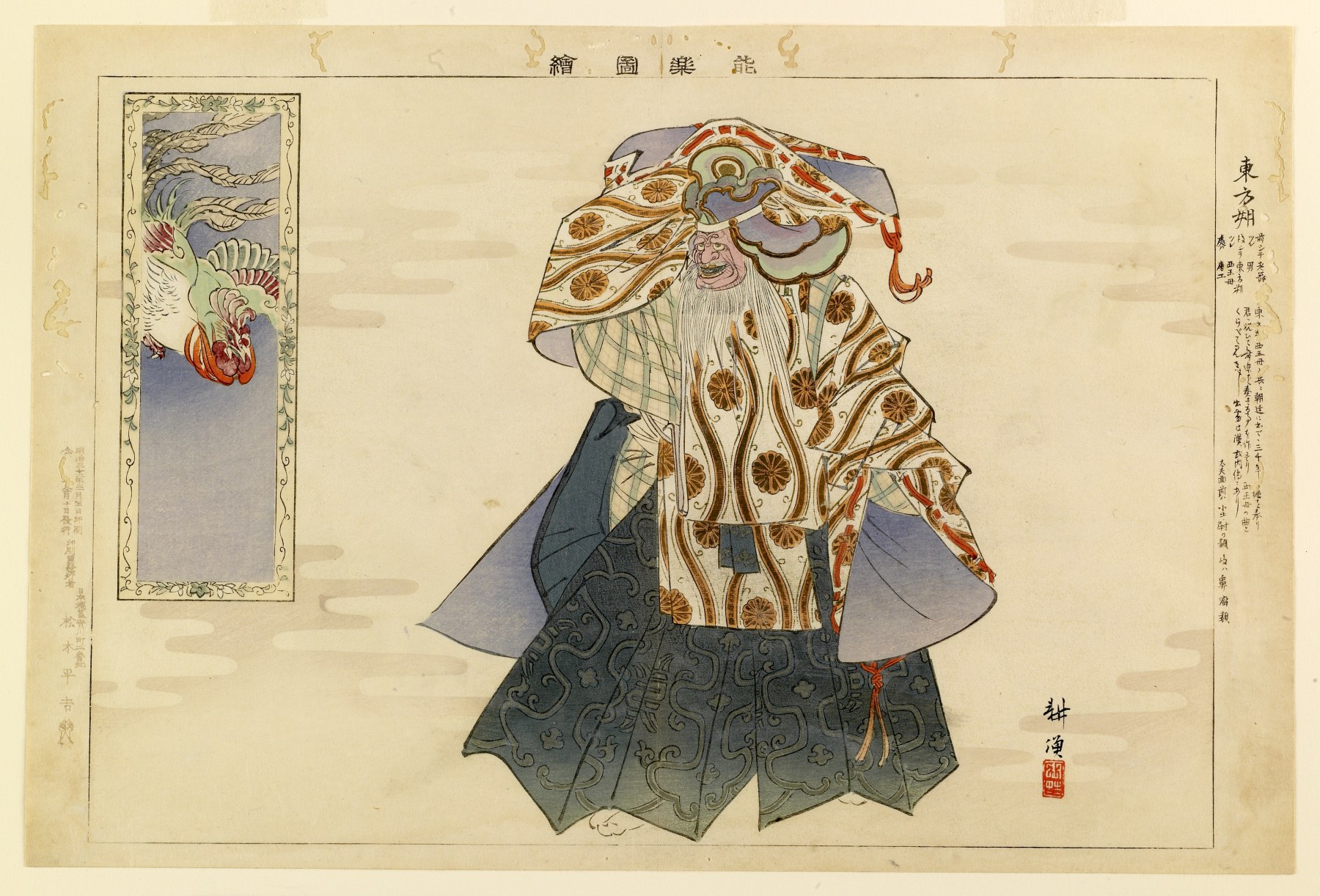
Matsuke Heikichi - Nogaku zue - Walters 95255
Kōgyo Tsukioka
- Medium:
- Oil Painting
- Era:
- Late 1800s (Victorian Ballroom)
- Source:
- Wikimedia Commons
- Rights:
- Public domain — free to use, share and adapt.
- Recorded as:
- Public Domain
Noh represents a performance tradition in which movement, music, mask, costume, and text are inseparable, and in which the actor's job is to embody archetypal figures through presence and control rather than through naturalistic gesture or virtuosic display. Understanding Noh expands the concept of dance beyond the Western balletic and social-dance traditions that dominate much of the historical record. This print, by recording an actual performer in an actual role, documents not just a costume but a lived practice of training and transmission that has endured for centuries.
What you are looking at
A Japanese actor in full Noh costume stands in three-quarter profile facing left, his body composed in a stately pose. He wears a voluminous white under-robe patterned with geometric designs in gold and rust, layered beneath a heavily decorated outer garment in deep indigo with elaborate brocade featuring floral motifs. Most striking is his headdress—a tall ornamental crown with sweeping curved elements in gold and rust that suggests both majesty and the supernatural. A red cord trails from the crown. The actor's face, though obscured by the characteristic Noh mask (which the catalogue identifies as a happy old man's mask, though the mask itself is not clearly visible in this frontal view), is turned slightly upward in a gesture suggesting contemplation or reverence. The composition is spare: the figure fills most of the frame against a pale ground, with a decorative border frame and a smaller scroll scene at left showing a phoenix descending—an image that echoes the spiritual content of the play.
The dancing
The actor's posture is upright and formal, with the weight centered and the body held in a dignified stance that suggests ritual rather than naturalistic movement. The arms hang naturally at the sides or rest gently against the voluminous fabric. There is no dynamic balance or turn; instead, the composition suggests a moment of stillness within performance—a held pose rather than the capture of active motion. The elaborate costume completely determines the silhouette, with no visible feet or detailed articulation of limbs beneath the heavy robes.
The dance depicted
This is Noh theatre, specifically a representation of the actor Matsuke Heikichi performing in *Tobosaku*—a Noh play based on a Chinese legend about immortality. In Noh performance, what Western viewers would call 'dance' is better understood as highly stylized and codified movement, performed by a masked actor in heavy costume at a measured, ritualistic pace. The image captures not a moment of vigorous dancing but a formal pose or stance (*kamae*) that would be held as part of the actor's progression through the play. Noh employs minimal gesture, controlled breathing, and precise positioning; movement emerges from shifts of weight rather than from animated gesture. The chorus narrates the legend while the actor embodies the character through presence and formal placement rather than through representational acting.
How it was made
This is a color woodblock print or possibly a hand-colored woodblock from a series illustrating Noh actors and roles. The technique allows for bold graphic clarity—the intricate patterns of the costumes rendered in careful detail—and for the dissemination of images of celebrated actors to a broad public. The decorative border, the supplementary scroll vignette at left (showing the phoenix from the play's iconography), and the inscription cartouches all follow the conventions of Japanese theatrical prints. The image is from *Nogaku zue* (Illustrations of Noh), a genre specifically devoted to documenting celebrated performers and canonical plays in their traditional costumes.
About this work
This is a documentary image of Noh theatre—specifically of the actor Matsuke Heikichi in the role of Tobosaku from the classical play of that name. It belongs in a dance gallery not because Noh involves the kind of movement that Western eyes recognize as dance, but because Noh is a canonical theatrical form that uses highly disciplined, codified movement as its primary expressive tool. The image is an artifact of theatrical practice and training, and of how performance traditions document themselves. For historians of East Asian performance, and for anyone interested in how 'dance' is culturally defined, Noh theatre is essential: it shows an entirely different lineage and conception of what formal movement in ritual and theatrical contexts can be.
How to look at it
Look at the absolute stillness of the pose—the centered weight, the formal upright posture, the lack of dynamic imbalance or reaching gesture. This is the Noh actor's fundamental stance. Notice how the costume dominates the composition; in Noh, the actor does not move through the costume but rather *is* the costume, and the visual design is as much a part of the performance as the actor's body. The headdress and the patterns on the robes carry symbolic meaning; the crown marks the character's supernatural or elevated status. The phoenix scroll at left anchors the image in the specific play's narrative. The border and inscription convention signal that this is a formal theatrical document, not a naturalistic moment captured from life.
The artist
Kōgyo Tsukioka (1871–1945) was a pioneering figure in Japanese art history—a painter and print artist who worked at the intersection of traditional Japanese aesthetics and Western academic training. He was trained in both nihonga (Japanese painting) and Western oil painting, and is known for his detailed, respectful documentations of theatrical performance. His *Nogaku zue* series represents a sustained commitment to recording Noh theatre at a moment of modernization, capturing the knowledge and practice of celebrated actors for preservation and public study. His work is characterized by precise draftsmanship, rich color, and genuine knowledge of his subjects.
The period
This print was made in 1899, during Japan's Meiji era (1868–1912), a period of rapid modernization and Western cultural influence. Despite industrialization and Westernization, Noh theatre maintained its canonical status in Japanese high culture and was actively preserved and studied. Kōgyo was part of a broader movement to document and elevate traditional Japanese arts even as Western influence reshaped Japanese society. In the same era, Japanese woodblock prints and theatrical imagery were circulating internationally and influencing Western artists, yet the Noh tradition itself remained relatively closed to Western audiences. This print sits at the intersection: it is a modern documentary work produced by an artist trained in Western techniques, recording an ancient theatrical form for a Japanese audience.
Where it lives
The work comes from the *Nogaku zue* (Illustrations of Noh), a series documenting Noh theatre. It is held in the Walters Art Museum collection (accession 95255). The Wikimedia Commons source indicates it is publicly accessible, though full provenance history is not recorded in the catalogue entry.
Dance in this work
Questions about this work
Is this a painting or a print?
The catalogue lists it as an oil painting, but the visual evidence—the bold graphic clarity, the flat color planes, the decorative border, and the series context—all suggest this may be a woodblock print or a hand-colored woodblock. The record should be verified.
What is Noh, and how is it different from ballet or other theatrical dance?
Noh is a classical Japanese theatrical form (originating in the 14th century) that uses masked actors, highly stylized movement, poetry, and music to embody archetypal characters and tell stories often drawn from history, legend, or the supernatural. Unlike ballet, Noh does not emphasize virtuosity, extension, or rapid changes of direction. Instead, movement is minimal, controlled, and deliberate; the actor progresses through carefully codified stances and transitions. The mask determines the character's identity and emotional register, while the actor's body contributes presence and discipline. Noh is closer to ritual theatre than to Western concert dance.
Who was Matsuke Heikichi?
Matsuke Heikichi was a celebrated Noh actor of the late Meiji era, known for his performance of classical roles. The *Nogaku zue* series documents leading actors of the day in their canonical roles, preserving a record of their costumes, masks, and performance traditions. He represents the continuity of Noh practice through a period of major cultural change in Japan.
What does the phoenix scroll at the left signify?
The phoenix is a symbol from Chinese cosmology of auspiciousness, longevity, and the supernatural. In the *Tobosaku* play, the phoenix references the divine realm and the theme of immortality central to the story. The scroll is part of the print's compositional design, anchoring the actor in the play's mythological context.
More dance artwork