33 works in this view — arrow keys or swipe to move between them.
Dance in Art · 1490
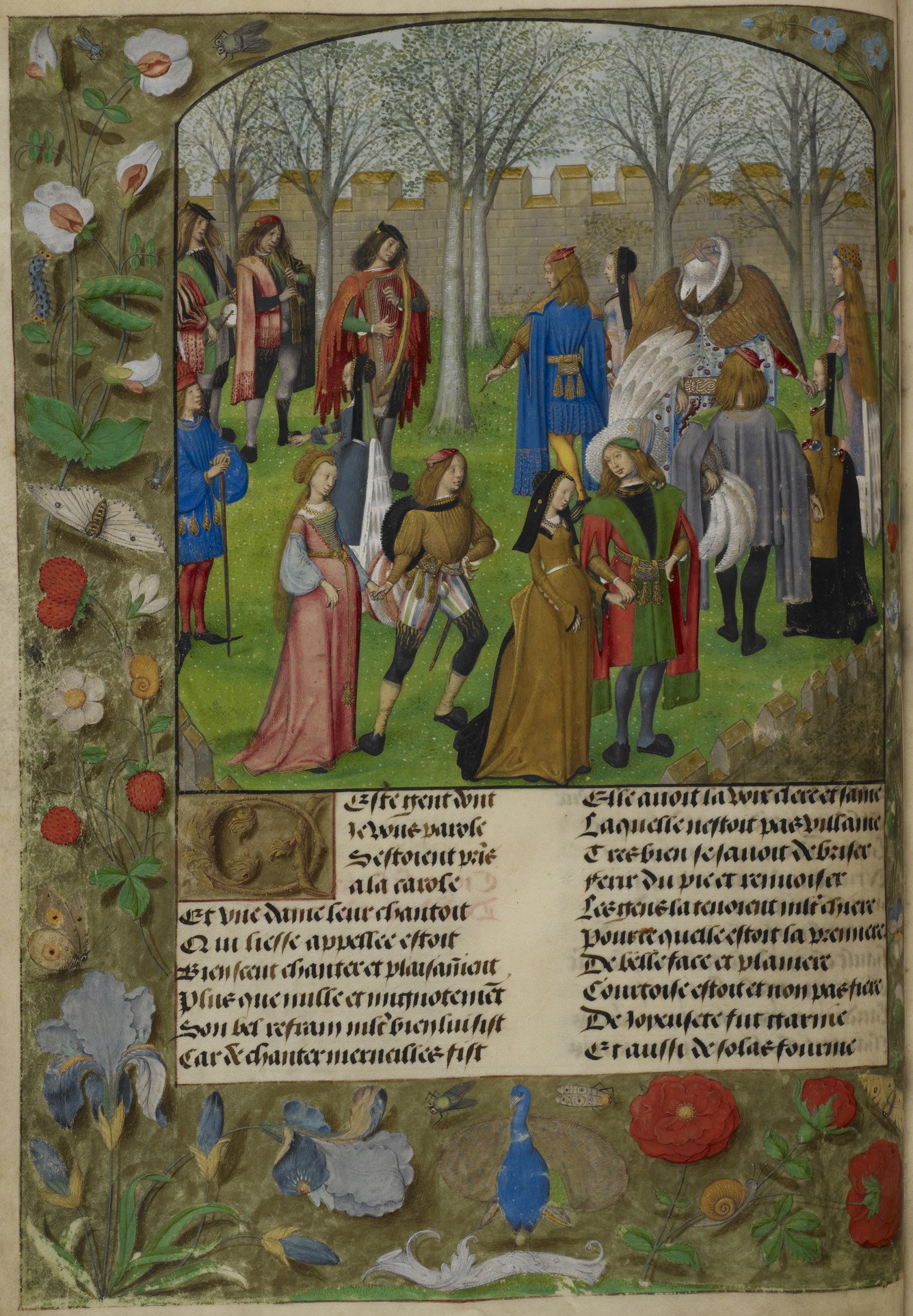
The Carolle in the Garden - Roman de la Rose (c.1490-1500), f.14v - BL Harley MS 4425
Master of the Prayer Books of around 1500
- Medium:
- Oil Painting
- Era:
- Pre-1700 (Renaissance/Baroque)
- Source:
- Wikimedia Commons
- Rights:
- Public domain — free to use, share and adapt.
- Recorded as:
- CC0
The carolle is one of the oldest documented group dances in European culture, yet it survives today almost entirely through literary references and a handful of visual sources such as this one. This image shows the hold, formation, and setting of the dance with unusual clarity, making it invaluable evidence for historians reconstructing medieval social practice. It also illustrates how dance functioned in courtly life not as performance but as a structured ritual of bonding and display—a way for the nobility to enact their own identity and values.
What you are looking at
A walled garden in spring, enclosed by crenellated walls glimpsed between bare trees just coming into leaf. A group of about fifteen figures in rich dress—nobles, ladies, and courtiers—move together in a circle or chain formation across a green lawn. In the foreground, a woman in a long rose-pink gown with trailing sleeves leads the dance, her hand joined to a youth in blue and hose. Behind them, more couples and single figures follow in loose linked formation. Two figures stand slightly apart: a man in rich brown robes with an anxious expression, and a noble-looking woman in a pearl-trimmed gown, possibly Lady Gladness, who seems to direct the proceedings. The scene is framed by a margin of flowers—roses, tulips, and peonies—and small birds in flight, characteristic of manuscript decoration. The light is cool and green, suggesting early morning or a spring day. The composition balances narrative clarity with decorative richness: the dancers occupy the centre while the botanical border draws the eye outward.
The dancing
The bodies move in a smooth chain or carolle formation, with arms extended and linked at shoulder or hand height rather than in the formal closed hold of later ballroom. The nearest dancers are shown mid-stride with legs slightly bent and torsos upright, suggesting a gliding rather than a bouncing action. Their weight appears distributed lightly; there is no sense of heaviness or effort. The linked-hand position is the dominant motif—hands joined or held aloft—binding the group into a single organism. The woman leading wears her skirt long and full, trailing behind her in a graceful arc, while the men show their hose clearly. One figure (possibly Sir Mirth) gestures with an open hand toward the dancers, as if welcoming or encouraging. The overall effect is of lightness and ease rather than virtuosity.
The dance depicted
This is the carolle (also spelled carole or carola), a social chain dance performed at court in medieval and early Renaissance Europe. The carolle was central to aristocratic entertainment, often accompanied by singing and performed outdoors in gardens or chambers. It required no special skill—anyone could join the chain—yet it was a display of grace and courtly identity. The image shows it in its characteristic spring garden setting, as described in courtly literature (notably in the Roman de la Rose, of which this is an illustration). The linked-hand formation and the smooth, gliding movement are consistent with period descriptions: the dance involved walking or a gentle shuffle to the side, with the group moving in a circle while maintaining hand contact. The presence of a leader (traditionally a man or woman of rank) who sets the pace and direction is evident here.
How it was made
This is a manuscript leaf—a page from an illuminated book of hours or literary manuscript—made in tempera and gold leaf on vellum. The technique allowed for rich colour, fine detail, and the integration of decorative borders: the botanical margin was as much a concern as the narrative scene. The medium circulated in a restricted aristocratic audience; this was a precious object, made by hand for a wealthy patron, and the dancing scene would have been read as a reflection of the patron's own courtly life. The clarity of the figures and their dress, and the deliberate choice to set the scene in a walled garden, suggest this was made to be both inspiring and aspirational—a model of courtly behaviour.
About this work
This is an illustration from a copy of the Roman de la Rose, the most influential courtly love poem of the Middle Ages, made in the Low Countries around 1490–1500. It depicts the carolle, a group chain dance that was fundamental to courtly entertainment and courtship ritual. The scene shows the dance in its ideal setting—a spring garden—and in the moment described in the text, where the Lover is drawn into the dance by Lady Gladness and Sir Mirth, key allegorical figures in the poem's narrative of love and desire. The image is both a record of actual social practice (the carolle was danced at court) and a literary illustration, meant to show the reader what the poem meant by beauty, grace, and courtly order. It sits at the intersection of manuscript culture, courtly ideology, and the history of social dance.
How to look at it
The artist has frozen the carolle at the moment of maximum grace: the figures are mid-stride, bodies balanced, arms linked, moving together in a smooth chain. Notice the linked hands—this is the defining structure of the dance. Notice too the woman's trailing skirt and the lightness of the figures' posture: they are not dancing with weight or effort, but with an almost floating ease. This was the ideal of courtly dance, and the artist has achieved it through the smooth, continuous line of the body and the unhurried spacing of the figures. The garden setting is not incidental: the carolle was a performance of courtly order imposed on nature, and the walled garden, with its neat green lawn and decorative flowers, provides the perfect frame for that display.
The artist
The manuscript is attributed to the Master of the Prayer Books of around 1500, a Flemish or Franco-Flemish illuminator whose hand appears in several high-quality manuscripts made in the 1490s and early 1500s. The artist was a specialist in courtly literary illustration and miniature painting, trained in the detailed, jewel-like technique of Flemish book illumination. The botanical borders—a hallmark of Flemish manuscript decoration—would have been executed with the same precision as the narrative scene, reflecting the studio's commitment to richness and completeness.
The period
The roman de la Rose was written in the 13th century but was continuously copied and illustrated into the 16th century, with illuminated versions circulating among the wealthy throughout the 15th and 16th centuries. This copy dates to the end of that tradition, made at a moment when manuscript culture was being displaced by printing. The carolle itself was in decline by 1500 among the highest nobility—court dances were becoming more complex and formalized—but the poem's cultural authority ensured that illustrations of it continued to be made and valued. The image thus captures both a living social practice (which persisted in rural and provincial contexts) and an increasingly nostalgic fantasy of courtly life, as printed books began to replace manuscripts.
Where it lives
The manuscript is held in the British Library (Harley MS 4425, folio 14v). It is a luxury copy of the Roman de la Rose, made for an unknown patron of wealth and taste. The page format and the quality of illumination suggest it was commissioned rather than produced for the open market. The source is Wikimedia Commons.
Dance in this work
Questions about this work
What is the carolle?
The carolle is a chain or round dance in which participants hold hands and move together in a circle or line. It was the primary social dance of the medieval European court and was often accompanied by singing. It required no special skill—the point was collective participation and grace rather than individual display. The dance appears in courtly literature from the 12th century onward and was associated with courtship, festivity, and the celebration of spring.
Did people really dance like this?
Yes, though the image is both a record and an ideal. The linked-hand formation and smooth movement shown here are consistent with period descriptions in literary texts and in a few other visual sources. However, manuscripts like this were aspirational: they showed how courtly people wished to dance, and how writers thought dancing should look. The reality was probably messier, more varied, and less perfectly choreographed.
Who was the Master of the Prayer Books?
The Master is unknown by name, but is identified by style through a group of high-quality illuminated manuscripts produced in the Flemish or Franco-Flemish tradition around 1490–1510. The name comes from the prayer books attributed to this hand. The artist was a specialist in refined, detailed miniature painting and decorative borders, and was likely trained in a major workshop in Bruges, Ghent, or Paris.
Why is the garden so detailed?
The garden is part of the allegory of the Roman de la Rose. In the poem, the garden is the enclosed space of courtly love, and the carol marks the entry of the Lover into a world of beauty and desire. The flowers and the walled space are not decoration but meaning: they signal that this is an ideal space, separate from the ordinary world. The Flemish artist has emphasized this through meticulous floral borders and careful perspective.
More dance artwork