49 works in this view — arrow keys or swipe to move between them.
Dance in Art · 1910
BAKST Odaliske
Leon Bakst
- Medium:
- Oil Painting
- Dance:
- Ballet
- Era:
- 1900-1920 (Ragtime/Early Jazz)
- Source:
- Wikimedia Commons
- Rights:
- Public domain — free to use, share and adapt.
- Recorded as:
- Public Domain
Bakst's costume designs were integral to the success and fame of the Ballets Russes and established the visual language of Orientalist ballet for decades. This image documents a foundational moment in 20th-century theatrical design and reveals the aesthetics of early modern ballet—its emphasis on spectacle, its embrace of non-Western imagery (however fantastical), and its treatment of the dancer's body as a surface for sumptuous display rather than as an instrument for movement alone.
What you are looking at
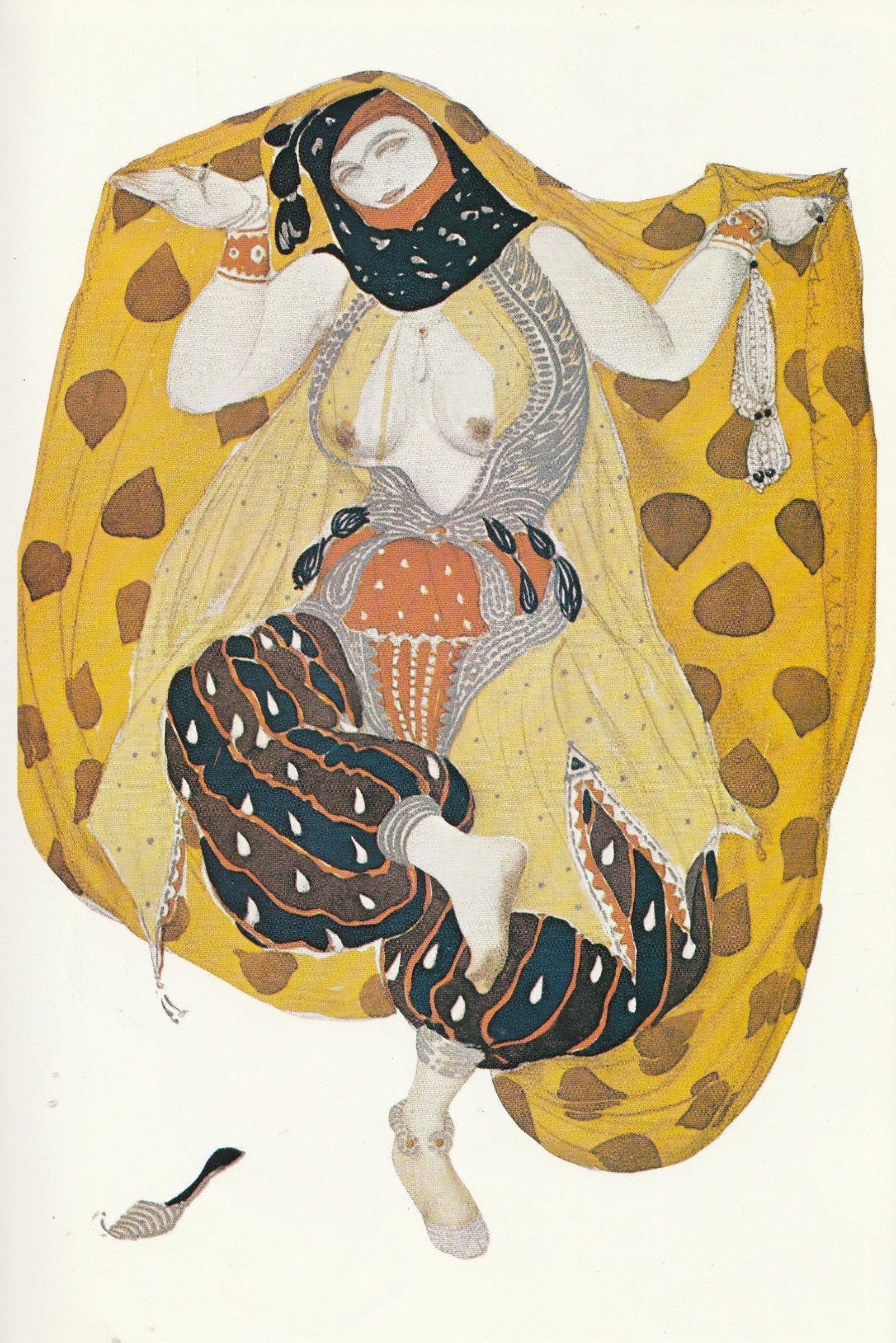
A single female figure dominates the composition, posed in a dynamic, lifted stance against a large expanse of golden yellow fabric patterned with brown teardrop or leaf motifs. The dancer wears a dark teal or black wrapped garment around her torso and hips, decorated with white dotted patterns and edged with ornate silver or white trim. Her upper body is bare, pale-skinned, and her face is rendered in profile with dramatic makeup—dark brows, pale complexion, and a dark head covering that wraps around her chin. She holds aloft the voluminous yellow drapery with both arms raised, the fabric billowing and creating a sense of weightless movement. Her lower body is wrapped in a rust-orange patterned fabric with similar dotted white details and metallic threading. The pose suggests a moment of exuberant display or unveiling, with the body held in a lifted, open position. A small curled detail appears at the lower left, possibly a decorative flourish or signature element. The overall effect is of a moment frozen in elegant, theatrical movement.
The dancing
The dancer's frame is notably open and expansive, with arms raised and extended outward to support and display the voluminous drapery overhead. Her body is elongated and lifted, suggesting light weight and buoyancy; her torso is arched slightly backward in a pose of abandon or exuberance. The weight appears to be held upward through the arms and upper back rather than rooted to the ground. The bare upper body emphasizes the musculature and line of the torso as a central expressive element. This is a solo female dancer, and the composition treats her body as an axis around which the spectacular drapery orbits.
The dance depicted
This is a costume study or theatrical portrait rather than a depiction of a specific dance technique or movement vocabulary. The work is identified as a design for Bakst's *Scheherazade*, a 1910 Ballets Russes production choreographed by Michel Fokine. The costume shown is recognizable as that of an Odalisque—a member of a sultan's harem—typical of the Orientalist fantasy that defined this ballet. The pose and the treatment of the body suggest the aesthetic of Romantic and early Imperial ballet, with an emphasis on épaulement, upper-body expressivity, and the theatrical unveiling or display of costume rather than on technical virtuosity such as turnout or pointe work. The image captures the moment of a performer in full theatrical character, modeling the exotic costume that would transport audience members to an imagined Ottoman palace.
How it was made
The work is executed in oil paint on paper or canvas, rendered in a style that combines painterly precision with decorative linearity typical of early 20th-century theatrical design. Bakst's technique emphasizes the architectural construction of the costume—the layering of fabrics, the applied ornament, and the interplay of pattern and solid color—as much as the figure wearing it. The flattened perspective and the bold use of a limited but rich color palette (golds, blacks, teals, rusts, whites, and silver) are characteristic of costume design for the stage, which prioritizes visual impact and clarity at a distance. The work functions as both fine art and practical design document, intended to guide dressmakers and set the visual tone for the production.
About this work
This is a costume design by Léon Bakst for the Odalisque role in the Ballets Russes production *Scheherazade* (1910). The work showcases Bakst's mastery of color, pattern, and theatrical fantasy; it captures not a specific movement or technique but the visual and cultural identity that Orientalist ballet projected onto the dancer's body. The image reveals how early 20th-century ballet understood exoticism: through luxurious fabric, bold ornamentation, and a body posed to display rather than dance. Bakst's designs were as famous as the choreography itself, and this work exemplifies the visual splendor that made the Ballets Russes a revolutionary force in theater and design.
How to look at it
Attend first to the geometry and structure of the pose: notice how the dancer's body is lifted and opened, how the arms frame and support the drapery rather than execute a specific technical movement. This is a portrait of costume as much as of dance. Then trace the color relationships: the golden ground is echoed in the dancer's skin tone and creates a field against which the darker, patterned fabrics of the costume pop forward. Notice the precision of the applied pattern and ornament—the white dots, the silver threading—and how these details give weight and specificity to fabrics that might otherwise read as flat or generic. Finally, observe the face and its dramatic, stylized presentation: this is not naturalism but theatrical character, a face as much designed as the costume it belongs to.
The artist
Léon Bakst (1866–1924) was a Russian painter, set designer, and costume designer best known for his work with the Ballets Russes under Sergei Diaghilev. Bakst's designs combined influences from classical antiquity, Orientalism, and modernist aesthetics; his color sense and compositional boldness revolutionized theatrical design. Beyond theater, he was a painter of considerable skill and an influential figure in Russian art circles. His work for *Scheherazade*, *L'Après-midi d'un faune*, and other landmark productions established him as one of the most important designers of the early 20th century.
The period
The 1910s were the golden age of the Ballets Russes (founded 1909), when Russian choreography, design, and performance were transforming European and North American attitudes toward dance. *Scheherazade*, which premiered in 1910, was among the company's most popular works; its fusion of fantasy, sensuality, and visual magnificence made it a sensation. The broader moment was one of rapid modernization in art and design: the same decade saw the emergence of Cubism, Futurism, and other avant-garde movements. Yet the Ballets Russes embraced a different kind of modernism—one rooted in color, ornamentation, and the integration of the arts. Bakst's designs epitomized this aesthetic: lavish, deliberately artificial, and deeply theatrical.
Where it lives
The work is identified as a Bakst costume design for *Scheherazade* but is held in an unrecorded collection; the source is Wikimedia Commons. The catalog record is sparse, providing only artist, title, date, and medium. The image itself is the primary evidence for the attribution and identification.
Dance in this work
Questions about this work
Did this design actually make it into the ballet?
*Scheherazade* premiered at the Ballets Russes in 1910 and was performed many times. Bakst's designs were executed and worn on stage, though costumes were sometimes modified or remade over the years. This drawing shows the design as Bakst conceived it; whether this exact costume was constructed and performed is not documented in the catalog record.
What is an Odalisque?
An Odalisque is a female slave or concubine in a harem, particularly in the Ottoman Empire. The term became central to Orientalist fantasy in European art, where it represented exoticism, sensuality, and 'otherness.' *Scheherazade* is set in a fictional Ottoman palace, and the Odalisques are members of the harem; Bakst's costume emphasizes exotic luxury and theatrical fantasy rather than historical accuracy.
How much of this is Bakst's design and how much is the performer's idea?
This is a design document, not a photograph of performance. Bakst conceived the pose, the costume, the colors, and the overall visual concept. The figure shown may be a model or a notation of how Bakst imagined the costume in space; it is not a record of how a specific dancer performed the role.
Why is the dancer's body bare?
Bakst has shown the bare torso to display the line of the body, to emphasize the figure's exoticism and sensuality, and to establish the relationship between skin tone and the surrounding colors and patterns of the costume. The bared upper body was scandalous and thrilling to 1910 audiences and was part of the Ballets Russes' deliberate challenge to Victorian propriety.
More Ballet artwork