27 works in this view — arrow keys or swipe to move between them.
Dance in Art · 1942
Beckmann Grosses-Variete-mit-Zauberer-und-Taenzerin G1266 web
Max Beckmann
- Medium:
- Oil Painting
- Era:
- 1920-1950 (Swing Era)
- Source:
- Wikimedia Commons
- Rights:
- Public domain — free to use, share and adapt.
- Recorded as:
- Public Domain
For dance historians, this painting captures the aesthetic and physical language of Weimar-era cabaret and variety entertainment, at a moment when classical ballet technique was being absorbed into popular theatrical forms. For art historians and broader audiences, it represents a key expressionist vision of performance as a site of psychological intensity and social performance.
What you are looking at
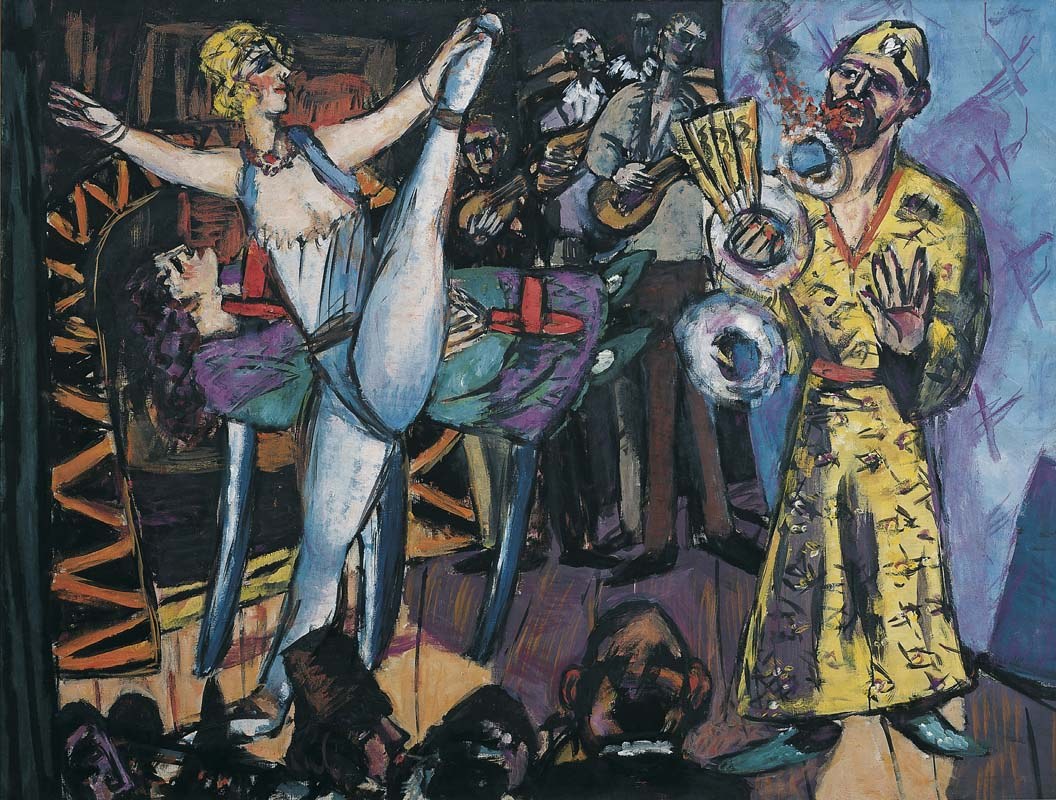
A carnival or vaudeville stage scene rendered in expressionist style, with a pale female dancer in the center-left, her body stretched vertically with one leg raised high, wearing a blue wrap or costume. She is spotlit and framed by a yellow "VARIETE" sign. To her right stands a yellow-robed figure (the "magician" of the title) holding what appear to be plates or circular props, his face mask-like and severe. Behind them, a group of darker figures—musicians or other performers—cluster in shadow, their faces and forms partially dissolved into the dark background. The stage floor is rendered in warm ochres and purples, and the entire composition is built from bold, angular brushstrokes in acid yellows, blues, purples, and blacks. The lighting is theatrical and unnatural, with stark contrasts between the pale dancer and the murky background.
The dancing
The central female figure is extended in a vertical line with pronounced weight shift: one leg kicks or extends upward while her opposite arm reaches outward, creating diagonal tension across her torso. Her head tilts back slightly. The pose suggests a moment of balletic arabesque or lifted extension, though rendered with expressionist distortion rather than classical precision. The magician figure beside her is more static and frontal, his body rigid. The background figures are compressed and gestural rather than anatomically explicit, their postures suggesting movement and interaction but without clear delineation of hold or frame.
The dance depicted
The work depicts a theatrical cabaret or variety-show dancer, likely performing in a Berlin-style Variété of the 1920s–1940s. The pose suggests classical ballet vocabulary—a leg extension with opposing arm reach—but the context (vaudeville setting, magician, theatrical props) indicates a mixed entertainment form combining ballet technique with music-hall spectacle. The dancer's body is elongated and strained, conveying both virtuosity and vulnerability. This is entertainment dance, not concert ballet, and the image captures a moment of theatrical elevation rather than the grounded social dancing of the ballroom.
How it was made
Oil painting on canvas, executed in an expressionist manner with bold, broad brushwork and non-naturalistic color. The technique employs strong chiaroscuro—high-contrast lighting between the pale, spotlit dancer and the dark, churning background—which heightens dramatic intensity. The paint is applied with visible gestural marks, and colors are used expressionistically (acid yellows, purples, blacks) rather than representationally. This approach allows the artist to convey psychological and emotional content alongside literal form, capturing not just the appearance of a variety show but its atmosphere of spectacle, artifice, and underlying strain.
About this work
Max Beckmann's *Großes Varieté mit Zauberer und Tänzerin* (Large Variety Show with Magician and Dancer) of 1942 depicts a moment of theatrical performance in a cabaret or vaudeville setting. A female dancer extends into a balletic pose center-stage while a magician and ensemble surround her, all rendered in expressionist style with electric color and dramatic chiaroscuro. The work belongs to a body of modernist paintings by Beckmann exploring performance, spectacle, and the theatrical culture of the German 1920s and beyond. It documents not a social or folk dance but a professional entertainment form—the variety show—and its intersection with classical dance vocabulary and circus arts.
How to look at it
Attend to the moment the artist has chosen: the dancer is caught mid-extension, her body stretched and vulnerable rather than composed or at rest. Notice the tension between the classical balletic vocabulary of the pose (the lifted leg, the reached arm, the vertical spine) and the cabaret setting and expressionist distortion of the body—she is not performing ballet in a concert hall but entertainment dance in a crowded, murky room. The magician's rigid, mask-like face and the compressed crowd behind her create a sense of pressure and artifice. The color—the acidic yellows and the electrical contrast—is expressionist, not naturalistic; it conveys the feeling of the moment rather than its visual appearance.
The artist
Max Beckmann (1884–1950) was a German expressionist painter who lived through both world wars and the full arc of Weimar and Nazi Germany. He was deeply engaged with themes of performance, theater, and the human figure under psychological and social pressure. Beckmann moved to Amsterdam in 1937 and to the United States in 1947; throughout his career he returned repeatedly to circus and theatrical subjects as vehicles for exploring artifice, vulnerability, and the mask-like quality of modern social life.
The period
The painting dates to 1942, during Beckmann's exile in Amsterdam. It evokes the Berlin variety theaters and cabarets of the 1920s and 1930s, when the Variété was at its height as a form of popular entertainment combining classical and popular dance, comedy, magic, and music. This was also the era when German Expressionism was flourishing as an artistic movement. By 1942, under Nazi rule, such theatrical forms had been either suppressed or co-opted; Beckmann's painting, made in exile, is a retrospective evocation of a lost cultural world. In dance terms, this was a period when ballet was expanding beyond concert stages into commercial entertainment, and when the boundary between "high" and "popular" dance was actively being negotiated.
Where it lives
The work is recorded as an oil painting by Max Beckmann from 1942, sourced from Wikimedia Commons. No holding collection is currently recorded in the catalogue.
Dance in this work
Questions about this work
Is this a ballet or a cabaret dance?
It is cabaret or variety-show dance—commercial entertainment that borrowed classical ballet vocabulary. The Variété performer used balletic techniques (extension, turnout, lift) within a theatrical and often comedic context. This work captures that hybrid form: the dancer's pose is balletically trained, but the setting and the presence of the magician locate it firmly in the world of music-hall spectacle.
What is the magician doing?
The figure in yellow appears to be holding plates or circular props, suggesting he is performing a plate-spinning or juggling act—a common vaudeville turn. The "Magician and Dancer" of the title indicates two co-featured acts sharing the stage, a typical variety-show format.
Why does the painting look so distorted?
Beckmann was an expressionist painter who used distortion, exaggerated color, and angular brushwork to convey emotional and psychological intensity rather than visual accuracy. In this work, those distortions evoke the artifice and psychological pressure of theatrical performance—the gap between the performer's extended body and the darker, more chaotic world surrounding her.
Why did Beckmann paint cabaret scenes?
Theater and circus were recurring subjects in Beckmann's work because they allowed him to explore themes of performance, masks, vulnerability, and the constructed nature of identity. The variety show was also a distinctively modern, urban, and morally complex form—it contained both spectacle and exploitation, which interested him as artistic subject matter.
More dance artwork