49 works in this view — arrow keys or swipe to move between them.
Dance in Art · 1903
Das Album IV Heft 3 Titel
Jacques Wély
- Medium:
- Oil Painting
- Era:
- 1900-1920 (Ragtime/Early Jazz)
- Source:
- Wikimedia Commons
- Rights:
- Public domain — free to use, share and adapt.
- Recorded as:
- Public Domain
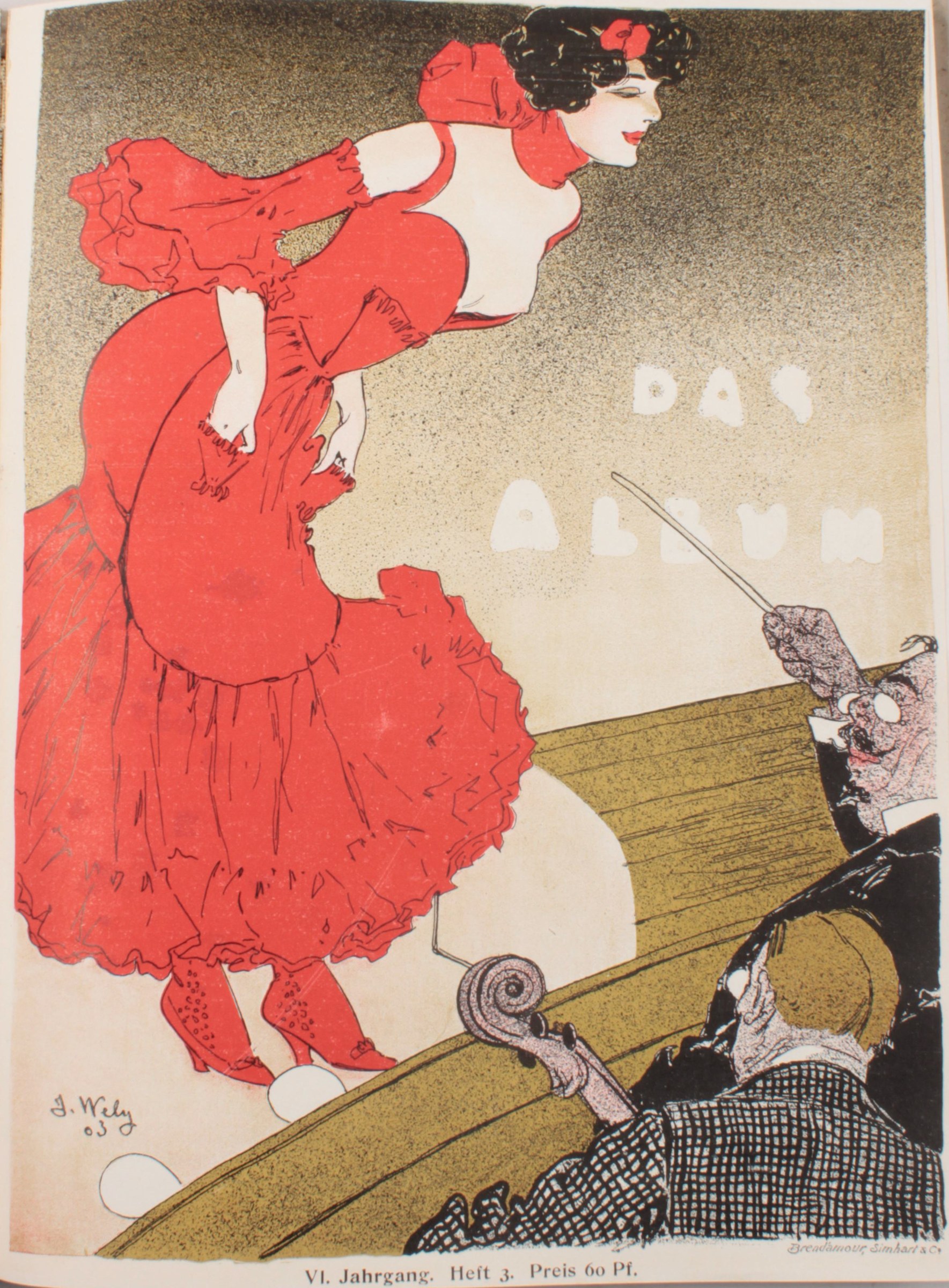
This image documents not actual dance but the visual codes and conventions through which dance and female performance were presented to early 20th-century audiences. The exaggeration, the costume, and the compositional staging reveal how fin-de-siècle entertainment—music hall, cabaret, and theatrical dance—relied on visual spectacle and fashion as much as movement. For historians of performance, costume, and gender representation, the work is a valuable record of how the performing female body was imagined and marketed.
What you are looking at
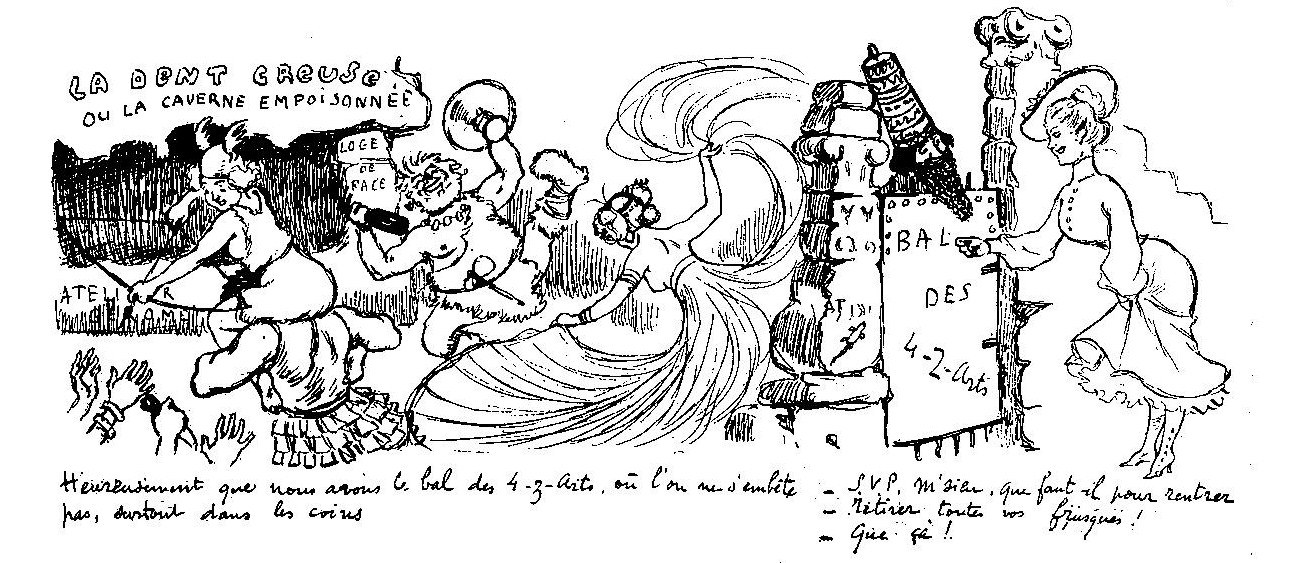
A woman in a brilliant red dress dominates the composition, leaning forward in a theatrical pose against a neutral background. Her gown is voluminous and heavily ruffled, with elaborate detailing at the hem and shoulder, the skirt billowing as though caught mid-movement. She wears red stockings and shoes to match, and her dark hair is styled in an elaborate upswept arrangement with a red bow. In the lower right corner, a man in dark formal dress (visible only from the waist down) reaches toward her with a pointer or rod, his hand emerging from shadow. The woman gazes away from him, her body angled to display the dress's construction. The composition is theatrical and somewhat satirical—the exaggeration of the costume and the woman's affected posture suggest this is commentary on fashion, courtship rituals, or stage performance rather than a naturalistic scene.
The dancing
Two figures: the woman's body is twisted in a contrapposto pose with her weight shifted, creating an S-curve that emphasizes the silhouette of the dress. Her arms are not engaged in any dance frame or hold; instead, one arm hangs naturally while the other is positioned to display her figure. The man behind her is mostly concealed, visible only as a hand and arm wielding what appears to be a conductor's baton or pointer. There is no closed hold, no partnering frame—the relationship between them is observational rather than collaborative. The woman appears to be the object of scrutiny rather than a participant in a social dance.
The dance depicted
This is not a depiction of ballroom or social dance in the conventional sense. While the woman's pose and the formal dress suggest a turn-of-the-century theatrical or cabaret context, the composition reads more as fashion illustration or social satire than as dance documentation. The red gown and theatrical presentation situate this in the world of Parisian music hall or burlesque performance, popular entertainment forms that employed exaggerated movement and costume. The figure's exaggerated posture and the man's directorial stance (with pointer) suggest a moment of performance or display rather than authentic partnered movement. This is more likely a commentary on fashion, female display, and the male gaze than a record of actual dance steps.
How it was made
The catalogue record lists this as an oil painting, but the image appears to be a color lithograph or color print—a medium well-suited to illustration and magazine reproduction. The flat areas of bright color (especially the saturated red), the bold outlines, and the grainy texture visible in the background are characteristic of early 20th-century color lithography rather than oil painting. The publication data ('VI. Jahrgang, Heft 3. Preis 60 Pf.') printed at the bottom identifies this as a magazine cover or spread from Das Album, a Parisian arts journal, suggesting it was designed for mass reproduction and circulation among educated European audiences interested in contemporary art, fashion, and culture.
About this work
This is a cover illustration from Das Album, a Parisian periodical documenting contemporary culture, art, and fashion. The work depicts a woman in exaggerated theatrical dress being observed or directed by a man, a composition that conflates fashion display with performance and commentary on the modern woman's role as spectacle. The red gown and cabaret-adjacent styling place it firmly in the world of early 20th-century entertainment and consumer culture. As a magazine illustration rather than fine art, it represents how dance and performance—or at least the visual language of performance—were consumed by the educated middle-class readership of such publications. The work captures the aesthetic conventions of Belle Époque entertainment: exaggerated silhouette, theatrical posturing, and the erotics of female display.
How to look at it
Attend to the extreme exaggeration of the woman's posture and the costume's construction: the artist is not depicting naturalistic movement but rather a frozen moment of display, where the body is arranged for maximum visual effect. Notice the relationship between the two figures—the woman presents herself; the man with the pointer directs or judges. This is the aesthetic of the fashion show or rehearsal space rendered as entertainment, and the composition is less about dance than about the ritual of performance itself. The illustration's graphic clarity and bold color are essential to its meaning: this is how early 20th-century audiences encountered and consumed images of performance and style.
The artist
Jacques Wély (signed 'J. Wély') was a commercial illustrator and graphic artist active in the Paris art scene during the early 20th century. He contributed illustrations to Das Album and other periodicals documenting contemporary Parisian culture, fashion, and entertainment. His work exemplifies the fin-de-siècle and Art Nouveau sensibility: sophisticated graphic design, attention to decorative line and silhouette, and engagement with the aesthetics of mass-market entertainment and consumer culture. Wély worked in a tradition of magazine and poster illustration that positioned artists as cultural commentators on modern urban life.
The period
This work dates to 1903, during the height of the Parisian Belle Époque and the golden age of the music hall and cabaret—venues like the Moulin Rouge (opened 1889) and the Folies Bergère where performance, fashion, and spectacle were inseparable. This was also the period when Art Nouveau design dominated European graphic arts, emphasizing decorative line, silhouette, and the aestheticization of everyday consumer culture. In dance history, this moment marks the emergence of modern theatrical dance and the increasing visibility of female performers as commercial entertainers whose bodies were objects of aesthetic consumption. The illustrated magazine was the primary medium through which Parisian entertainment culture was documented and circulated to a broad educated audience.
Where it lives
This is a magazine illustration from Das Album (Volume 6, Issue 3, priced at 60 Pfennig), a Parisian periodical devoted to contemporary art and culture. The work was likely published as a cover or feature illustration in a journal intended for educated readers interested in modern design, fashion, and entertainment. The source is listed as Wikimedia Commons, where it is held in public digital collections.
Dance in this work
Questions about this work
Is this actually a dance scene?
Not in the strict sense of social or partnered ballroom dance. It depicts a moment of theatrical performance or fashion display—a woman in an exaggerated pose being observed or directed by a man. The composition is more about spectacle and the ritualization of the female body than about actual dance movement or steps. However, it documents how performance, fashion, and entertainment were visually presented in early 20th-century Parisian culture.
Why does the catalogue say 'oil painting' when it looks like a print?
The catalogue record may be incorrect or incomplete. The image characteristics—flat color areas, bold outlines, the grainy texture, and the publication information printed at the bottom—are consistent with color lithography, a printmaking technique widely used for magazine illustration. This was the standard medium for fashion and entertainment illustration of the period, designed for mass reproduction and distribution.
What was Das Album, and who read it?
Das Album was a Parisian arts periodical (published in French and German) documenting contemporary culture, art, design, and entertainment. Its educated, cosmopolitan readership included art collectors, designers, and consumers of high culture interested in modern developments in Parisian style and artistic practice. Magazine illustrations like this one were how such audiences encountered and consumed images of contemporary performance and fashion.
What does the man with the pointer represent?
He likely represents a director, dance master, or showman—the authority figure who stages and controls the female performer's display. His presence and his tool of direction emphasize that this is a moment of performance or rehearsal, where the woman's body is being arranged and evaluated by male oversight. This dynamic reflects historical gender hierarchies in entertainment and theater.
More dance artwork