49 works in this view — arrow keys or swipe to move between them.
Dance in Art · 1902
Gösta von Hennigs; Spanska danserskor
Various artists
- Medium:
- Oil Painting
- Era:
- 1900-1920 (Ragtime/Early Jazz)
- Source:
- Wikimedia Commons
- Rights:
- Public domain — free to use, share and adapt.
- Recorded as:
- Public Domain
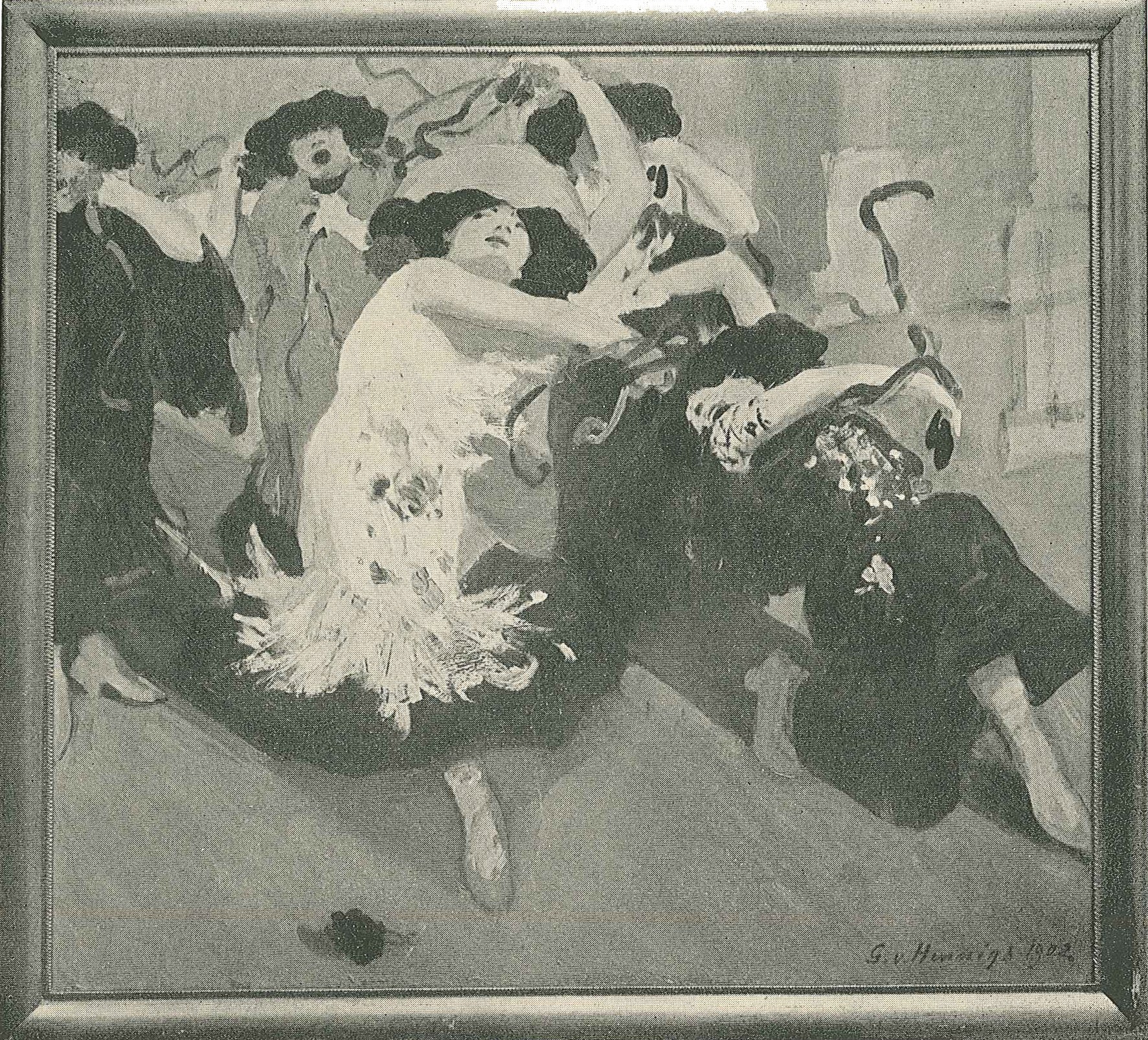
The painting shows how Spanish dance was marketed and consumed by European audiences at the threshold of modernism, documenting a moment when flamenco and related traditions entered the urban entertainment economy as prestigious spectacle rather than vernacular practice. For historians of theatrical dance and cultural circulation, it is evidence of how European artists understood and represented non-European dance traditions during this period.
What you are looking at
A crowded interior scene depicting Spanish dancers performing for an assembled audience of fashionably dressed spectators. The composition is theatrical and energetic: in the center, a woman in a white ruffled dress executes a dynamic turn or leap, her body arched and limbs extended, while another dancer in dark clothing moves nearby. The surrounding figures—men in dark suits and women in elegant Edwardian dress with high collars and elaborate hats—press close around the dancers, creating an intimate, almost salon-like atmosphere of urban entertainment. The light is soft and atmospheric, rendered in muted grays and blacks with highlights catching the white fabric of the central dancer's costume. The setting appears to be an indoor venue, perhaps a dance hall or private performance space, captured in a moment of high energy and close audience engagement.
The dancing
The central dancer displays an extended, lifted posture with visible arch through the torso and raised arms—a vocabulary associated with theatrical Spanish dance. Her white dress, with its voluminous ruffled skirt, reads as a performer's costume designed to display movement. The surrounding figures are static by contrast, leaning in as spectators. The dancer's frame is open and expansive rather than paired or ballroom-closed, and her body angle suggests a turn or a moment of suspension rather than a grounded step pattern.
The dance depicted
The work depicts Spanish theatrical dance—flamenco or a related Spanish dance tradition adapted for theatrical performance and urban audiences around 1900. The white costume, the dynamic lifted posture, the ruffled skirt designed for visual display, and the context of an interior performance venue all point to professional Spanish dance as performed in European cities in the Ragtime era. This is not vernacular flamenco but its theatrical version, packaged for fashionable entertainment. The painting captures the moment when Spanish dance culture was being consumed by cosmopolitan audiences across Europe.
How it was made
Oil painting on canvas. The technique employs soft, diffused handling—the figures are suggested rather than sharply outlined, and the atmospheric quality creates depth through tonal gradation rather than linear perspective. This impressionistic approach was common for salon paintings of entertainment and leisure subjects around 1900. The technique allows the artist to capture the transient, kinetic moment of performance while keeping the viewer's eye moving through the crowded composition.
About this work
This 1902 oil painting by Gösta von Hennigs documents the moment when Spanish dance entered the repertoire of European urban entertainment. The work captures not the dance itself in technical detail but the social context of its consumption: the intimacy of a fashionable performance, the electricity between performer and assembled witnesses, and the theatrical presentation of a dance tradition to an audience of metropolitan spectators. It is a record of cultural translation and the market for Spanish exoticism at the turn of the twentieth century.
How to look at it
Attend to the moment the artist has chosen: not a moment of stillness but of suspension and turning, where the dancer's body is extended and visible to the assembled audience. Notice how the artist frames the viewer as if you were one of the spectators crowded around the performance—there is no theatrical distance here, no proscenium. The white costume dominates the composition not through scale but through its isolation against the dark suits and dresses surrounding it, and the ruffles are rendered with particular attention to how they move and catch light. This is a painting about spectatorship as much as about dance.
The artist
Gösta von Hennigs (1866–1941) was a Swedish painter known for salon scenes, portraits, and genre paintings of contemporary leisure and entertainment. His work frequently depicted fashionable urban life and theatrical subjects, placing him within the tradition of late nineteenth-century European painters of modern social life. The soft, impressionistic handling of light and the focus on momentary, transient scenes reflect the influence of broader artistic trends toward capturing contemporary experience.
The period
In 1902, Spanish dance was experiencing a major revival in European cultural life, particularly in Paris and other cosmopolitan centers. This coincided with broader European fascination with non-European cultures and with the expansion of theatrical entertainment as a commercial industry. The painting reflects the era's appetite for Spanish exoticism—a fascination that would intensify through the early twentieth century and influence modernist artists including Picasso and Diaghilev. Simultaneously, the Ragtime era was reshaping American and European popular dance through jazz and syncopation, but European high culture still looked to Spanish tradition as a marker of passionate, theatrical authenticity.
Where it lives
The work is recorded as an oil painting from 1902 attributed to Gösta von Hennigs. The current holding collection is not recorded. The image is sourced from Wikimedia Commons.
Dance in this work
Questions about this work
Is this flamenco?
The painting depicts theatrical Spanish dance as performed in urban European venues around 1900. Whether the specific tradition is flamenco, bolero, or another Spanish form cannot be determined from the image alone. What matters is that this is Spanish dance as theatrical spectacle—professionally performed, costumed, and marketed to fashionable audiences—rather than vernacular or regional practice.
Why is the audience so close to the dancer?
The crowded, intimate composition reflects how Spanish dance was often performed in early 1900s urban entertainment venues: smaller halls, salons, and cabaret spaces rather than large theaters. The proximity created a sense of immediacy and exclusivity that appealed to fashionable audiences seeking modern, transgressive entertainment.
What does the white dress tell us?
The white ruffled costume is a performer's costume designed to display movement—the fabric catches light and moves with the body in ways that make the dance visible and dramatic. It signals that this is professional, theatrical Spanish dance, not everyday clothing, and positions the dancer as a spectacle to be consumed by the assembled audience.
More dance artwork