35 works in this view — arrow keys or swipe to move between them.
Dance in Art · 1924
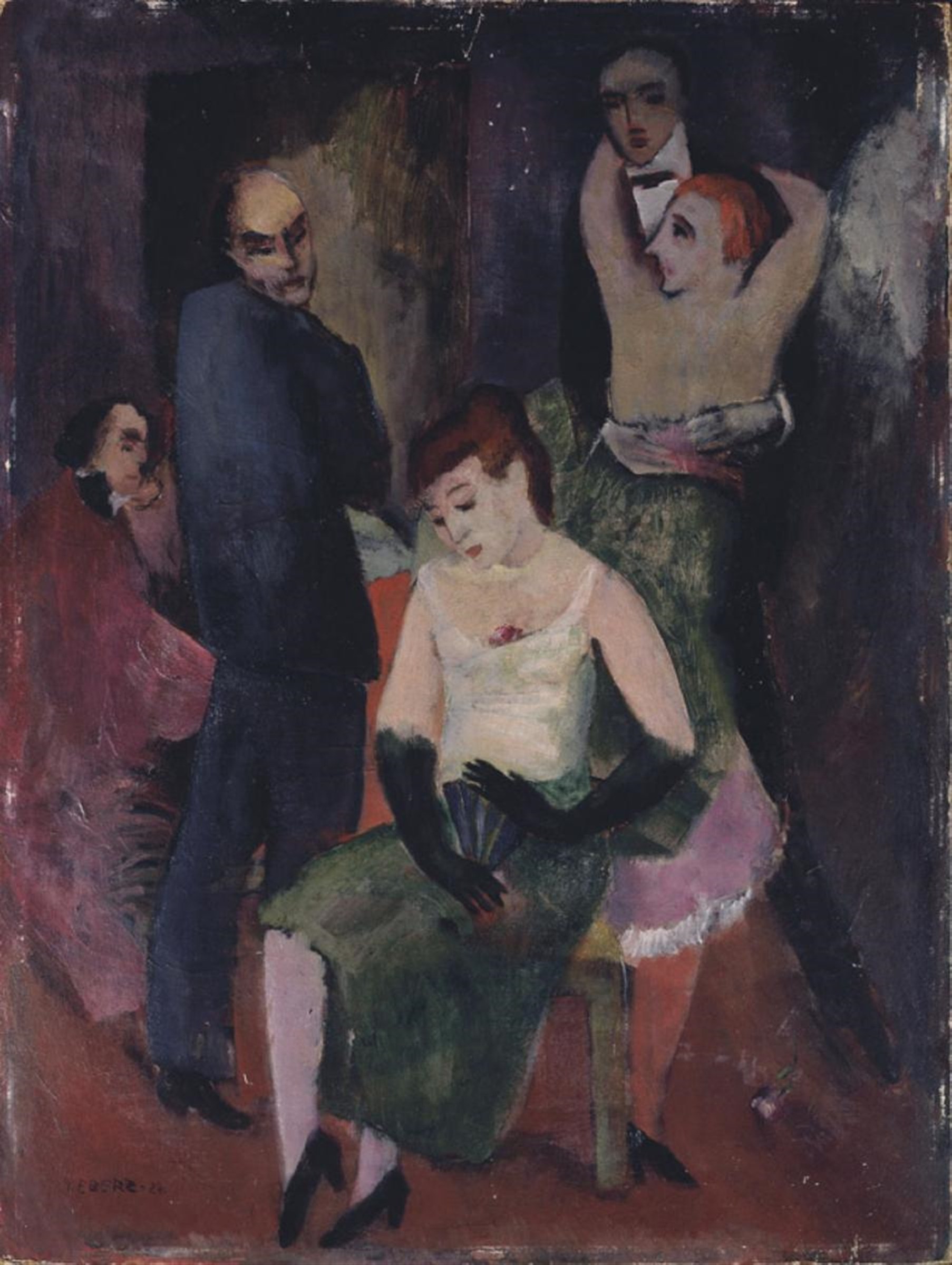
Josef Eberz - Tabarin, 1924
Josef Eberz
- Medium:
- Oil Painting
- Era:
- 1920-1950 (Swing Era)
- Source:
- Wikimedia Commons
- Rights:
- Public domain — free to use, share and adapt.
- Recorded as:
- Public Domain
This painting documents a form of performance and movement—cabaret erotic dance—that was central to modernist visual and social life but remains marginal in dance history and museum collections. It also reveals how artists understood the cabaret not as entertainment but as a site of psychological and social vulnerability, a theme that recurs throughout German Expressionism and the Weimar period. For dance historians, it is evidence of how the 1920s nightclub performer was constructed as a subject and object simultaneously.
What you are looking at
Five figures in evening dress occupy a darkened interior, their forms rendered in muted jewel tones and flesh-colored washes against a deep aubergine and brown background. The central figure—a woman with short reddish hair wearing a sleeveless white dress with a rose-colored accent at the hip and black gloves—stands with her weight on one leg, her torso angled toward the viewer. She is attended by four men in dark suits and formal dress: one stands immediately behind her with his hand raised near her face, another leans in from the left wearing a burgundy jacket, a third stands upright in the middle distance, and a fourth figure appears on the right. The painting captures a moment of intimate theater: the woman's expression is downturned and contemplative, while the men's attention is riveted upon her. The composition suggests neither ballroom propriety nor consensual partnership, but rather the peculiar economy of the cabaret or music-hall, where a single performer commands a circle of male regard.
The dancing
The central woman's stance is asymmetrical and composed—her weight shifted, one arm hanging while the other rests across her body, creating a posture of exposure rather than dance frame. She does not touch any of the men around her, nor they her, yet the spatial arrangement suggests a performance or display: the men form an informal ring of attention. No partner hold is visible. If movement occurs, it is the woman's alone, while the men remain largely static, their bodies angled inward. The figure on the right, bare-shouldered and pale, seems almost statuesque by contrast with the woman's slight animation.
The dance depicted
This does not depict ballroom, theatrical, or social dance in the conventional sense. Instead, it appears to show cabaret performance—the Tabarin was a famous Montmartre nightclub of the 1920s specializing in revue, striptease, and erotic entertainment. The woman is likely a performer in such a setting, and the painting captures the transaction between performer and spectators that defined such venues. The gesture is one of availability rather than dance technique; if she dances, it is in the idiom of cabaret strip performance or the sexually charged theater-dance that evolved in interwar Paris. The record's label 'General Dance' does not adequately capture what is actually depicted.
How it was made
Oil on canvas, rendered in the expressionist style of 1920s German painting. The artist has used loose, suggestive brushwork and muted, almost queasy color—sallow flesh tones, bruised purples, sickly greens—to create psychological unease rather than beauty. Light sources are ambiguous, emerging from within the dark field to bleach certain areas of face and fabric. This technique allows the painter to render the sordid intimacy and moral vertigo of the cabaret interior without illustrative detail. The work's visceral discomfort is entirely the product of its handling.
About this work
Josef Eberz's *Tabarin* is a 1924 oil painting that uses the cabaret performance as a vehicle for exploring the psychology of spectatorship and desire. It shows a woman performer surrounded by male clients or admirers in the dim interior of a Montmartre nightclub, the venue famous for erotic revue. The painting is not interested in dance technique or social convention; it documents instead the power dynamic and commodification at the heart of performance in such spaces. Eberz employs expressionist technique—acidic color, loose paint, psychological distortion—to make the scene's moral and emotional landscape visible. The work belongs in a collection of dance imagery because cabaret and strip performance have always been forms of movement and spectacle, even as they fall outside the institutional and theatrical dance canon that museums traditionally preserve.
How to look at it
Attend first to the woman's face and posture: her downturned gaze and asymmetrical stance suggest not triumph or joy, but introspection or resignation. Then trace the geometry of male attention around her—how each man is oriented toward her, yet does not touch. Notice the murky color and the way light seems to come from no single source but rather to emerge from within the dark field, making the scene feel underwater or nightmarish. The artist has frozen not a moment of joyful performance but a moment of psychological transaction, where the woman's body is present but her interiority withdrawn. The painting asks you to feel the discomfort of spectatorship rather than to enjoy the spectacle.
The artist
Josef Eberz (1880–1942) was a German painter associated with Expressionism and New Objectivity (Neue Sachlichkeit). He worked primarily in Berlin and was known for urban and theatrical subjects, often exploring psychological states and social themes through distorted color and form. His work was characteristic of the Weimar-era artistic engagement with cabaret, performance, and the demimonde. He exhibited widely in Germany during the 1920s and 1930s but fell into relative obscurity after the Nazi period.
The period
The painting dates to 1924, at the height of the Weimar cabaret era. Berlin and Paris were centers of nightclub culture, and the cabaret—especially erotic or avant-garde cabaret—was a subject of intense artistic interest. German Expressionists in particular were drawn to the cabaret as a subject that embodied modernity, sexual liberation, social anxiety, and the collision between high art and mass entertainment. The Tabarin in Montmartre was one of Paris's most famous cabaret venues, known for its revue and transgressive entertainment. In this period, cabaret dancers and performers occupied an ambiguous cultural position: celebrated as symbols of modernity and sexual freedom, but also vulnerable to exploitation and moral condemnation. The painting's psychological intensity reflects this ambivalence.
Where it lives
The work is sourced from Wikimedia Commons. The holding collection is not recorded in the catalogue.
Dance in this work
Questions about this work
Was the Tabarin a real nightclub?
Yes. The Tabarin was a celebrated cabaret in Montmartre, Paris, famous in the 1920s and 1930s for revue and adult entertainment. It continued operating through much of the 20th century.
Is this painting sexually explicit?
No, not by modern standards. The woman is clothed, and the painter's interest is in psychological states and the power dynamic between performer and spectators, not in rendering the body for erotic effect. The discomfort the painting creates is emotional and moral, not graphic.
Does this show a real dance form?
Cabaret and music-hall performance involved movement and spectacle, though not the structured technique of ballet or ballroom dance. The woman's stance and posture suggest the kind of performance-based movement associated with revue and erotic cabaret, where the performer's presence and comportment mattered more than codified steps.
Why is this in a dance collection?
Because cabaret performance is a historical form of movement and spectacle, even if it exists outside the institutions and definitions that have traditionally governed 'dance.' Including it challenges the boundaries of what counts as dance and whom the dance archive is willing to remember.
More dance artwork