36 works in this view — arrow keys or swipe to move between them.
Dance in Art · 1950
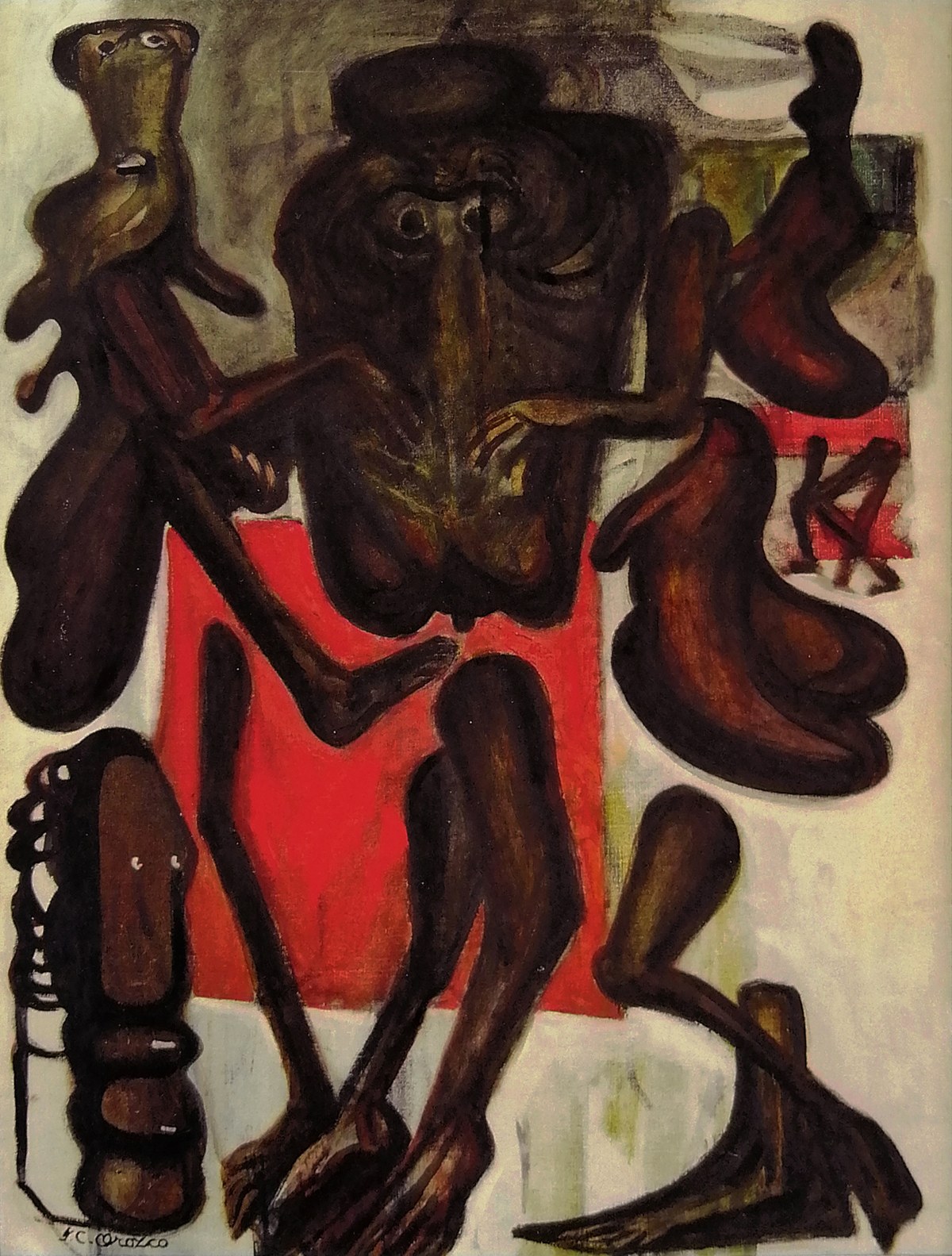
José Clemente Orozco, Danza negra en Harlem II
José Clemente Orozco
- Medium:
- Oil Painting
- Era:
- 1920-1950 (Swing Era)
- Source:
- Wikimedia Commons
- Rights:
- Public domain — free to use, share and adapt.
- Recorded as:
- Public Domain
This painting is significant as a major 20th-century artist's interpretation of African American dance and Harlem culture—a moment when modernist visual artists were engaging seriously with Black cultural expression. It demonstrates how dance functioned symbolically in modernist art, not as technical spectacle but as a vehicle for exploring identity, spirituality, and resistance. The work also documents the international resonance of Harlem as a cultural capital, attracting the visual and intellectual attention of artists like Orozco who saw in its dance practices something essential about modernity itself.
What you are looking at
The composition centers on a dark-skinned female dancer in a brilliant red dress, her body twisted in a dynamic contrapposto stance with one leg extended and arms raised in expressive gesture. She is surrounded by five abstracted wooden sculptural forms—some resembling totemic figures or masks, others more biomorphic—rendered in dark brown and ochre tones. The figures press close around her, some appearing to lean or gesture toward the central dancer. The setting is ambiguous: a pale cream background suggests either a stage or a gallery space. The style is expressionist, with heavy black outlines, rough brushwork, and a limited palette that emphasizes the red dress as the sole chromatic anchor. The mood is one of dynamic interaction between the solitary dancer and the primitive or ancestral presences that surround her—whether supportive, constraining, or dialogic remains deliberately unclear.
The dancing
The central dancer displays a twisted torso with weight shifted to one leg, the other lifted and extended; her arms are raised in an open, reaching gesture that suggests both celebration and a kind of ritual invocation. Her body moves through space with angular, modernist articulation rather than classical line. The surrounding wooden forms are abstracted but vaguely anthropomorphic—some suggest standing figures, others seated or crouching postures. The composition suggests a soloist dancing in relation to or communion with these other presences, though their stillness contrasts dramatically with her apparent motion.
The dance depicted
This work does not depict a recognizable ballroom, theatrical, or established folk dance style. Instead, it appears to represent modern or contemporary interpretive dance—the kind performed in avant-garde theatrical contexts of the early-to-mid 20th century. The title *Danza negra en Harlem II* (Black Dance in Harlem II) indicates the artist is depicting African American or African diaspora dance culture, likely responding to the vibrant performance and nightlife scenes of Harlem in the 1920s–1940s. The expressionist style and ambiguous narrative suggest the artist is capturing an emotional or spiritual essence of the dance rather than its technical choreography. The wooden forms may represent ancestral or cultural presences, transforming a nightclub scene into something ritualistic.
How it was made
Oil painting on canvas. The artist uses bold, simplified forms and a restricted palette—browns, ochres, reds, and cream—with heavy black outlines that recall woodcut and expressionist printmaking traditions. This technique allows Orozco to emphasize psychological and emotional content over naturalistic detail. The rough, gestural brushwork conveys urgency and intensity; the paint is applied with visible directness. Oil painting's opacity and layering capacity enabled the artist to build the sculptural solidity of the surrounding forms while keeping the central figure vibrant and assertive.
About this work
This 1950 oil painting by José Clemente Orozco depicts a solitary female dancer in a red dress surrounded by abstracted wooden figures in a compressed, expressionist composition. Rather than documenting a specific dance style, the work captures the emotional and spiritual register of African American dance culture in Harlem—interpreting the nightlife scene through a modernist, almost ritualistic formal language. The dancer's twisted, extended body and raised arms suggest both exuberance and invocation, while the looming presences around her evoke ancestral or cultural forces. Orozco, a Mexican muralist and painter known for socially conscious art, here engages with African American modernism and the aesthetic politics of the Harlem Renaissance, translating lived performance into a meditation on cultural identity, presence, and power.
How to look at it
Look first at the central figure's posture: Orozco has frozen the dancer mid-gesture, with her body weight shifted and one leg extended, capturing not a static pose but a moment of dynamic motion and emotional expression. Notice how the surrounding wooden forms press inward, some with face-like features, others more abstract—these shift between audience, ancestral presence, and psychological embodiment depending on where your eye rests. The isolated red dress glows against the muted surround, making the dancer simultaneously vulnerable and radiant. The heavy black outlines and rough handling throughout emphasize emotional truth over visual naturalism—Orozco is painting the feeling and significance of the dance, not its technical mechanics.
The artist
José Clemente Orozco (1883–1949) was a leading Mexican muralist and painter of the 20th century, celebrated for monumental public works that engaged with themes of social justice, revolution, and human suffering. Known for his expressionist style, Orozco developed a vocabulary of distorted, powerful figuration and dramatic chiaroscuro to convey psychological and political intensity. Though primarily associated with Mexican indigenismo and revolutionary themes, Orozco traveled widely and engaged with other modernisms; his engagement with African American culture in works like this reflects his broader interest in marginalized peoples and their expressive traditions. He died in 1949, making this work from the final year of his life.
The period
The Harlem Renaissance (1920s–1930s) had established African American art, music, and dance as major cultural forces by the time Orozco painted this work in 1950. Though the Renaissance's peak had passed, Harlem remained iconic as a symbol of Black cultural achievement and artistic innovation. In visual art, the 1940s–1950s saw growing engagement by major artists with African and African American aesthetics—partly through increased awareness of African sculpture's influence on modernism, and partly through explicit solidarity with African American struggle. Orozco's choice of subject reflects this moment, as well as a broader shift in how modernist painters approached the human figure and the body in motion.
Where it lives
The work is documented in Wikimedia Commons; current location and institutional holdings are not recorded in the catalogue. This indicates it is a publicly documented work that may be held in a museum collection, but exact provenance is unconfirmed.
Dance in this work
Questions about this work
What kind of dance is being depicted?
The painting does not represent a specific named dance style. Instead, Orozco captures the expressive, interpretive energy of African American dance culture in Harlem—likely drawing on jazz dance, social dancing, and the performative tradition of Harlem's nightclubs and cabarets. The title and the artist's expressionist style suggest he is interested in the spiritual and emotional content of the dance rather than its technical form.
Why are there wooden figures around the dancer?
These abstracted forms likely represent ancestral or spiritual presences, evoking African cultural traditions and the deep historical roots of African American expressive culture. They may also suggest an audience, or more abstractly, the psychological and cultural forces that shape and surround individual performance. Orozco's expressionism makes these ambiguities intentional—they invite multiple readings.
Is this painting part of Orozco's major body of work?
While Orozco is best known for his large-scale public murals addressing revolutionary and indigenous themes, he created many easel paintings throughout his career. This work from 1950, the year of his death, reflects his sustained interest in the human figure and in socially engaged subject matter, but it is smaller in scale and more personal in scope than his monumental public work.
What does the red dress signify?
The brilliant red dress is the sole bright color in the composition, making it visually dominant and symbolically charged. It may evoke the sensuality and vitality associated with performance and nightlife, the visibility and desirability of the Black female body in public space, or simply the radiance and power of the dancer herself. The color's intensity against the muted surrounds emphasizes her presence.
More dance artwork