49 works in this view — arrow keys or swipe to move between them.
Dance in Art · 1774
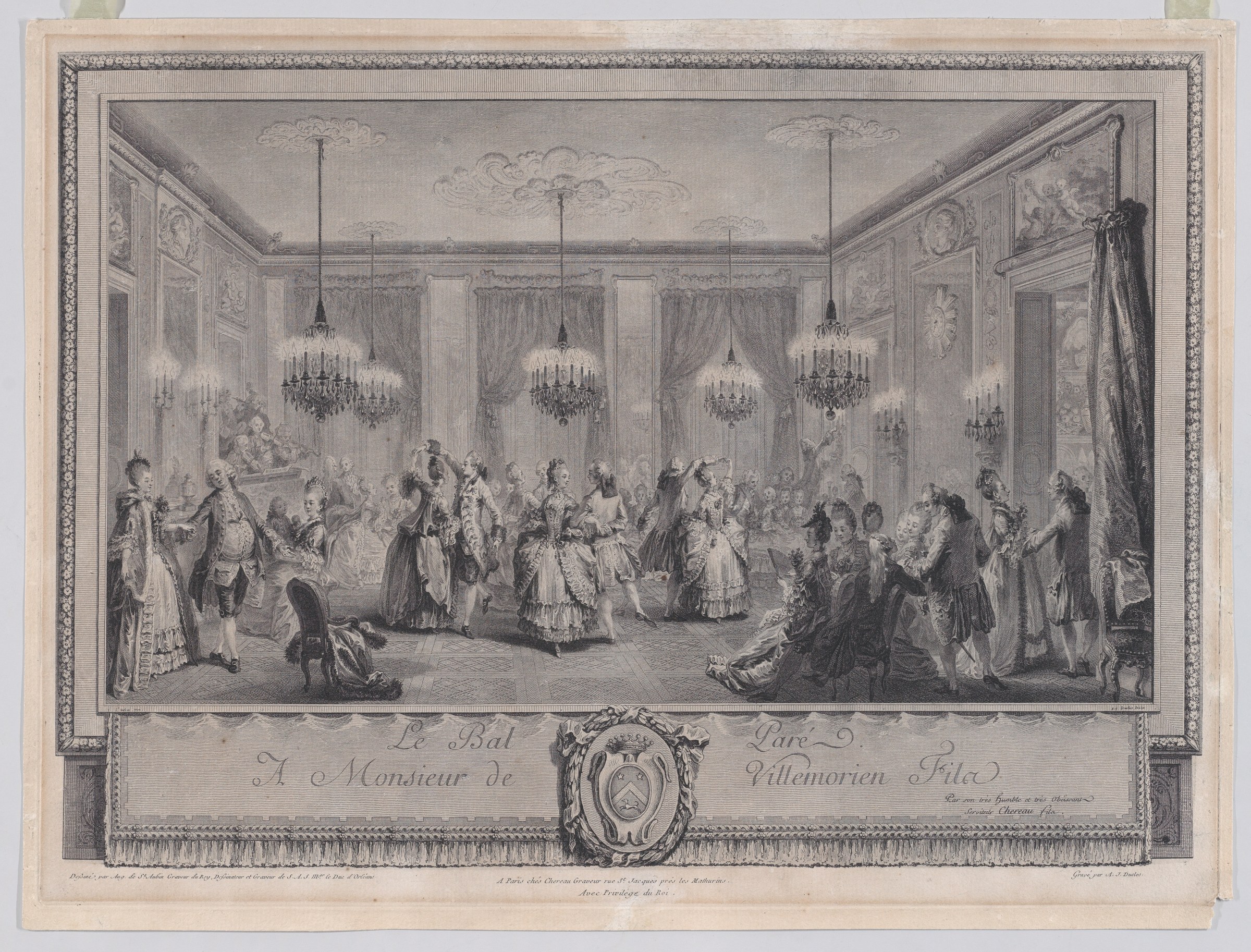
Le Bal Paré Met DP887763
Antoine-Jean Duclos
- Medium:
- Oil Painting
- Era:
- 1700s (Enlightenment/Minuet Era)
- Source:
- Wikimedia Commons
- Rights:
- Public domain — free to use, share and adapt.
- Recorded as:
- CC0
This work demonstrates how dance functioned as a disciplined social practice in aristocratic life—not as entertainment or spectacle but as a coded system for displaying rank, accomplishment, and marriageability. For historians of dance, the engraving's precision makes it an invaluable record of posture, spacing, and the material context (floor, light, costume, music room) in which the minuet was performed.
What you are looking at
An 18th-century aristocratic ball in full swing, rendered as an engraving. The scene occupies a grand rectangular salon with a coffered and ornamented ceiling, its surface articulated by rosette medallions at regular intervals. Five substantial crystal chandeliers hang from the ceiling, illuminating the assembled company. The walls are paneled and hung with large painted panels (likely Rococo scenes) and swags of draped fabric between arched wall sconces. The floor is polished parquet. Dozens of fashionably dressed guests mill, converse, and dance throughout the space. The women wear the full-skirted gowns and elaborate coiffures of the 1770s; the men wear embroidered coats, breeches, and stockings. In the center and middle distance, couples and small groups stand or move in the formal postures of minuet and other courtly dances. The composition draws the eye through the space with careful perspective, emphasizing the length and grandeur of the hall and the profusion of candle-lit detail. A large drape hangs prominently on the right side. The print preserves the refined, documentary character of a formal invitation or commemorative record.
The dancing
The dancers maintain the upright, formal carriage characteristic of 18th-century court dance. Men and women face one another or stand in linear formations typical of the minuet and cotillion. Arms are held in the light, controlled frame of the period—women's arms often at or near waist height, men's extended in a formal, measured manner. The skirts dominate the female silhouette and swirl subtly, suggesting restricted, deliberate footwork rather than free movement. Groups are organized in couples and small sets, reflecting the structure of partnered and group dances. The overall impression is one of restrained elegance and synchronized social ritual rather than vigorous physicality.
The dance depicted
This is a representation of formal aristocratic social dance of the 1770s—most likely a minuet, cotillion, or quadrille, the three dominant ballroom forms of the period. The title, *Le Bal Paré à Monsieur de Villemorien*, identifies this as a recorded social event, probably a named noble's ball rather than a theatrical performance. The minuet's continued prominence in Rococo society is evident in the upright frame, the deliberate pacing, and the geometric organization of couples. The engraving documents not the dance steps themselves but the social spectacle of the ball—the setting, the dress code, the careful choreography of courtship and status that dancing embodied.
How it was made
This is an engraving (not, as the catalogue records, an oil painting). The technique—fine cross-hatching and careful linear work—allows precise detail in architectural elements, textiles, and figure drawing while maintaining the tonal modeling necessary to suggest depth and illuminate the chandelier-lit interior. Engraving was the primary medium for commemorative and documentary prints in the 18th century and implies circulation among the educated nobility and merchant classes who collected such records. The inscription in French below the image and the formal composition suggest this was produced as a souvenir or formal record of a specific named ball, likely distributed to attendees or within the patron's circle.
About this work
This engraving documents a formal ball in 1770s France, capturing the architectural splendor, dress code, and social choreography of aristocratic dance at the height of the Rococo period. The precise, orderly rendering preserves not the kinetic energy of dance but the ritual performance of courtship, status, and refinement that the minuet and cotillion embodied. As a named, commemorative record of a specific event, it sits between pure documentation and the idealized ballroom scenes that were stock subjects in Rococo printmaking. It is a primary source for the spatial and social organization of 18th-century court dance and the furnishing standards that framed it.
How to look at it
Attend to the spatial organization: dancers are not clustered in the center but distributed across the salon, suggesting the turn-based, progressive structure of minuets and cotillions rather than a free-form ball. Notice the precise postures—upright, measured, geometric—that distinguish courtly dance from the looser, more energetic forms that would follow. The engraving's documentary precision allows you to read the fabrics, the shoe styles, the arrangement of hair and jewelry as integral to the dance itself. The light from the chandeliers is carefully rendered to model form and suggest the ballroom's festive atmosphere while maintaining the orderly, almost ceremonial tone of the event.
The artist
Antoine-Jean Duclos was an 18th-century French engraver associated with Rococo society scenes and ballroom imagery. His practice centered on the commemoration of aristocratic social life through finely detailed engravings that circulated among the nobility. Works of this type were often produced to order, as souvenirs of significant events or as gifts for patrons.
The period
In the 1770s, the minuet remained the dominant form of aristocratic social dance, though the cotillion and quadrille were gaining ground. The ballroom itself was a carefully designed social theater, and the engraving reflects the Rococo obsession with refinement, artifice, and the aesthetics of interior life. Prints of named balls served as status markers and fashion records, circulating among the elite. The persistence of the minuet and the formal dress code visible here also mark the late Rococo moment—within two decades, revolutionary disruption would end this world of ritual courtship through dance.
Where it lives
The source is listed as Wikimedia Commons, with no holding collection recorded. This appears to be a commemorative engraving, likely produced in limited numbers as a souvenir for attendees or the patron's circle. The survival of such prints in museum and library collections across Europe is common; their original function was documentary and commemorative rather than fine art.
Dance in this work
Questions about this work
What dance are they doing?
Most likely a minuet, cotillion, or quadrille—the three principal social dances of 1770s aristocratic ballrooms. The engraving documents the social event rather than isolating the steps, so the precise choreography is not the focus. The formal postures and geometric spacing of the couples suggest the measured, turn-based structure of these dances.
Why is this called 'Paré' (adorned)?
*Bal paré* was 18th-century terminology for a formal, dressed ball—an evening where full court dress (silk, jewels, elaborate coiffure) was required. The term distinguished such balls from masquerades, domestic dances, or informal gatherings.
Who was Monsieur de Villemorien?
The title identifies this as a ball given by or in honor of a specific named nobleman, likely someone of sufficient rank and wealth to commission a commemorative engraving. The custom of recording named social events through print was common among 18th-century French nobility.
Is this a real event or imaginary?
The specificity of the title—naming a patron and the event type—suggests this commemorates an actual ball rather than a generic ballroom fantasy. The precision and documentary tone of the engraving support this. However, the artist may have idealized or reorganized details for aesthetic effect.
More dance artwork