40 works in this view — arrow keys or swipe to move between them.
Dance in Art · 1922
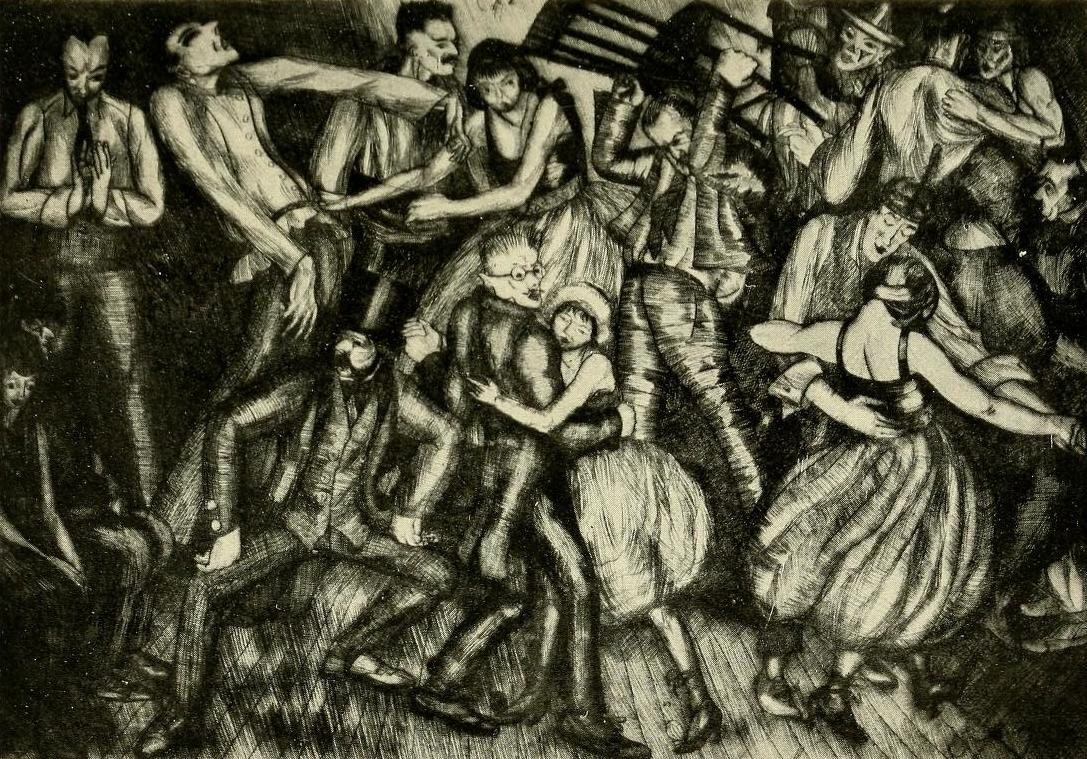
Peggy Bacon - Dance at the League
Peggy Bacon
- Medium:
- Oil Painting
- Era:
- 1920-1950 (Swing Era)
- Source:
- Wikimedia Commons
- Rights:
- Public domain — free to use, share and adapt.
- Recorded as:
- Public Domain
This work documents the social texture of 1920s American social dancing at a moment when it was becoming democratized and feminized, moving beyond ballroom instruction into spontaneous, pleasure-driven community practice. Bacon's treatment of the scene—crowded, mixed-age, informal, energetic—captures something essential about how jazz-age dancing functioned as a social institution rather than a performance art. For historians and dancers, it is evidence of how bodies moved and interacted in this period, and how artists of the time saw dance as central to the reimagining of American social life.
What you are looking at
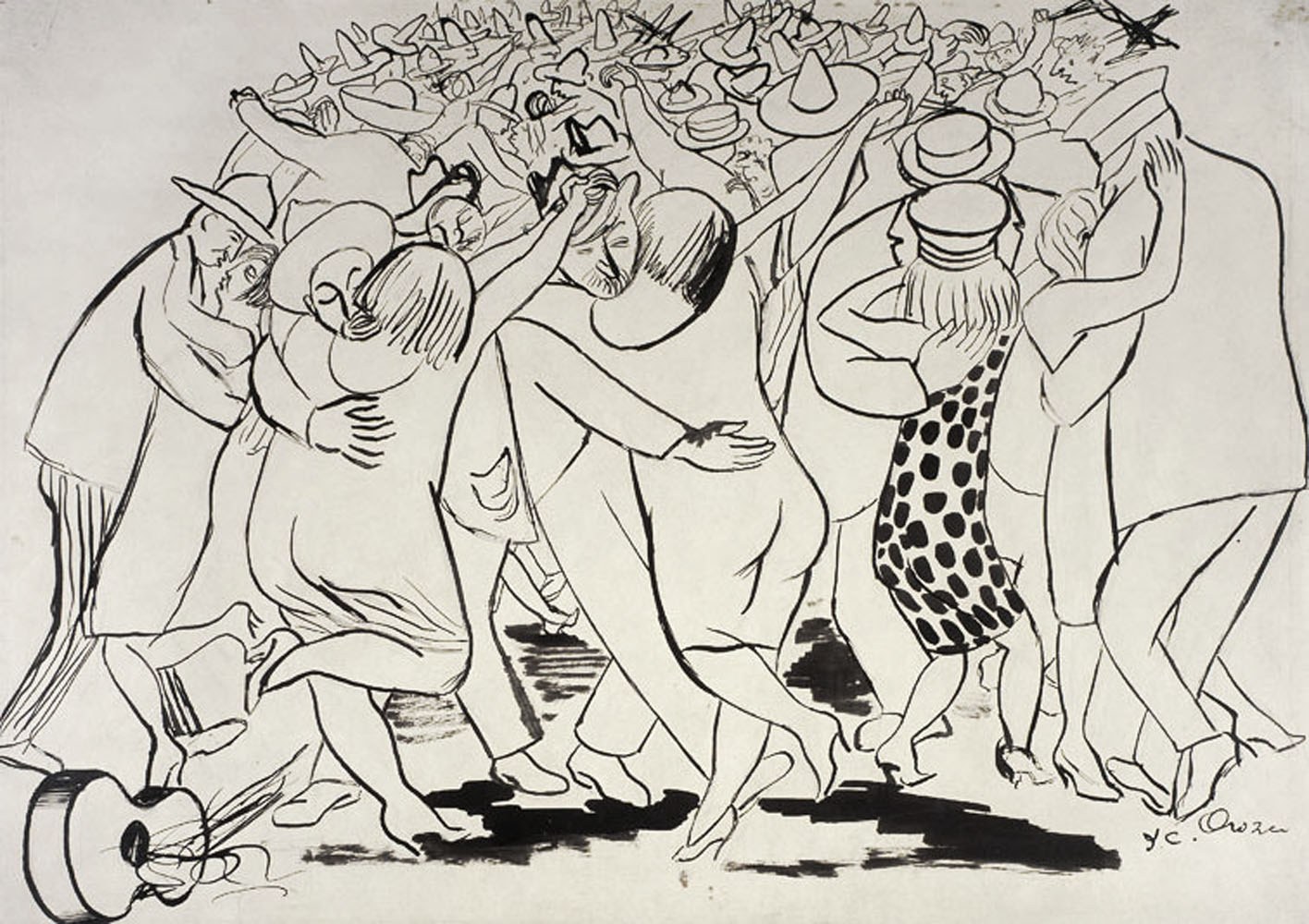
A crowded social dance scene rendered in energetic pen or ink linework, showing roughly twenty figures packed into a shallow interior space. The composition is dense and overlapping, with figures at multiple depths creating a sense of spontaneous movement and social interaction. Dancers wear 1920s dress—women in drop-waist dresses with hemlines at or just below the knee, men in suits and hats. The scene captures a moment of animated social dancing, with couples and groups in various configurations: some locked in closed positions, others in looser contact or solo gesturing. The linework is expressionistic and gestural, with heavy crosshatching creating shadow and volume. A few figures wear spectacles, and the overall mood is one of jazz-age informality and pleasure—this is a dance hall or party scene, not a stage performance.
The dancing
The bodies show varied positions typical of 1920s social dancing: several couples in recognizable closed ballroom holds (one man's arm clearly around a woman's waist, her hand on his shoulder); others in more relaxed positions suggestive of Charleston or freestyle movement. A few figures appear to be gesturing or clapping. Arms are often outstretched or akimbo, indicating the looser physicality of vernacular jazz-age dance. The weight distribution is generally upright and mobile rather than balletic. Children appear among the dancers, integrated into the scene as onlookers or participants, which suggests a community or family social event.
The dance depicted
This is almost certainly a social dance scene from the 1920s jazz era, most likely depicting the Charleston, lindy hop, or general ballroom social dancing of the period. The mix of closed ballroom holds with freer, more expressive arm positions and the energetic, informal atmosphere all point to American social dancing of the Swing Era. The artist has captured the democratic, mixed-age character of such events—this is not a performance for an audience but a gathering where dancing is the primary social activity. The dress, composition, and style all align with early-1920s vernacular dance culture.
How it was made
The work appears to be a pen or ink drawing, possibly an etching or engraving (the catalogue lists it as oil painting, but the visual evidence suggests drawing or print). The dense, directional linework, the interplay of line and white paper, and the monochromatic rendering are characteristic of printmaking or ink drawing rather than oil painting. The technique allows for fine gestural mark-making and rapid suggestion of movement through hatching. This method would have been suitable for reproduction and circulation in magazines or books, suggesting the work may have been part of illustrated journalism or art criticism of the period.
About this work
Peggy Bacon's 'Dance at the League' (1922) captures a moment of informal social dancing in a crowded, energetic interior scene. The work is a snapshot of 1920s American dance culture at the moment when jazz-age social forms were reshaping American leisure and gender relations. Bacon, a noted artist and printmaker of the Interwar period, was closely engaged with New York's artistic and literary circles, and this work reflects both her observational interest in contemporary life and her skill in rendering dynamic human figures in complex compositions. The painting belongs to a broader tradition of artists documenting the social revolution of the 1920s, a period when dancing—especially the Charleston and lindy hop—became a marker of modernity, youth, and social freedom.
How to look at it
Look first at the composition: notice how the figures overlap and fill the space, creating a sense of crowding and spontaneity. Follow the arm and leg positions—the variety of holds and postures tells you about the range of dance forms happening simultaneously. Observe the faces: many are shown in profile or three-quarter view, eyes closed or averted, suggesting absorption in movement and music rather than performance for an external viewer. The linework creates rhythm through repetition and variation; heavy crosshatching creates shadows that separate figures and suggest depth in a shallow space. This technique—suggestive rather than descriptive—was typical of 1920s modernist drawing and allowed the artist to convey motion and atmosphere rather than anatomical precision.
The artist
Peggy Bacon (1895–1987) was an American painter, printmaker, and writer active primarily in the twentieth century. She was a prominent figure in New York's artistic and literary circles during the 1920s and 1930s, known for her incisive social observations and her printmaking, particularly etchings and engravings. Her work often depicted contemporary life—bohemian gatherings, theatrical scenes, portraits of literary figures—with a blend of humor, intimacy, and formal sophistication. She was associated with The Dial and other little magazines of the period, and her prints were widely reproduced and circulated. Bacon's approach to the figure was modernist but rooted in close observation, and she had a particular gift for capturing social dynamics and the energy of groups.
The period
In 1922, when this work was made, American social dancing was undergoing rapid transformation. The Charleston, introduced in 1923 but emerging in various forms in 1922, would soon become the emblem of the Jazz Age. Social dancing had shifted decisively from the formal, segregated spaces of the ballroom to the democratic, mixed spaces of dance halls, cabarets, and private parties. Women's increased participation in social dancing, combined with looser dress and more expressive movement styles, was read by both enthusiasts and critics as a sign of broader social change—the loosening of Victorian propriety, the rise of youth culture, and the influence of African American musical and dance forms on mainstream American culture. Bacon's image captures this moment of transition and its urban, multiethnic, energetic character.
Where it lives
The work is recorded as held in an unspecified collection and was sourced from Wikimedia Commons. The catalogue record provides minimal information; the medium is listed as oil painting, though the visual evidence suggests a drawing or print technique.
Dance in this work
Questions about this work
Is this depicting a specific dance like the Charleston?
The mix of closed ballroom holds and looser, more expressive arm positions suggests this is a social dance scene encompassing multiple forms common in 1922—ballroom dancing, early forms of the Charleston, and freestyle jazz-age movement. Rather than depicting a single named dance, it captures the pluralistic character of 1920s social dancing, where different styles coexisted in the same space.
Why are there children in this dance scene?
The presence of children suggests this is a community or family social event rather than a commercialized dance hall. In the 1920s, family gatherings and community dances often included children as both observers and participants, reflecting the social function of dancing as a communal rather than strictly adult leisure activity.
What does the style of drawing tell us?
The loose, gestural linework and expressive handling suggest the artist was interested in capturing energy and social atmosphere rather than precise anatomical detail. This modernist approach—influenced by Expressionism and contemporary printmaking—was well suited to depicting the spontaneity and informality of social dancing.
Who was Peggy Bacon?
Bacon (1895–1987) was a prominent American painter and printmaker of the Interwar period, known for her incisive social observations and her close involvement with New York's literary and artistic circles. She frequently depicted contemporary life and was particularly skilled at capturing group dynamics and the energy of social gatherings.
More dance artwork