43 works in this view — arrow keys or swipe to move between them.
Dance in Art · 1924
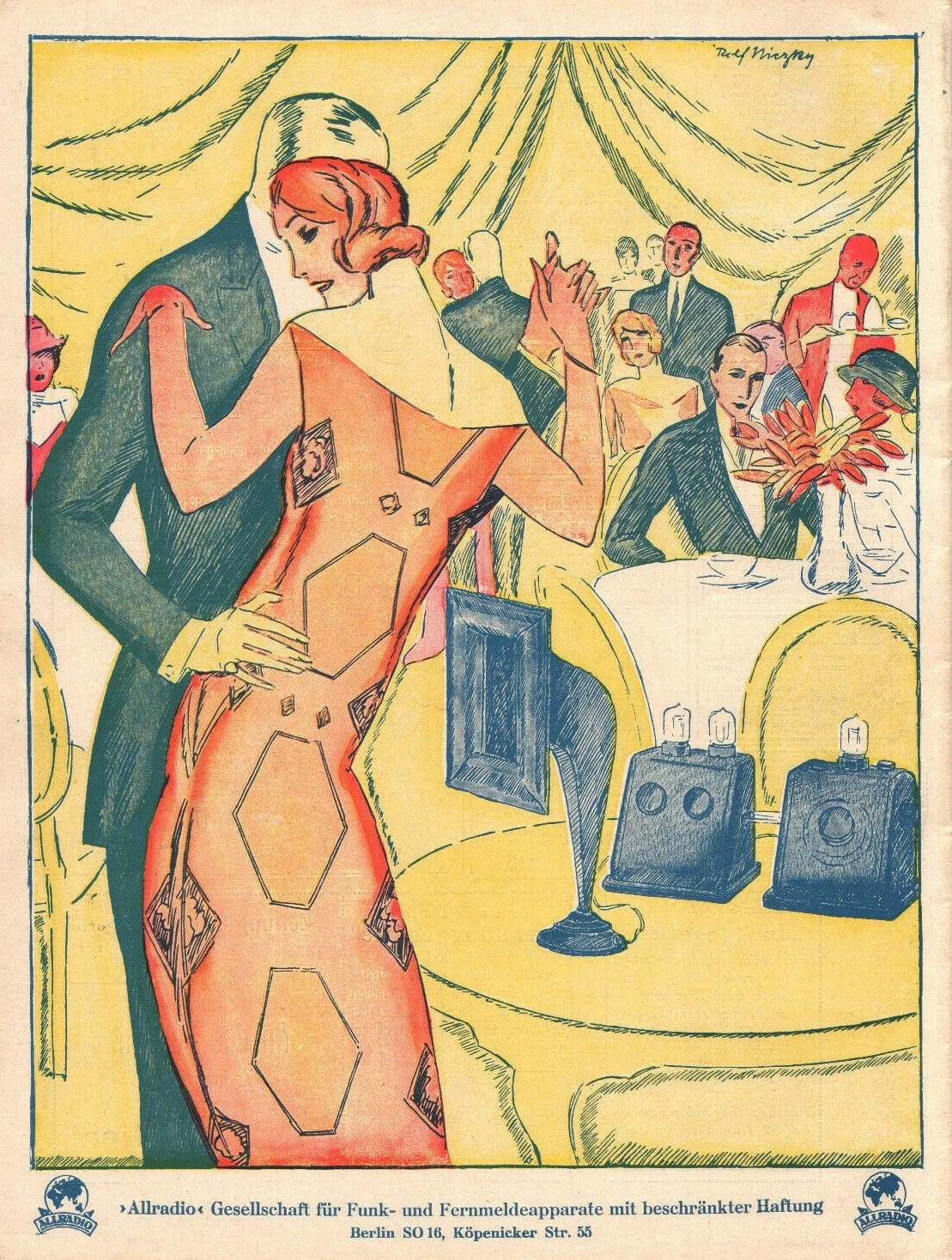
Rolf Niczky - Allradio, 1924
Rolf Niczky
- Medium:
- Oil Painting
- Era:
- 1920-1950 (Swing Era)
- Source:
- Wikimedia Commons
- Rights:
- Public domain — free to use, share and adapt.
- Recorded as:
- Public Domain
This work documents how dance functioned in commercial advertising during the 1920s—not as the subject itself but as a visual marker of modernity, leisure, and urban sophistication that could be borrowed to sell unrelated products. It also captures the aesthetic and social reality of 1920s ballroom dancing in an urban European setting, showing the dress codes, social groupings, and physical conduct of dancers in this period. For historians of both dance and graphic design, it reveals how the movement vocabulary and visual language of social dance became a cliché of modernity almost immediately.
What you are looking at
A woman in a striking red and orange geometric-patterned dress dances at what appears to be an indoor social gathering or party, circa 1924. The dress features bold hexagonal cutouts revealing skin beneath, paired with a dark blue jacket—a notably avant-garde ensemble for the period. She stands in profile, turning slightly, her posture animated and her red-bobbed hair styled in the fashionable Marcel waves of the 1920s. Behind her, well-dressed men and women in formal attire observe from a semicircle, some seated, others standing. The setting is a tent or pavilion with draped fabric visible above, creating an intimate but public theatrical space. In the foreground, mechanical radio receivers or broadcast equipment sit on a yellow table—the focal point that reveals this is not merely a social dance but an advertisement for Allradio, a Berlin radio and telecommunications company. The composition celebrates modernity: the geometric dress, the radio technology, the urban social scene, and the woman's confident, forward-facing pose.
The dancing
The central dancer stands with weight shifted to one leg, her torso rotated slightly to face the viewer while her head turns in profile. Her posture is upright and composed rather than exuberant—this is social dancing, not performance movement. Her arms hang naturally at her sides with slight bend at the elbows, the position of a woman between steps or pausing in conversation. The observers behind her are seated and standing in informal groups, their attention partly on the dancer and partly on the radio equipment, indicating that the dance itself is secondary to the technology being advertised.
The dance depicted
This is social ballroom dancing of the 1920s, the era of the jazz and swing craze in Europe. The woman's posture, dress, and setting are consistent with the modern social dances of the period—likely a foxtrot, quickstep, or early swing variation performed in an urban entertainment venue. The formality of the dress code, the pavilion setting, and the composed bearing of the dancers suggest a hotel or club dance floor rather than street dance or folk tradition. The image does not depict a specific structured choreography but rather the social practice of improvised partner dancing that defined the era.
How it was made
This is a colour print—likely a lithograph or chromolithograph based on the technique visible in the line work and colour separation. The catalogue record identifies it as an oil painting, but the image shows characteristics of commercial print media: flat colour areas, bold outlines in dark ink, the precise registration typical of lithographic printing. The medium is consistent with its function as a magazine advertisement (from *Der Junggeselle*, 1924), designed for mass reproduction and affordable circulation. The hand-drawn quality and art deco styling place it in the commercial art tradition of Weimar Germany.
About this work
This is a 1924 German advertisement for Allradio, a Berlin radio manufacturer, masquerading as a dance scene. The work captures the moment when emerging broadcast technology and modern social dancing converged as markers of cosmopolitan urban life in the 1920s. The composition uses the fashionable figure of the modern woman—bobbed hair, geometric dress, composed deportment—as the advertisement's anchor, while radio receivers occupy the foreground, suggesting that this technology belongs in the same sphere of modernity and leisure as the social dances of the era. The image is an artefact of Weimar consumer culture, using dance and contemporary fashion to market a new technology to a newly urban, media-conscious public.
How to look at it
Notice first the composition's hierarchy: the dancer is centred but the radio receivers occupy the foreground at eye level, making them visually dominant despite their smaller size. The artist has frozen the moment of a turn or weight shift—the dancer's torso and head are not aligned, suggesting movement—but the pose is restrained and elegant rather than dynamic. Observe how the geometric pattern on the dress echoes the rectangular forms of the radio receivers behind it, visually linking fashion and technology as parallel expressions of modernity. The advertising text at the bottom, naming the company and its Berlin location, confirms that this image is not documentary but promotional, designed to make radio ownership feel as desirable and fashionable as the woman's striking dress.
The artist
Rolf Niczky was a commercial artist and illustrator active in Berlin during the 1920s. The style and execution identify him as working within the art deco and new objectivity (Neue Sachlichkeit) movements that dominated German graphic design in the Weimar period. His work for *Der Junggeselle* magazine and commercial clients shows the hand of a professional illustrator comfortable with bold geometric forms, fashionable female figures, and the visual language of consumer advertising. Beyond these details, little is documented of his biographical practice.
The period
In 1924, social ballroom dancing was at the height of its popularity in urban Europe and America, driven by the jazz age and the accessibility of recorded music through radio and phonograph. Berlin was a centre of this cultural ferment, with dance halls and modern nightclubs proliferating. Simultaneously, radio technology itself was new and aspirational—broadcasting had begun in Germany in 1923, and radio sets were expensive luxury items marketed to the urban middle class. The advertising industry was discovering how to use image and aspiration to sell new technologies; this advertisement exploits the cultural prestige of modern fashion and social dancing to make radio receivers appear as essential to modern life as the ability to dance well. Art deco styling dominated commercial graphic design, with its emphasis on geometric forms, streamlined elegance, and the celebration of modernity through machine-age aesthetics.
Where it lives
This image is sourced from Wikimedia Commons. It is identified as a magazine advertisement (*Werbeanzeige*) published in *Der Junggeselle*, no. 22, 1924—a German periodical. The original holding collection is not recorded. The work is a piece of commercial graphic design and mass media rather than fine art, typical of the magazine advertising that subsidised popular publications in the 1920s.
Dance in this work
Questions about this work
What dance is this showing?
The image depicts social ballroom dancing of the 1920s, most likely a foxtrot or quickstep in an urban dance hall or nightclub setting. The dancer's posture and the formal dress code are consistent with European ballroom dancing of this era. The work does not show a specific choreography but rather the social practice of improvised partner dancing.
Why are there radios in a picture of dancing?
This is an advertisement for Allradio, a Berlin radio and telecommunications manufacturer. The artist has combined two symbols of 1920s modernity—fashionable social dancing and new broadcast technology—to suggest that radio ownership is as essential and desirable as participation in modern urban social life.
Why is the woman's dress so revealing for 1924?
The geometric cutouts are daring for the period but consistent with avant-garde fashion and dancewear of the mid-1920s. The dress announces the wearer as fashionable and modern, aligned with the jazz age and the cultural freedoms associated with 1920s urban nightlife. For an advertisement, the striking design also makes the image memorable and eye-catching.
Is this really a painting?
The catalogue record identifies it as oil painting, but the image is almost certainly a colour lithograph or chromolithograph—a commercial print medium designed for mass reproduction in magazines. The flat colour areas, bold outlines, and precision of the technique are consistent with lithographic commercial art rather than oil painting.
More dance artwork