49 works in this view — arrow keys or swipe to move between them.
Dance in Art · 1886
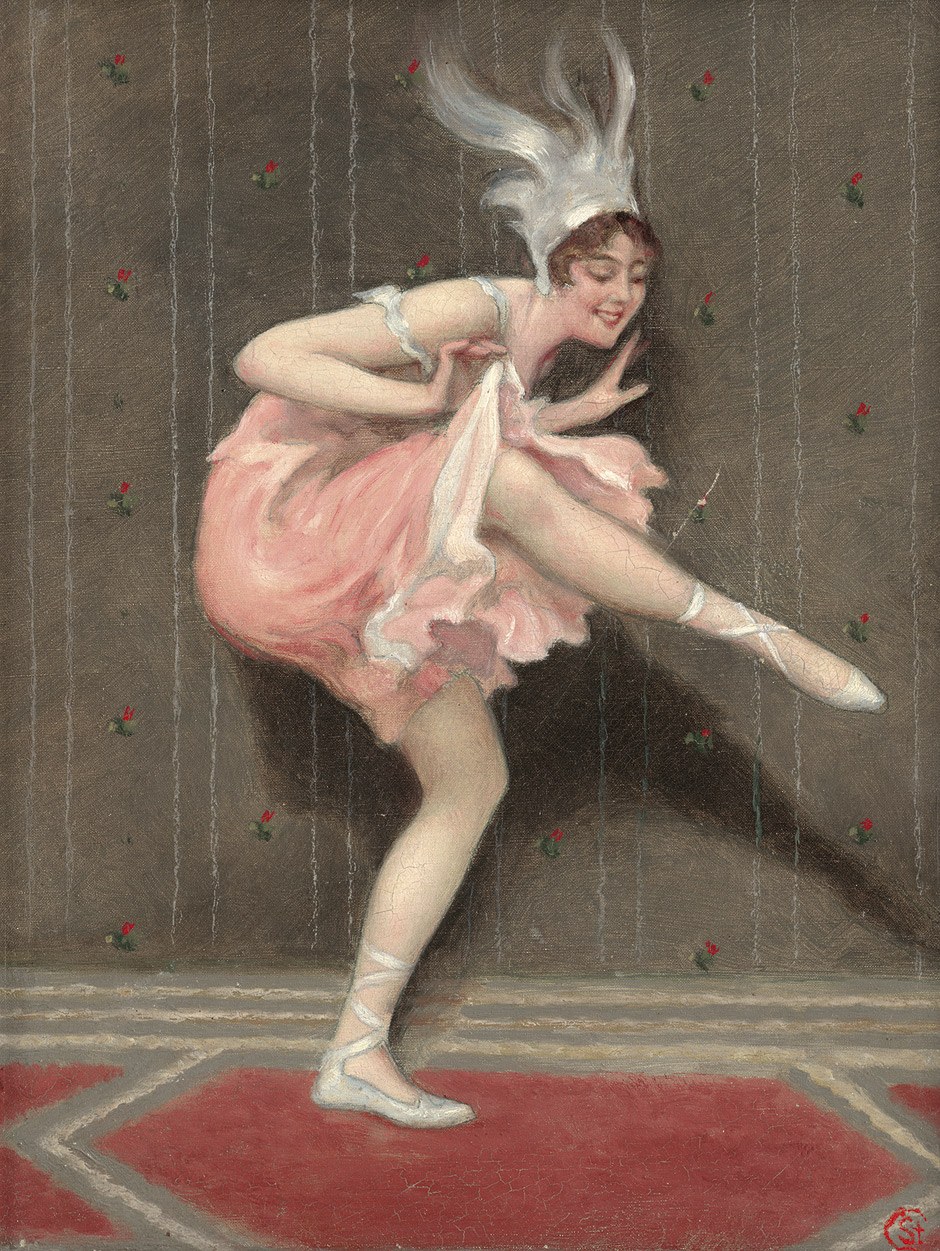
Carl Strathmann - Tanzende Dame (1886)
Carl Strathmann
- Medium:
- Oil Painting
- Era:
- Late 1800s (Victorian Ballroom)
- Source:
- Wikimedia Commons
- Rights:
- Public domain — free to use, share and adapt.
- Recorded as:
- Public Domain
This work documents the visual language of late-Victorian ballet as it was circulated through popular commercial art. The painting shows not necessarily how the dance was performed in a historical moment, but how it was marketed and consumed by the public: the feathered headdress, the carefully posed asymmetrical arm work, and the theatricalized lighting are all conventions of how ballet was packaged for a bourgeois audience. For a historian of 19th-century dance aesthetics and theatrical imagery, this is primary evidence of the visual codes that defined what ballet looked like to those who experienced it primarily through engravings, oils, and theatre programmes.
What you are looking at
A young female dancer in a pale pink tulle skirt and white pointe shoes performs a dynamic solo against a dark striped wallpapered background decorated with small red rosettes. She is captured mid-leap or sustained turn, her body weight balanced on one supporting leg while the other is raised. Her arms are positioned asymmetrically—one drawn inward across her torso, the other extended—and her white feathered headdress rises dramatically above her head, caught in motion. Her posture is elongated and upright, her gaze directed downward in concentration. She stands on a raised stage or platform with a red carpet or flooring, suggesting a theatrical proscenium setting. The composition freezes a moment of sustained elevation and control, lit to emphasize the pale flesh tones and the luminosity of the tulle against the sombre background.
The dancing
A single female dancer occupies the frame, supported on the ball of one foot in pointe work. Her free leg is raised but not in an extreme extension—the supporting leg is nearly straight, suggesting she is either at the apex of a controlled rise or in a sustained balance rather than a balletic leap. Both arms work asymmetrically: the upper arm nearest the viewer is drawn across her body at approximately mid-torso height, while the far arm extends outward at a lower angle. Her upper back and neck are elongated and her head is inclined downward. The pose suggests a moment of suspended control and inward focus rather than exuberant display.
The dance depicted
This is almost certainly a Romantic-era ballet figure, dated to 1886. The pointe shoes, the tulle skirt (a romantic tutu), the elongated upright carriage, and the asymmetrical arm port de bras are all consistent with mid-to-late 19th-century ballet vocabulary and aesthetic. The white feathered headdress was a common trope of Romantic ballet, associated with sylphs and supernatural female characters. The pose—sustained, introspective, with controlled balance rather than explosive extension—is typical of how mid-Victorian ballet was depicted in popular prints and oils. The work captures a moment of poetic restraint rather than technical virtuosity, reflecting the aesthetic priorities of the Romantic ballet as it persisted into the 1880s.
How it was made
The work is recorded as an oil painting and appears to be so—the soft blending of flesh tones, the careful gradation of light on the tulle, and the subtle shading of the striped wallpaper all suggest oil on canvas or paper. The technique is academic and polished, with careful attention to the luminosity of pale fabrics and skin against darker surroundings. This is a finished salon or commercial work, not a sketch; the degree of finish and the attention to theatre lighting effects suggest it was created for display or reproduction as a print, making it a work of popular theatrical culture rather than fine-art practice.
About this work
This is a Romantic-era ballet image—a popular oil painting from the height of the Victorian fascination with theatrical dance. It captures a solitary female dancer in the conventional costume and pose of mid-19th-century ballet aesthetics: pointe shoes, romantic tutu, white feathered headdress, and an introspective moment of sustained balance rather than dynamic extension. The work is representative of how ballet was visualized and consumed in commercial art during a period when the Romantic ballet was being preserved and restaged rather than actively innovated. It belongs in a dance gallery as evidence of how ballet was understood and represented in popular visual culture during the 1880s—a period when the conventions of Romantic ballet had become codified and were being circulated through theatrical prints and commercial oils.
How to look at it
Attend to the moment the artist has chosen to freeze: not a leap or an explosive gesture, but a sustained balance—the dancer appears to be rising onto pointe or holding an elevation, her body elongated and her gaze inward. This is the characteristic moment of Romantic ballet representation: not virtuosity or dynamism, but poise and interiority. Notice how the asymmetrical arm position and the downward gaze create a mood of reverie or melancholy rather than display. The white feathered headdress rising above her head was a visual shorthand for the supernatural female figures (sylphs, spirits, and ethereal creatures) that defined Romantic ballet. The theatrical lighting—the way the pale tulle and flesh seem to glow against the dark background—was a convention of how stage lighting was translated into painted representation, signalling that this is a theatrical moment rather than a naturalistic one.
The artist
Carl Strathmann (1866–1939) was a German painter and illustrator associated with the Munich academic school and the Jugendstil (Art Nouveau) movement. He specialized in theatrical subjects, costume design, and decorative figures—particularly representations of dancers, actresses, and elegant female nudes. His work circulated widely through commercial prints, theatre publications, and salon exhibitions. The painting's soft academic style, theatrical subject, and emphasis on decorative effect are characteristic of his practice as a commercial painter whose work mediated the world of late-19th-century theatre for a literate public.
The period
By 1886, Romantic ballet was no longer being actively composed in Western Europe; instead, classical ballet was being established as the dominant form through the Imperial Russian ballet. However, Romantic-era ballets and figures continued to be staged in revivals and remained potent symbols of theatrical grace in popular imagination. The aesthetic of this painting—introspective, pale, ethereal—reflects the persistence of Romantic iconography in Victorian visual culture even as the actual repertoire and technique of ballet were evolving elsewhere. This painting dates from a moment of transition when Romantic ballet had become historical and was being nostalgically represented and consumed through commercial art.
Where it lives
The work is recorded as held in an unspecified collection and sourced from Wikimedia Commons. The catalogue entry is minimal, offering only a title, artist, date, and medium. No accession number, institutional home, or exhibition history is recorded.
Dance in this work
Questions about this work
Is this a Romantic ballet or a classical ballet?
The costume and iconography are Romantic in origin—the white tutu, the feathered headdress, and the ethereal aesthetic were conventions of mid-19th-century Romantic ballet. However, the work was painted in 1886, by which time classical ballet was the dominant form. This is a Romantic image created during the classical period—evidence that Romantic ballet remained culturally potent as a symbol of theatrical grace even after the repertoire had shifted.
What is the white feathered headdress?
In 19th-century ballet, feathered headdresses or crowns were associated with supernatural female characters—sylphs (spirits of the air), water nymphs, and ethereal creatures. They were a visual convention signalling that the dancer represented something otherworldly or magical rather than a human character. The headdress in this painting is consistent with depictions of roles like the Sylph in *La Sylphide* (1832).
Why is she looking down?
The downward gaze was a standard convention of Romantic-era ballet representation, signalling introspection, melancholy, or spiritual reverie. It was part of the aesthetic code that made a figure read as ethereal and poetic rather than merely virtuosic. In popular theatrical imagery, this pose indicated that the dancer was absorbed in feeling rather than demonstrating technical skill.
What dance is this?
The image does not depict a specific named ballet or role, but rather a generic Romantic ballet figure—a type that circulated widely in popular theatrical imagery. The costume and pose are conventional enough that many different Romantic-era roles might have been dressed similarly.
More dance artwork